



Dantrolene-13C3

Based on 1 Customer Validation
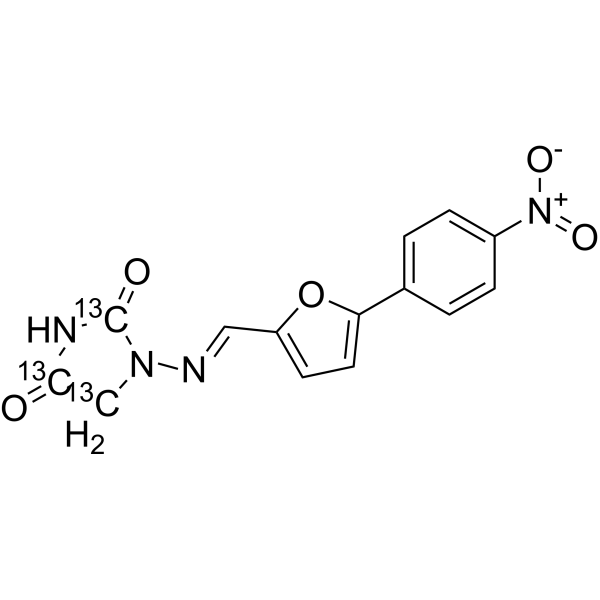
Dantrolene-13C3 is the 13C3 labeled Dantrolene. Dantrolene (F368), a muscle relaxant, non-competitively inhibits human erythrocyte glutathione reductase. Ki and IC50 values are 111.6 μM and 52.3 μM, respectively. Dantrolene is a ryanodine receptor antagonist and Ca2+ signaling stabilizer. Dantrolene can be used for the research of muscle spasticity, malignant hyperthermia, Huntington's disease and other neuroleptic malignant syndrome.
For research use only. We do not sell to patients.
- Purity : 99.0%
- CAS No.: 1185234-99-4
- Formula: C1113C3H10N4O5
- Molecular Weight:317.23
-
Storage:Powder -20°C, 3 years , 4°C, 2 years ; In solvent -80°C, 6 months , -20°C, 1 month

To place orders, for customer services and technical support, please contact: MedChemExpress USA
Tel: 609-228-6898 E-mail: [email protected] [email protected]


-
 Biological Activity
-
Chemical Information
- Protocols
- Purity & Documentation
- References
-
 Help & FAQs




Biological Activity
Description
In Vitro
Stable heavy isotopes of hydrogen, carbon, and other elements have been incorporated into drug molecules, largely as tracers for quantitation during the drug development process. Deuteration has gained attention because of its potential to affect the pharmacokinetic and metabolic profiles of drugs[1].
MedChemExpress (MCE) has not independently confirmed the accuracy of these methods. They are for reference only.
Application
1. This compound can be used as a tracer
2. This compound can be used as an internal standard for quantitative analysis by NMR, GC-MS, or LC-MS.


Chemical Information
-
CAS No. 1185234-99-4
-
Unlabeled CAS 24868-20-0
-
Appearance Solid
-
Molecular Weight 317.23
-
Formula C1113C3H10N4O5
-
Color Off-white to light yellow
-
SMILES
O=[13C](N[13C]1=O)[13CH2]N1/N=C/C2=CC=C(C3=CC=C(C=C3)[N+]([O-])=O)O2
-
Synonyms
F 368-13C3
-
Shipping
Room temperature in continental US; may vary elsewhere.
-
Storage
Powder -20°C 3 years 4°C 2 years In solvent -80°C 6 months -20°C 1 month


Purity & Documentation
-
Data Sheet (270 KB)
-
SDS (252 KB)
- English - EN (252 KB)
- Français - FR (252 KB)
- Deutsch - DE (252 KB)
- Norwegian - NO (252 KB)
- Español - ES (252 KB)
- Swedish - SV (252 KB)
- Italian - IT (252 KB)
- Korean - KR (252 KB)
- Portuguese - PT (252 KB)
-
Handling Instructions (2659 KB)
References
[1]. Russak EM, et al. Impact of Deuterium Substitution on the Pharmacokinetics of Pharmaceuticals. Ann Pharmacother. 2019 Feb;53(2):211-216. [Content Brief]
[2]. W J Meyler, et al. The effect of dantrolene sodium on rat skeletal muscle in relation to the plasma concentration. Eur J Pharmacol. 1979 Feb 1;53(4):335-42. [Content Brief]
[3]. F Zhao, et al. Dantrolene inhibition of ryanodine receptor Ca2+ release channels. Molecular mechanism and isoform selectivity. J Biol Chem. 2001 Apr 27;276(17):13810-6. [Content Brief]
[4]. Murat Sentürk, et al. Dantrolene inhibits human erythrocyte glutathione reductase. Biol Pharm Bull. 2008 Nov;31(11):2036-9. [Content Brief]
[5]. Shigeki Kobayashi, et al. Dantrolene, a therapeutic agent for malignant hyperthermia, markedly improves the function of failing cardiomyocytes by stabilizing interdomain interactions within the ryanodine receptor. J Am Coll Cardiol. 2009 May 26;53(21):1993-2005. [Content Brief]
[6]. Xi Chen, et al. Dantrolene is neuroprotective in Huntington's disease transgenic mouse model. Mol Neurodegener. 2011 Nov 25;6:81. [Content Brief]

Calculators
Concentration (start) × Volume (start) = Concentration (final) × Volume (final)


Dantrolene-13C3 Related Classifications
HY-12542S Related Classifications
 Powered by Bioz