

13 Results for "

electrostatic complexation

" in MedChemExpress (MCE) Product Catalog:
Products (13)

13 Results for "electrostatic complexation" in MCE Product Catalog:

21
21 Cited Publications
Cat. No.: HY-W127378
CAS No.: 144189-73-1
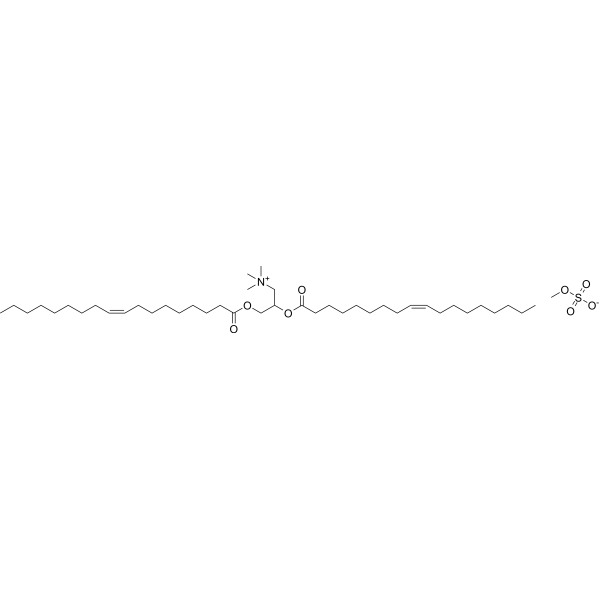
Synonyms: 1,2-Dioleoyl-3-trimethylammonium-propane methylsulfate
Target:  

Liposome

Research Areas:  

Others

DOTAP methylsulfat is a cationic lipid reagent, a cationic derivative of trimethylammonium, linked to two 18-carbon fatty acid tails, each with a single olefin group. DOTAP methylsulfat can self-assemble with negatively charged ions (such as DNA) to form complexes, which can be adsorbed to the cell membrane surface and enter the cell by electrostatic interaction and endocytosis, respectively. DOTAP methylsulfat promotes endosomal membrane fusion with its own hydrophobic domain, releases DNA into the cytoplasm, and exerts gene delivery function. DOTAP methylsulfat can be widely used in research fields such as gene therapy, cell transfection, and non-viral vector design .
loading...
    loading...
Cat. No.: HY-Y1101B
CAS No.: 7529-22-8
Synonyms: N-Methylmorpholine N-Oxide; MMNO; 4-Methylmorpholine 4-oxide
Research Areas:  

Others

4-Methylmorpholine N-oxide (N-Methylmorpholine N-Oxide; MMNO; 4-Methylmorpholine 4-oxide) is an amine oxide ligand and ozonation reagent. 4-Methylmorpholine N-oxide forms coordination complexes with lanthanum (III) nitrate and yttrium (III) nitrate via its nitroso oxygen atom. The metal-ligand bonds are dominated by electrostatic interactions with a small covalent component. 4-Methylmorpholine N-oxide is applicable in ozonation reactions for the synthesis of methyl 9-oxononanoate .
loading...
    loading...
Cat. No.: HY-W145665
CAS No.: 9005-82-7
Amylose is not a typical small-molecule ligand with a specific traditional receptor-binding target. It is a polysaccharide. In food science and biological systems, amylose can interact with proteins and free fatty acids through non-covalent forces like hydrophobic interactions and electrostatic interactions. For example, it can form a ternary complex with them, which is related to the structure and digestion of starch. It is widely studied in the fields of food science, carbohydrate metabolism, and is also relevant in research on controlling glycemic responses, as it affects starch digestion rate .
loading...
    loading...
Cat. No.: HY-D0006
CAS No.: 1662-01-7
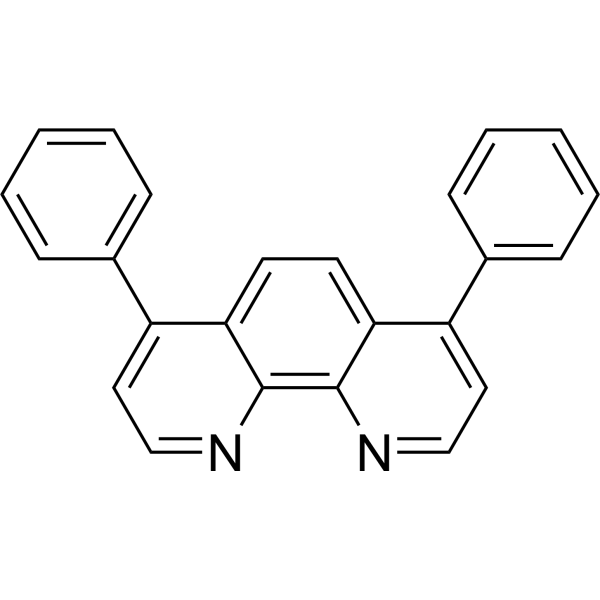
Bathophenanthroline is a nitrogen-containing organic ligand that can form stable complexes with transition metal ions such as Ru 2+. In proteomics, Bathophenanthroline is often used for in-gel protein staining. The negatively charged sulfonic acid groups of Bathophenanthroline interact electrostatically with the positively charged amino acid residues of proteins, thereby achieving specific binding to proteins and enhancing the fluorescent signal of detection. Bathophenanthroline can be used for protein separation and detection in SDS-PAGE gels in the field of proteomics, as well as other fluorescence studies[1]. Ex/Em=532 nm/610 nm[1].
loading...
    loading...
Cat. No.: HY-P4076
CAS No.: 791642-10-9
Research Areas:  

Infection

MPG peptides, Pβ is an amphipathic cell-penetrating peptide. MPG peptides, Pβ consists of three components: the hydrophobic fusion sequence (GALFLGFLGAAGSTMGA) of HIV glycoprotein 41, a spacer domain (WSQP), and the nuclear localization signal (KKKRKV) of the large T antigen of Simian virus 40. MPG peptides, Pβ can form stable non-covalent complexes with nucleic acids (including DNA) through electrostatic interactions and improve their intracellular delivery. MPG peptides, Pβ can be used in studies of HIV-1-related immune responses .
loading...
    loading...
Cat. No.: HY-W1048558A
Synonyms: mPEG2000-COOH
mPEG2000-CM (mPEG2000-COOH) is a carboxyl-terminated monomethoxy polyethylene glycol. mPEG2000-CM bears a reactive carboxyl group (-COOH) at its structural terminal site, which can form stable amide bonds with amino groups and ester bonds with hydroxyl groups. mPEG2000-CM binds to PCA-g-PCL copolymers via electrostatic interaction to form polyion complex micelles with a hydrophilic PEG surface, which enhances the stability of micelles in aqueous media. mPEG2000-CM can be used for drug delivery .
loading...
    loading...
Cat. No.: HY-126436D
CAS No.: 26982-21-8
Synonyms: L-Ornithine homopolymer hydrochloride (MW 15000-30000)
Poly-L-ornithine hydrochloride (MW 15000-30000) is a polycationic homopolymer composed of L-ornithine. Poly-L-ornithine hydrochloride (MW 15000-30000) adsorbs negatively charged species through electrostatic interactions. Poly-L-ornithine hydrochloride (MW 15000-30000) can be used as a key component of polyelectrolyte complexes to construct core-shell structure carriers to achieve controlled delivery of growth factors (such as rhBMP-2, FGF-1). Poly-L-ornithine hydrochloride (MW 15000-30000) is used in the study of diabetes and bone regeneration related diseases .
loading...
    loading...
Cat. No.: HY-W243460
CAS No.: 39208-15-6
Research Areas:  

Others

EDTA copper (II) disodium salt, 97% is a negatively charged copper (II)-ethylenediaminetetraacetic acid chelate and also an adsorption substrate. EDTA copper (II) disodium salt, 97% forms amide bonds with chitosan amino groups in weakly acidic (pH 3-5) solutions, while it forms the CuEDTA (OH) 3− hydroxyl complex in strongly alkaline (pH > 12) solutions. EDTA copper (II) disodium salt, 97% can be adsorbed onto granular activated carbon, with electrostatic interactions dominating its pH-dependent adsorption behavior. EDTA copper (II) disodium salt, 97% can be used to eliminate the inhibition of enzyme-catalyzed reactions caused by trace heavy metals .
loading...
    loading...
Cat. No.: HY-W004588
CAS No.: 72914-19-3
Research Areas:  

Others Cancer

tBu2bpy is a bidentate nitrogen ligand that coordinates with Pt (II) and Pt (IV) to form functional complexes. The tBu2bpy Pt (II) bis-crown ether complex selectively recognizes Mg 2+ and Zn 2+; both ions significantly enhance the fluorescence of the complex and cause a blue shift of the absorption peak. Its six-coordinate Pt (IV) complex [Pt (X)2Me2 ( tBu2bpy)] inhibits the proliferation of tumor cells. tBu2bpy Pt (IV) complexes bind to DNA through multiple interactions including partial intercalation, groove binding, and electrostatic interaction, and can competitively displace ethidium bromide and covalently bind to purine nucleotides. tBu2bpy can be used in relevant research in fields such as organic synthesis .
loading...
    loading...
Cat. No.: HY-D0476
CAS No.: 10343-58-5
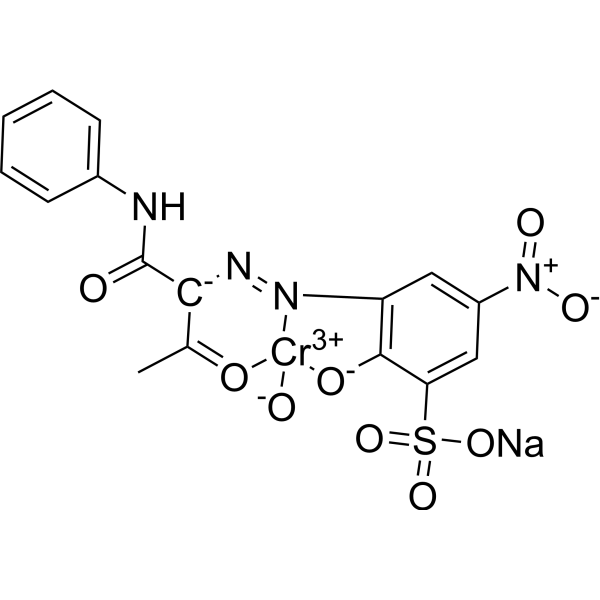
C.I. Acid yellow 99 is an acidic yellow dye that combines with coconut shell pith through electrostatic and complexing reactions.
loading...
    loading...
Cat. No.: HY-165427
CAS No.: 2758820-82-3
Target:  

Liposome

Research Areas:  

Cancer

Lipid 11 (Compound Lipid 1) is a cationic lipid for nucleic acid delivery. Lipid 11 forms lipid nanoparticles (LNPs) through electrostatic binding with nucleic acids (such as ceDNA). Lipid 11 forms complexes with negatively charged nucleic acids via cationic amine groups, which can be endocytosed by cells to release nucleic acids for activity. Lipid 11 is promising for research of gene therapy drug delivery systems .
loading...
    loading...
Cat. No.: HY-184755
CAS No.: 25087-26-7
Synonyms: PMAA
Research Areas:  

Others

Poly(methacrylic acid) (PMAA) is a pH/ionic strength-responsive swelling agent and polycation complexing agent. Poly(methacrylic acid) undergoes reversible swelling and size changes through carboxylic acid ionization and sodium ion charge shielding. As a weak polyacid, Poly(methacrylic acid) forms cross-linked hydrogels and hollow capsules for the entrapment and storage of macromolecules. Poly(methacrylic acid) forms electrostatic complexes with polycations to reduce capsule permeability, and high-salt conditions disrupt such complexes to enable macromolecule release .
loading...
    loading...
Cat. No.: HY-184820
CAS No.: 54193-36-1
Synonyms: PMAA sodium
Research Areas:  

Others

Poly(methacrylic acid) sodium is a pH/ionic strength-responsive swelling agent and polycation complexing agent. Poly(methacrylic acid) sodium undergoes reversible swelling and size changes through carboxylic acid ionization and sodium ion charge shielding. As a weak polyacid, Poly(methacrylic acid) sodium forms cross-linked hydrogels and hollow capsules for the entrapment and storage of macromolecules. Poly(methacrylic acid) sodium forms electrostatic complexes with polycations to reduce capsule permeability, and high-salt conditions disrupt such complexes to enable macromolecule release .
loading...
    loading...
  • 1

