



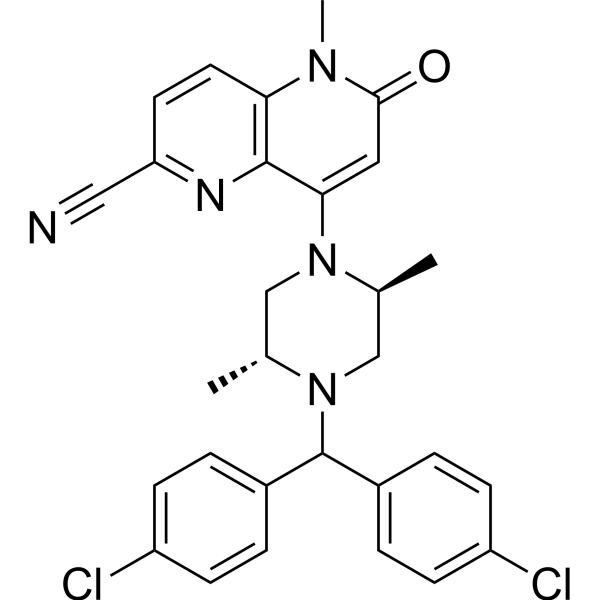
DGK-IN-1

Based on 1 Customer Validation
DGK-IN-1 is a DGK inhibitor (DGKa/DGKz IC50: 0.65/0.25 μM). DGK-IN-1 is a T cell activator that can be used in cancer and viral infection research.
For research use only. We do not sell to patients.
- Purity : 98.67%
- CAS No.: 2407892-34-4
- Formula: C29H27Cl2N5O
- Molecular Weight:532.46
-
Storage:Powder -20°C, 3 years , 4°C, 2 years ; In solvent -80°C, 6 months , -20°C, 1 month

To place orders, for customer services and technical support, please contact: MedChemExpress USA
Tel: 609-228-6898 E-mail: [email protected] [email protected]


-
 Biological Activity
-
Chemical Information
-
Solvent & Solubility
- Protocols
- Purity & Documentation
- References
-
 Help & FAQs




Biological Activity
Description
IC50 & Target
[1]|
DGKa 0.65 μM (IC50) |
DGKz 0.25 μM (IC50) |
In Vitro
DGK-IN-1 (Example 25) activates the expression of IFNγ in human CD8+ T cells (EC50: 4.3 nM) and whole blood (EC50: 0.39 μM)[1].
DGK-IN-1 inhibits the expression of IFNγ in mouse cytotoxic T cells (CTL) (IC50: 41 nM)[1].
MedChemExpress (MCE) has not independently confirmed the accuracy of these methods. They are for reference only.


Chemical Information
-
CAS No. 2407892-34-4
-
Appearance Solid
-
Molecular Weight 532.46
-
Formula C29H27Cl2N5O
-
Color Off-white to light yellow
-
SMILES
N#CC1=NC2=C(N(C)C(C=C2N3[C@@H](C)CN(C(C4=CC=C(Cl)C=C4)C5=CC=C(Cl)C=C5)[C@H](C)C3)=O)C=C1
-
Shipping
Room temperature in continental US; may vary elsewhere.
-
Storage
Powder -20°C 3 years 4°C 2 years In solvent -80°C 6 months -20°C 1 month


Solvent & Solubility
In Vitro:
DMSO : 5 mg/mL (9.39 mM; ultrasonic and warming and heat to 60°C; Hygroscopic DMSO has a significant impact on the solubility of product, please use newly opened DMSO)
Please refer to the solubility information to select the appropriate solvent. Once prepared, please aliquot and store the solution to prevent product inactivation from repeated freeze-thaw cycles.
Storage method and period of stock solution: -80°C, 6 months; -20°C, 1 month. When stored at -80°C, please use it within 6 months. When stored at -20°C, please use it within 1 month.
Please refer to the solubility information to select the appropriate solvent. Once prepared, please aliquot and store the solution to prevent product inactivation from repeated freeze-thaw cycles.
Storage method and period of stock solution: -80°C, 6 months; -20°C, 1 month. When stored at -80°C, please use it within 6 months. When stored at -20°C, please use it within 1 month.
Concentration (start) × Volume (start) = Concentration (final) × Volume (final)


Purity & Documentation
-
Data Sheet (276 KB)
-
SDS (251 KB)
- English - EN (251 KB)
- Français - FR (251 KB)
- Deutsch - DE (251 KB)
- Norwegian - NO (251 KB)
- Español - ES (251 KB)
- Swedish - SV (251 KB)
- Italian - IT (251 KB)
- Korean - KR (251 KB)
- Portuguese - PT (251 KB)
-
Handling Instructions (2659 KB)
References


Complete Stock Solution Preparation Table
Please refer to the solubility information to select the appropriate solvent. Once prepared, please aliquot and store the solution to prevent product inactivation from repeated freeze-thaw cycles.
Storage method and period of stock solution: -80°C, 6 months; -20°C, 1 month. When stored at -80°C, please use it within 6 months. When stored at -20°C, please use it within 1 month.
| Optional Solvent | Concentration Solvent Mass | 1 mg | 5 mg | 10 mg | 25 mg |
|---|---|---|---|---|---|
| DMSO | 1 mM | 1.8781 mL | 9.3904 mL | 18.7808 mL | 46.9519 mL |
| 5 mM | 0.3756 mL | 1.8781 mL | 3.7562 mL | 9.3904 mL |


DGK-IN-1 Related Classifications
HY-135898 Related Classifications
 Powered by Bioz