



Diethyltoluamide (Standard)

Based on 1 Customer Validation
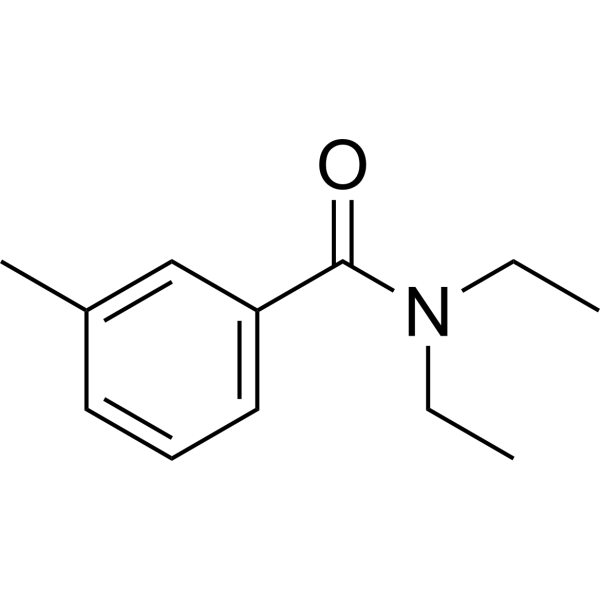
Diethyltoluamide (Standard) is the analytical standard of Diethyltoluamide. This product is intended for research and analytical applications. Diethyltoluamide (DEET) is the most common active ingredient in insect repellents. It is intended to provide protection against mosquitoes, ticks, fleas, chiggers, leeches, and many other biting insects. Diethyltoluamide is toxic to hepatocytes and can lead to many physiological, pharmacological, and behavioral abnormal ities, particularly motor deficits and learning and memory dysfunction.
For research use only. We do not sell to patients.
- Purity : 99.51%
- CAS No.: 134-62-3
- Formula: C12H17NO
- Molecular Weight:191.27
-
Storage:
Please store the product under the recommended conditions in the Certificate of Analysis.


To place orders, for customer services and technical support, please contact: MedChemExpress USA
Tel: 609-228-6898 E-mail: [email protected] [email protected]


-
 Product Information
-
Chemical Information
- Purity & Documentation
-
 Help & FAQs




Product Information
Information
Application
The compound is the grade of analytical standard, which is the reference standard supplied assay. It is commonly used in qualitative, quantitative and methodological research experiments in HPLC, GC and MS.


Chemical Information
-
CAS No. 134-62-3
-
Appearance Liquid
-
Molecular Weight 191.27
-
Formula C12H17NO
-
Color Colorless to light yellow
-
SMILES
O=C(C1=CC=CC(C)=C1)N(CC)CC
-
Synonyms
DEET (Standard); N,N-Diethyl-m-toluamide (Standard)
-
Shipping
Room temperature in continental US; may vary elsewhere.
-
Storage
Please store the product under the recommended conditions in the Certificate of Analysis.


Purity & Documentation
-
SDS (396 KB)
- English - EN (396 KB)
- Français - FR (396 KB)
- Deutsch - DE (396 KB)
- Norwegian - NO (396 KB)
- Español - ES (396 KB)
- Swedish - SV (396 KB)
- Italian - IT (396 KB)
- Korean - KR (396 KB)
- Portuguese - PT (396 KB)
-
Handling Instructions (2659 KB)
References
[1]. Lu W, et al. DEET as a feeding deterrent. PLoS One. 2017 Dec 14;12(12):e0189243. [Content Brief]
[2]. Das PC, et al. Enzyme induction and cytotoxicity in human hepatocytes by chlorpyrifos and N,N-diethyl-m-toluamide (DEET). Drug Metabol Drug Interact. 2008;23(3-4):237-60. [Content Brief]
[3]. Abdel-Rahman A, et al. Subchronic dermal application of N,N-diethyl m-toluamide (DEET) and permethrin to adult rats, alone or in combination, causes diffuse neuronal cell death and cytoskeletal abnormalities in the cerebral cortex and the hippocampus, and Purkinje neuron loss in the cerebellum. Exp Neurol. 2001 Nov;172(1):153-71. [Content Brief]

Calculators
Concentration (start) × Volume (start) = Concentration (final) × Volume (final)


Diethyltoluamide (Standard) Related Classifications
HY-B0978R Related Classifications
 Powered by Bioz