



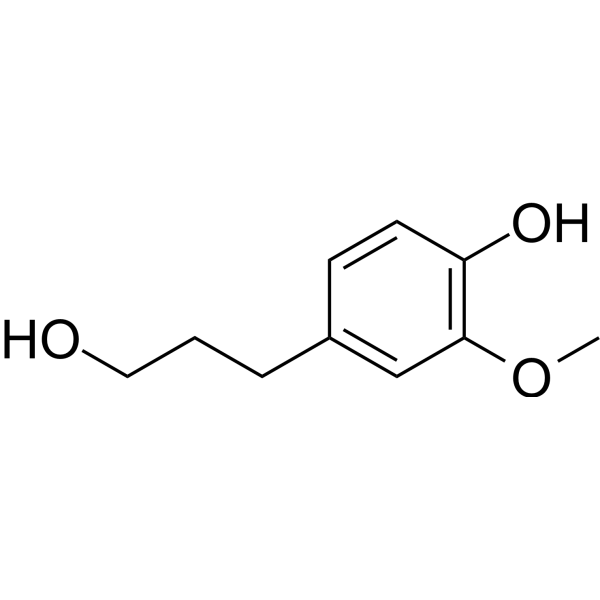
Dihydroconiferyl alcohol
Based on 1 publication(s) in Google Scholar
Dihydroconiferyl alcohol is a cell division factor. Dihydroconiferyl alcohol can be isolated from the American sycamore (Acer pseudoplatanus L.). Dihydroconiferyl alcohol inhibits the degradation of Indole-3-acetic acid (HY-18569). Dihydroconiferyl alcohol can stimulate the growth of soybean and tobacco callus tissue and synergistically enhance Indole-3-acetic acid-induced hypocotyl elongation in cucumber. Dihydroconiferyl alcohol can be used in the research of plant growth regulation.
For research use only. We do not sell to patients.
- Purity : 99.78%
- CAS No.: 2305-13-7
- Formula: C10H14O3
- Molecular Weight:182.22
-
Storage:
4°C, protect from light
* In solvent : -80°C, 6 months; -20°C, 1 month (protect from light)

To place orders, for customer services and technical support, please contact: MedChemExpress USA
Tel: 609-228-6898 E-mail: [email protected] [email protected]


-
 Biological Activity
-
Chemical Information
-
Solvent & Solubility
- Protocols
- Purity & Documentation
- References
-
 Help & FAQs



Publications Citing Use of MedChemExpress (MCE) Dihydroconiferyl alcohol
MoreAll Endogenous Metabolite Isoforms
More

Biological Activity
Description
In Vitro
Dihydroconiferyl alcohol (1 μM- 100 μM) promotes the growth of soybean callus primarily by stimulating cell division and stimulates the growth of tobacco callus[1].
Dihydroconiferyl alcohol (1 mM) synergistically enhances Indole-3-acetic acid (HY-18569)-induced elongation of cucumber hypocotyl sections[1].
MedChemExpress (MCE) has not independently confirmed the accuracy of these methods. They are for reference only. Further protocols information, click here.


Chemical Information
-
CAS No. 2305-13-7
-
Appearance Solid
-
Molecular Weight 182.22
-
Formula C10H14O3
-
Color White to yellow
-
SMILES
OC1=CC=C(CCCO)C=C1OC
-
Structure Classification
-
Initial Source
-
Shipping
Room temperature in continental US; may vary elsewhere.
-
Storage
4°C, protect from light
* In solvent : -80°C, 6 months; -20°C, 1 month (protect from light)


Publications (1)
-
Journal Impact Factor
-
Most Recent
-
J Ethnopharmacol
Dendrobium officinale extends lifespan in yeast and Drosophila via context-dependent PI3K-AKT modulation. [Abstract]2026 Apr 30:121777. PMID: 42069158


Solvent & Solubility
In Vitro:
DMSO : 50 mg/mL (274.39 mM; Need ultrasonic; Hygroscopic DMSO has a significant impact on the solubility of product, please use newly opened DMSO)
Please refer to the solubility information to select the appropriate solvent. Once prepared, please aliquot and store the solution to prevent product inactivation from repeated freeze-thaw cycles.
Storage method and period of stock solution: -80°C, 6 months; -20°C, 1 month (protect from light). When stored at -80°C, please use it within 6 months. When stored at -20°C, please use it within 1 month.
Please refer to the solubility information to select the appropriate solvent. Once prepared, please aliquot and store the solution to prevent product inactivation from repeated freeze-thaw cycles.
Storage method and period of stock solution: -80°C, 6 months; -20°C, 1 month (protect from light). When stored at -80°C, please use it within 6 months. When stored at -20°C, please use it within 1 month.
Concentration (start) × Volume (start) = Concentration (final) × Volume (final)

Protocols
-
CFSE Dye Dilution Proliferation Assay
The CFSE (carboxyfluorescein diacetate succinimidyl ester) dye dilution proliferation assay is based on the covalent labeling of intracellular proteins by a cell-permeant fluorescent dye that becomes fluorescent upon intracellular ester cleavage and then is stably retained within cells. As labeled cells divide, the dye is partitioned equally between daughter cells, resulting in a stepwise halving of fluorescence intensity that can be quantified by flow cytometry to determine the number of cell divisions undergone by each cell population. This fluorescence dilution approach enables quantitative tracking of lymphocyte proliferation at the single-cell level over multiple rounds of division. CFSE-based proliferation analysis has been widely applied to measure antigen-driven lymphocyte expansion in vitro, where discrete fluorescence peaks correspond to successive cell divisions and allow reconstruction of proliferative history within heterogeneous populations.
-
Dye-dilution cell tracking and proliferation staining
Dye-dilution cell tracking assays quantify cell proliferation by covalently labeling intracellular proteins with a stable fluorescent dye that is equally partitioned between daughter cells during mitosis, resulting in stepwise halving of fluorescence intensity with each cell division as measured by flow cytometry histograms. Carboxyfluorescein diacetate succinimidyl ester (CFSE) is a prototypical dye that diffuses into cells, is enzymatically converted into a fluorescent compound, and then covalently binds intracellular amine groups, producing long-lived fluorescence suitable for tracking multiple rounds of division in vitro and in vivo. Successive generations of dividing cells form discrete peaks of decreasing fluorescence intensity, enabling estimation of proliferation history, precursor frequency, and division index within heterogeneous populations. Alternative dyes such as CellTrace Violet (CTV) and far-red membrane dyes (e. g. , PKH26) follow the same dilution principle but differ


Purity & Documentation
-
Data Sheet (277 KB)
-
SDS (394 KB)
- English - EN (394 KB)
- Français - FR (394 KB)
- Deutsch - DE (394 KB)
- Norwegian - NO (394 KB)
- Español - ES (394 KB)
- Swedish - SV (394 KB)
- Italian - IT (394 KB)
- Korean - KR (394 KB)
- Portuguese - PT (394 KB)
-
Handling Instructions (2659 KB)
References


Complete Stock Solution Preparation Table
Please refer to the solubility information to select the appropriate solvent. Once prepared, please aliquot and store the solution to prevent product inactivation from repeated freeze-thaw cycles.
Storage method and period of stock solution: -80°C, 6 months; -20°C, 1 month (protect from light). When stored at -80°C, please use it within 6 months. When stored at -20°C, please use it within 1 month.
| Optional Solvent | Concentration Solvent Mass | 1 mg | 5 mg | 10 mg | 25 mg |
|---|---|---|---|---|---|
| DMSO | 1 mM | 5.4879 mL | 27.4394 mL | 54.8787 mL | 137.1968 mL |
| 5 mM | 1.0976 mL | 5.4879 mL | 10.9757 mL | 27.4394 mL | |
| 10 mM | 0.5488 mL | 2.7439 mL | 5.4879 mL | 13.7197 mL | |
| 15 mM | 0.3659 mL | 1.8293 mL | 3.6586 mL | 9.1465 mL | |
| 20 mM | 0.2744 mL | 1.3720 mL | 2.7439 mL | 6.8598 mL | |
| 25 mM | 0.2195 mL | 1.0976 mL | 2.1951 mL | 5.4879 mL | |
| 30 mM | 0.1829 mL | 0.9146 mL | 1.8293 mL | 4.5732 mL | |
| 40 mM | 0.1372 mL | 0.6860 mL | 1.3720 mL | 3.4299 mL | |
| 50 mM | 0.1098 mL | 0.5488 mL | 1.0976 mL | 2.7439 mL | |
| 60 mM | 0.0915 mL | 0.4573 mL | 0.9146 mL | 2.2866 mL | |
| 80 mM | 0.0686 mL | 0.3430 mL | 0.6860 mL | 1.7150 mL | |
| 100 mM | 0.0549 mL | 0.2744 mL | 0.5488 mL | 1.3720 mL |


Dihydroconiferyl alcohol Related Classifications
HY-W016393 Related Classifications
 Powered by Bioz