



DL-Menthol

Based on 1 Customer Validation
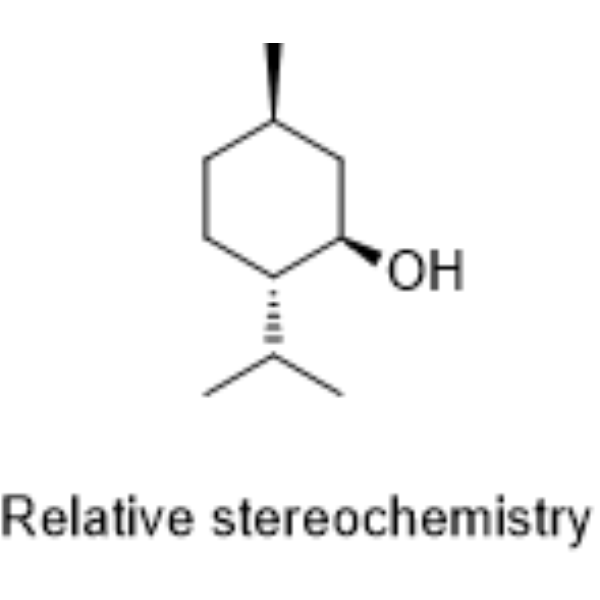
DL-Menthol (Racementhol) is an orally active, GABAaR positive allosteric modulator and UDP-glucuronosyltransferase (UGT) inhibitor that can cross the blood-brain barrier. DL-Menthol binds to GABAAR and exhibits an allosteric activation effect, enhancing GABA-mediated chloride influx and inhibiting neuronal excitability. DL-Menthol can induce surgical anesthesia in fish and inhibit the metabolic detoxification of tobacco carcinogens by human liver and intestinal UGT enzymes, resulting in reduced NNAL-N-Gluc production.
For research use only. We do not sell to patients.
- Purity : 98.0%
- CAS No.: 89-78-1
- Formula: C10H20O
- Molecular Weight:156.27
-
Storage:Powder -20°C, 3 years , 4°C, 2 years ; In solvent -80°C, 2 years , -20°C, 1 year

To place orders, for customer services and technical support, please contact: MedChemExpress USA
Tel: 609-228-6898 E-mail: [email protected] [email protected]


-
 Biological Activity
-
Chemical Information
-
Solvent & Solubility
- Protocols
- Purity & Documentation
- References
-
 Help & FAQs


-
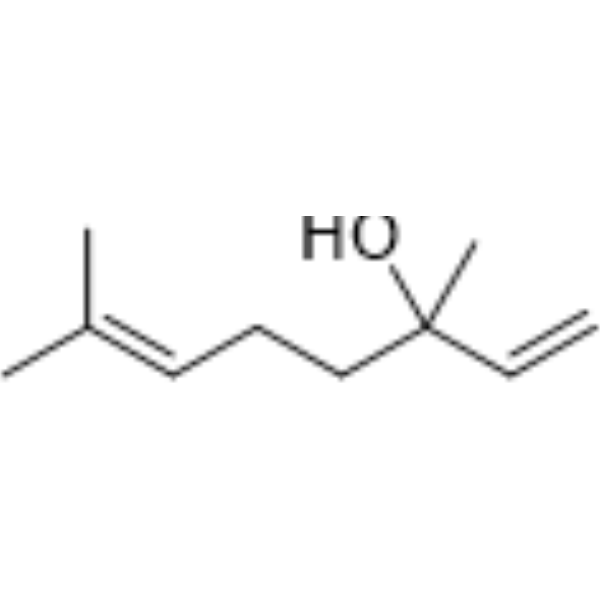
HY-N0368
Linalool,98% (stabilized with MEHQ)Antibiotic -
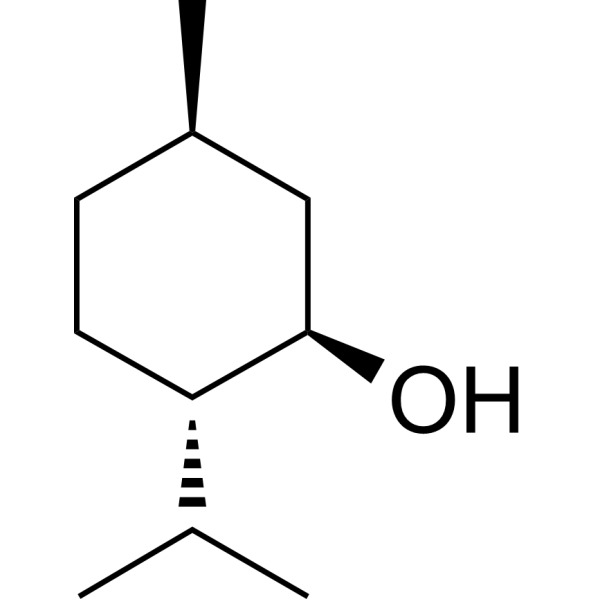
HY-75161
(-)-MentholEndogenous Metabolite -

HY-Y1683R
DL-Menthol (Standard) -
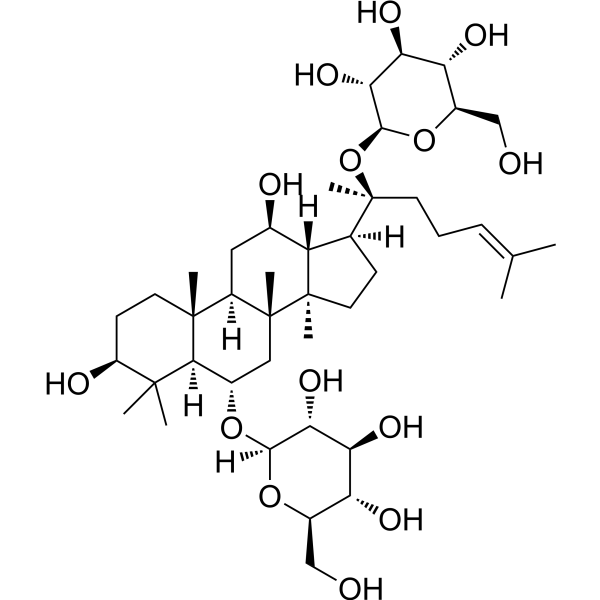
HY-N0045
Ginsenoside Rg1Apoptosis Inducer -
HY-Y0248A
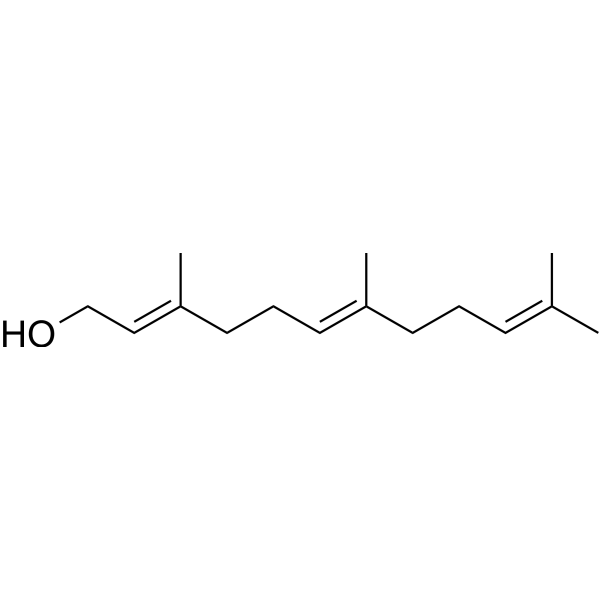
Farnesol -
HY-N0360
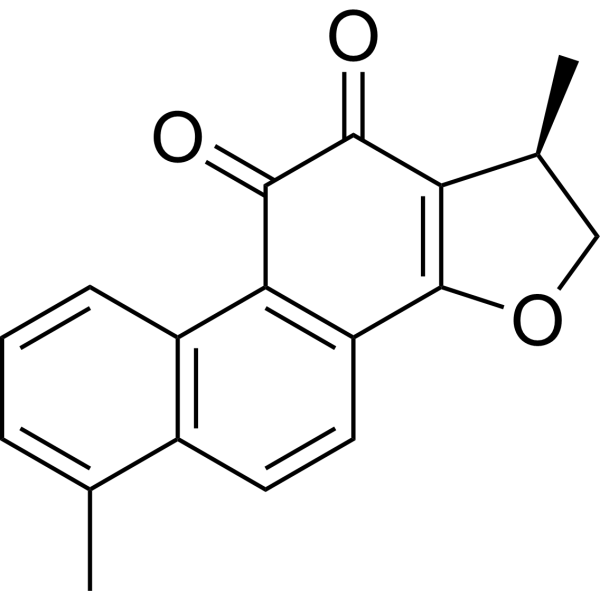
Dihydrotanshinone ISARS-CoV Inhibitor -
HY-N6968
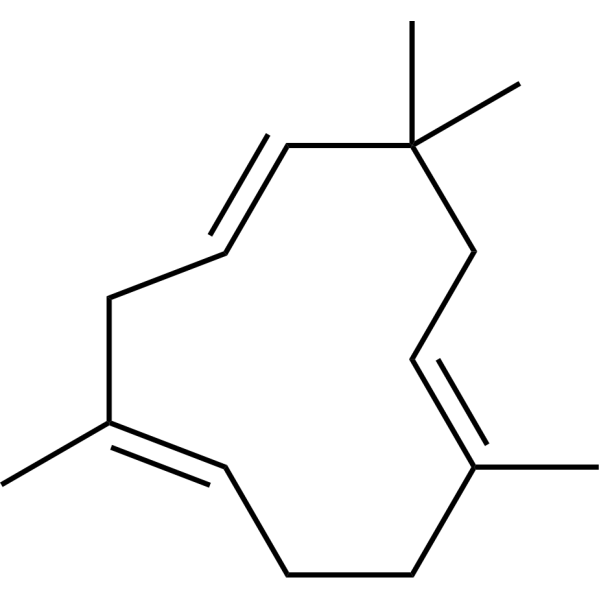
α-HumuleneCOX Inhibitor -
HY-N0265
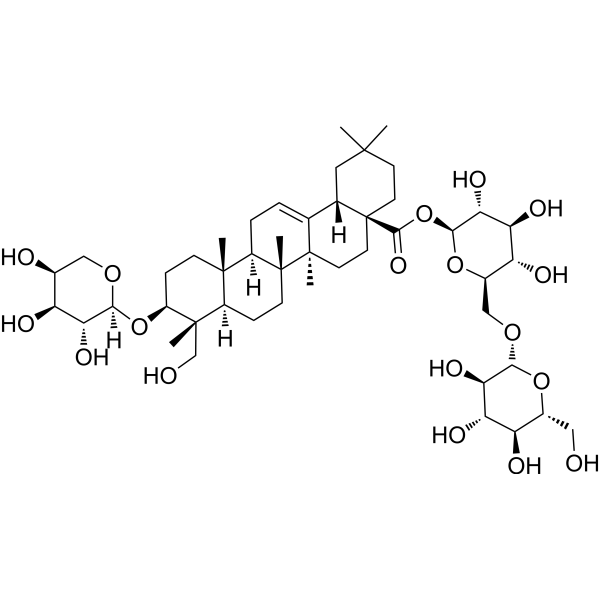
Asperosaponin VISaponin -

HY-75161R
(-)-Menthol (Standard)Endogenous Metabolite -
HY-N0547
NomilinAnti-Hyperglycemic Agent -
HY-B0355
Ginkgolide AGABA Antagonist -
HY-N0433
Astragaloside IINatural Product


Biological Activity
Description
In Vivo
0.5 mM DL-Menthol induces 100%, 90% and 100% surgical anesthesia in medaka, goldfish and zebrafish, respectively[1].
MedChemExpress (MCE) has not independently confirmed the accuracy of these methods. They are for reference only.
-
Animal Model:Japanese medaka (Oryzias latipes), goldfish (Carassius auratus), zebrafish (Danio rerio) (medaka 1.6±0.2 cm, goldfish 3.2±0.4 cm, zebrafish 1.7± 0.2 cm), aquatic behavioral assay for surgical anesthesia[2]
-
Dosage:0.1-3.0 mM (dissolved in dechlorinated water, vehicle control: 50 μL DMSO in 300 mL water)
-
Administration:Single-dose waterborne administration by adding to experimental tanks (300 mL water per fish), incubated for 6 minutes to observe anesthetic response; recovery time measured after transfer to fresh water
-
Result:Low-concentration effect (0.2-0.5 mM):
- Surgical anesthesia induction: Loss of equilibrium and lack of response to touch stimulus. Response rates increased with dose: 8-17% at 0.2 mM, 80-100% at 0.4-0.5 mM across all three fish species. - Latency and recovery: Latency to anesthesia decreased with increasing dose (e.g., 225-330 seconds at 0.2 mM vs. 40-60 seconds at 0.5 mM). Recovery time averaged 228-640 seconds, showing no significant dose dependency.
High-concentration effect (3.0 mM):
- Rapid movement followed by anesthesia: 73% of medaka and 40-60% of goldfish exhibited rapid movement within 4.4 ± 1.2 seconds, followed by anesthesia with a latency of 44 ± 20 seconds. This response was specific to menthol and the cold nociceptor agonist allyl isothiocyanate, but not the cold receptor agonist icilin, suggesting involvement of TRPA1-like pathways.
GABAaR antagonist interaction:
- Pretreatment with SR-95531 (70 μM for 30-120 min in medaka, 50-100 μM for 120 min in goldfish): Significantly prolonged anesthesia latency (e.g., from 26 ± 14 seconds to 66-99 seconds in medaka, 228 ± 10 seconds to 249-351 seconds in goldfish). Cold-water stimulation latency remained unchanged, confirming specificity to GABAₐR-mediated pathways.


Chemical Information
-
CAS No. 89-78-1
-
Appearance Solid
-
Molecular Weight 156.27
-
Formula C10H20O
-
Color White to off-white
-
SMILES
C[C@H]1C[C@@H](O)[C@H](C(C)C)CC1
-
Synonyms
Racementhol
-
Structure Classification
-
Shipping
Room temperature in continental US; may vary elsewhere.
-
Storage
Powder -20°C 3 years 4°C 2 years In solvent -80°C 2 years -20°C 1 year


Solvent & Solubility
In Vitro:
DMSO : 100 mg/mL (639.92 mM; Need ultrasonic; Hygroscopic DMSO has a significant impact on the solubility of product, please use newly opened DMSO)
H2O : 1 mg/mL (6.40 mM; Need ultrasonic)
Please refer to the solubility information to select the appropriate solvent. Once prepared, please aliquot and store the solution to prevent product inactivation from repeated freeze-thaw cycles.
Storage method and period of stock solution: -80°C, 2 years; -20°C, 1 year. When stored at -80°C, please use it within 2 years. When stored at -20°C, please use it within 1 year.
* Note: If you choose water as the stock solution, please dilute it to the working solution, then filter and sterilize it with a 0.22 μm filter before use.
Please refer to the solubility information to select the appropriate solvent. Once prepared, please aliquot and store the solution to prevent product inactivation from repeated freeze-thaw cycles.
Storage method and period of stock solution: -80°C, 2 years; -20°C, 1 year. When stored at -80°C, please use it within 2 years. When stored at -20°C, please use it within 1 year.
* Note: If you choose water as the stock solution, please dilute it to the working solution, then filter and sterilize it with a 0.22 μm filter before use.
Concentration (start) × Volume (start) = Concentration (final) × Volume (final)
In Vivo:
Select the appropriate dissolution method based on your experimental animal and administration route.
- For the following dissolution methods, please ensure to first prepare a clear stock solution using an In Vitro approach and then sequentially add co-solvents:
- To ensure reliable experimental results, the clarified stock solution can be appropriately stored based on storage conditions. As for the working solution for In Vivo experiments, it is recommended to prepare freshly and use it on the same day.
- The percentages shown for the solvents indicate their volumetric ratio in the final prepared solution. If precipitation or phase separation occurs during preparation, heat and/or sonication can be used to aid dissolution.
Add each solvent one by one: 10% DMSO 90% (20% SBE-β-CD in Saline)
Solubility: ≥ 2.5 mg/mL (16.00 mM); Clear solution
This protocol yields a clear solution of ≥ 2.5 mg/mL (saturation unknown).
Taking 1 mL working solution as an example, add 100 μL DMSO stock solution (25.0 mg/mL) to 900 μL 20% SBE-β-CD in Saline, and mix evenly.
Preparation of 20% SBE-β-CD in Saline (4°C, storage for one week): 2 g SBE-β-CD powder is dissolved in 10 mL Saline, completely dissolve until clear.
In Vivo Dissolution Calculator
Please enter the basic information of animal experiments:
-
-
-
-
Recommended: Prepare an additional quantity of animals to account for potential losses during experiments.
Please enter your animal formula composition:
-
%DMSO +
Recommended: Keep the proportion of DMSO in working solution below 2% if your animal is weak.
-
%+
-
+%Tween-80 + +
-
%Saline +
The co-solvents required include: DMSO, . All of co-solvents are available by MedChemExpress (MCE). , Tween 80. All of co-solvents are available by MedChemExpress (MCE).
Working solution concentration: 0.22 mg/mL
Method for preparing stock solution: mg drug dissolved in μL DMSO. Stock solution concentration: mg/mL.
1. Take μL DMSO stock solution;
2. Add μL .
μL , mix evenly;
3. Then add μL Tween 80, mix evenly;
4. Then add μL
Please ensure that the stock solution in the first step is dissolved to a clear state, and add co-solvents in sequence. You can use ultrasonic heating (ultrasonic cleaner, recommended frequency 20-40 kHz), vortexing, etc. to assist dissolution.

Protocols
-
Protocol for Fluorescence In Situ Hybridization (FISH)
Fluorescence in situ hybridization detects specific DNA or RNA sequences inside fixed cells or tissue sections by hybridizing fluorescently labeled nucleic-acid probes to complementary target sequences, allowing the target’s copy number, chromosomal position, spatial distribution, or transcript abundance to be visualized microscopically. DNA-FISH detects genomic loci, chromosomal gains/losses, amplifications, deletions, and rearrangements, while RNA-FISH detects RNA molecules or transcript localization; in cancer cells, mouse tumors, neurons, organoids, macrophages, or drug-screening samples, the readout is fluorescent puncta, fusion/split signals, or localized RNA signal interpreted relative to validated controls.
-
Neuronal voltage-sensitive dye imaging
Neuronal voltage-sensitive dye imaging detects membrane-potential-dependent optical changes from dyes associated with neuronal membranes, enabling optical recording of electrical activity from single neurons, dendrites, axons, spines, or neuronal populations in brain slices and cultured neurons. VSD signals are typically reported as fractional fluorescence or absorbance changes over baseline, such as ΔF/F or ΔI/I, and published protocols use high-speed cameras or photodiode arrays because neuronal voltage signals occur on millisecond time scales. Fast VSD imaging can be applied at two common scales: bulk staining of brain slices to measure circuit-level spatiotemporal activity, and single-cell loading or biolistic delivery to record membrane-potential transients from individual neuronal compartments. Optical signals should be interpreted as membrane-potential-related readouts, and validation by simultaneous electrophysiology or pharmacological controls is recommended when the experimen
-
Cell-attached patch-clamp recording
Cell-attached patch-clamp recording measures ionic current through one or more ion channels in a small membrane patch that remains attached to an intact cell; the readout is a time-resolved current trace generated when channels in the sealed patch open and close under controlled pipette voltage or stimulus conditions. Classic applications include single acetylcholine receptor currents in frog skeletal muscle, single sodium-channel currents in cultured rat muscle cells, one-channel NMDA receptor recordings, and mechanically activated PIEZO-channel recordings. The method depends on forming a high-resistance pipette-membrane seal, commonly described as a gigaohm seal, which reduces leak and noise sufficiently to resolve picoampere-scale single-channel currents. In the cell-attached configuration, the patch membrane is not ruptured, so cytosolic composition is not directly dialyzed by the pipette solution.


Purity & Documentation
-
Data Sheet (275 KB)
-
SDS (393 KB)
- English - EN (393 KB)
- Français - FR (393 KB)
- Deutsch - DE (393 KB)
- Norwegian - NO (393 KB)
- Español - ES (393 KB)
- Swedish - SV (393 KB)
- Italian - IT (393 KB)
- Korean - KR (393 KB)
- Portuguese - PT (393 KB)
-
Handling Instructions (2659 KB)
References


Complete Stock Solution Preparation Table
Please refer to the solubility information to select the appropriate solvent. Once prepared, please aliquot and store the solution to prevent product inactivation from repeated freeze-thaw cycles.
Storage method and period of stock solution: -80°C, 2 years; -20°C, 1 year. When stored at -80°C, please use it within 2 years. When stored at -20°C, please use it within 1 year.
| Optional Solvent | Concentration Solvent Mass | 1 mg | 5 mg | 10 mg | 25 mg |
|---|---|---|---|---|---|
| H2O / DMSO | 1 mM | 6.3992 mL | 31.9959 mL | 63.9918 mL | 159.9795 mL |
| 5 mM | 1.2798 mL | 6.3992 mL | 12.7984 mL | 31.9959 mL | |
| DMSO | 10 mM | 0.6399 mL | 3.1996 mL | 6.3992 mL | 15.9980 mL |
| 15 mM | 0.4266 mL | 2.1331 mL | 4.2661 mL | 10.6653 mL | |
| 20 mM | 0.3200 mL | 1.5998 mL | 3.1996 mL | 7.9990 mL | |
| 25 mM | 0.2560 mL | 1.2798 mL | 2.5597 mL | 6.3992 mL | |
| 30 mM | 0.2133 mL | 1.0665 mL | 2.1331 mL | 5.3327 mL | |
| 40 mM | 0.1600 mL | 0.7999 mL | 1.5998 mL | 3.9995 mL | |
| 50 mM | 0.1280 mL | 0.6399 mL | 1.2798 mL | 3.1996 mL | |
| 60 mM | 0.1067 mL | 0.5333 mL | 1.0665 mL | 2.6663 mL | |
| 80 mM | 0.0800 mL | 0.3999 mL | 0.7999 mL | 1.9997 mL | |
| 100 mM | 0.0640 mL | 0.3200 mL | 0.6399 mL | 1.5998 mL |
* Note: If you choose water as the stock solution, please dilute it to the working solution, then filter and sterilize it with a 0.22 μm filter before use.


DL-Menthol Related Classifications
HY-Y1683 Related Classifications
 Powered by Bioz