



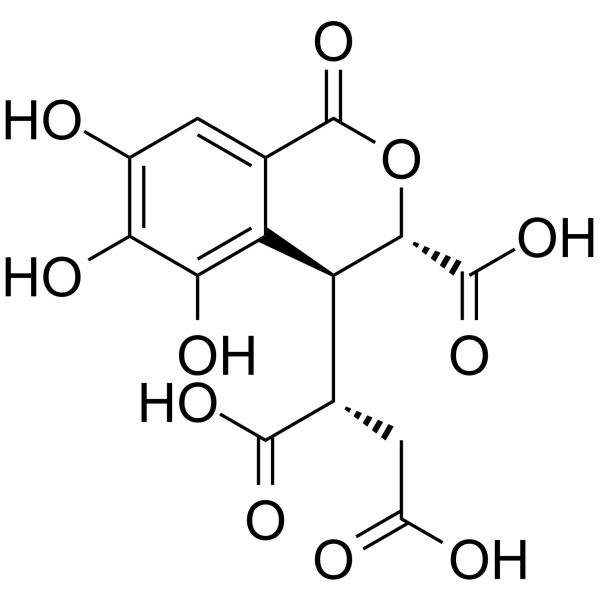
Chebulic acid
Based on 2 publication(s) in Google Scholar
Chebulic acid is a phenolic acid compound isolated from Terminalia chebula with strong antioxidant activity, which breaks protein cross-links induced by advanced glycation end products (AGEs) and inhibits the formation of AGEs. Chebulic acid is effective in controlling elevated metabolic parameters, oxidative stress, and liver damage, supporting its beneficial role in asthma, diabetes, and liver protection.
For research use only. We do not sell to patients.
- Purity : 99.89%
- CAS No.: 23725-05-5
- Formula: C14H12O11
- Molecular Weight:356.24
-
Storage:Powder -20°C, 3 years , 4°C, 2 years ; In solvent -80°C, 6 months , -20°C, 1 month

To place orders, for customer services and technical support, please contact: MedChemExpress USA
Tel: 609-228-6898 E-mail: [email protected] [email protected]


-
 Biological Activity
-
Chemical Information
-
Solvent & Solubility
- Protocols
- Purity & Documentation
- References
-
 Help & FAQs


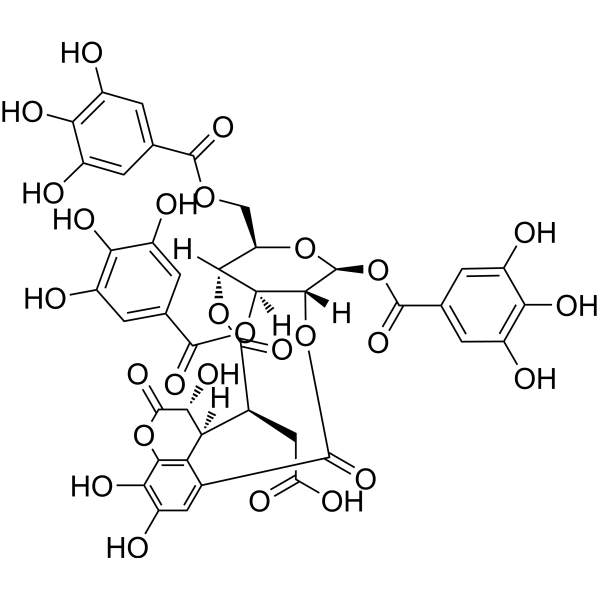
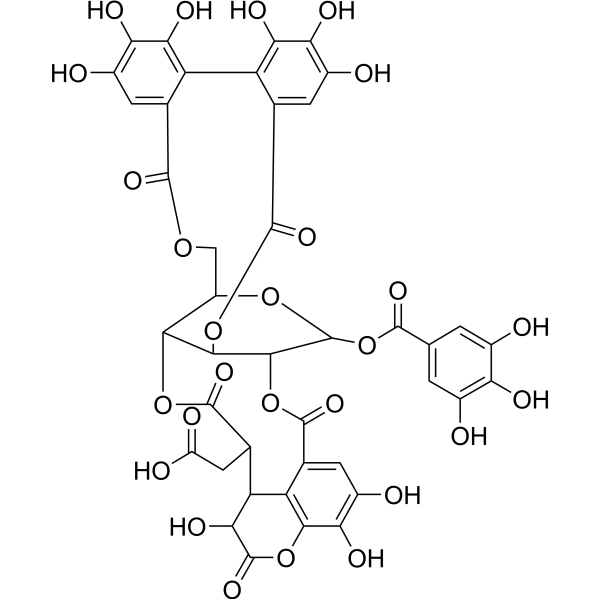

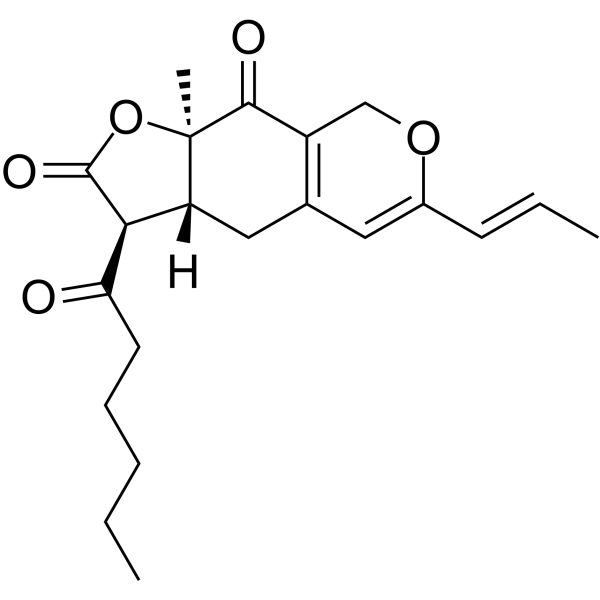

Publications Citing Use of MedChemExpress (MCE) Chebulic acid
More Customer Validation & Images

-
RT-PCR

-
WB

-
Apoptosis Analysis

-
IHC
-
IF


Biological Activity
Description
Cellular Effect
|
Cell Line

|
Type | Value | Description | References |
|---|---|---|---|---|
| Erythrocyte | IC50 |
0.62 mM
Compound: 15
|
Anticomplement activity in sheep erythrocytes assessed as concentration required for 50% hemolytic inhibition by classic pathway pretreated for 10 mins with guinea pig serum followed by erythrocyte addition measured after 30 mins by spectrophotometeric me
Anticomplement activity in sheep erythrocytes assessed as concentration required for 50% hemolytic inhibition by classic pathway pretreated for 10 mins with guinea pig serum followed by erythrocyte addition measured after 30 mins by spectrophotometeric me
|
[PMID: 29631958] |
| Erythrocyte | IC50 |
0.73 mM
Compound: 15
|
Anticomplement activity in rabbit erythrocytes assessed as concentration required for 50% hemolytic inhibition by alternative pathway pretreated for 10 mins with normal human serum followed by erythrocyte addition measured after 30 mins by spectrophotomet
Anticomplement activity in rabbit erythrocytes assessed as concentration required for 50% hemolytic inhibition by alternative pathway pretreated for 10 mins with normal human serum followed by erythrocyte addition measured after 30 mins by spectrophotomet
|
[PMID: 29631958] |
In Vitro
Chebulic acid (0.5, 1, 5 and 10 μg/mL; 24 h) reduces UPM-induced ROS generation in NCI-H441 at doses of 5 and 10 μg/mL[1]. Chebulic acid (5 and 10 μM; 24 h) dose-dependently reduces the expression levels of inflammatory factors in NCIH441 and dose-dependently increases the mRNA expression levels of Occludin and ZO-1 proteins in NCI-H441 in the presence of UPM[1]. Chebulic acid (0-250 μM; 24 h) has a mild toxic effect on HUVEC at doses above 50 μM[3]. Chebulic acid (0, 5, 10 and 25 μM; 24 h) dose-dependently reduces glycer-AGEs-induced ROS generation in HUVECs and THP-1 monocyte adhesion, and dose-dependently promotes the restoration of TER in HUVECs at doses of 10 and 25 μM[3]. Chebulic acid (1, 10 and 100 μg/mL; 30 min) protectes hepatocytes from the cytotoxicity of t-BHP in a dose-dependent manner[4]. Chebulic acid (0-26 μM; 24 h) increases the expression of Nrf2 in the nucleus of L-02 cells in a dose-dependent and time-dependent manner, and increases the phosphorylation levels of ERK, JNK and p38 MARK[5].
MedChemExpress (MCE) has not independently confirmed the accuracy of these methods. They are for reference only. Further protocols information, click here.
-
Cell Line:hepatocytes
-
Concentration:1, 10 和 100 μg/mL
-
Incubation Time:30 min
-
Result:Caused LDH leakage and MDA formation in t-BHP-treated cells, and decreased intracellular ROS levels in a dose-dependent manner. Caused t-BHP-treated cells to show cell viability similar to that of the control group at a dose of 100 μg/ml.
In Vivo
MedChemExpress (MCE) has not independently confirmed the accuracy of these methods. They are for reference only.
-
Animal Model:Wistar albino rats of ischemia-reperfusion model[1].
-
Dosage:25, 50 mg/kg
-
Administration:Oral gavage (p.o.) once a day for 28 days
-
Result:Reduced blood glucose, creatinine, urea nitrogen, glycated hemoglobin, proteinuria, urinary albumin excretion, glomerular filtration rate (GFR), and increased serum insulin and glycogen levels in diabetic rats.


Chemical Information
-
CAS No. 23725-05-5
-
Appearance Solid
-
Molecular Weight 356.24
-
Formula C14H12O11
-
Color White to off-white
-
SMILES
O=C([C@@H](CC(O)=O)[C@H]([C@H](O1)C(O)=O)C2=C(C(O)=C(C=C2C1=O)O)O)O
-
Structure Classification
-
Initial Source
-
Shipping
Room temperature in continental US; may vary elsewhere.
-
Storage
Powder -20°C 3 years 4°C 2 years In solvent -80°C 6 months -20°C 1 month


Publications (2)
-
Journal Impact Factor
-
Most Recent
-
J Exp Med
2021 May 3;218(5):e20202033. PMID: 33688918
Chebulic acid purchased from MedChemExpress. Usage Cited in: J Exp Med. 2021 May 3;218(5):e20202033. [Abstract]
Levels of MDM4 and MDM2 mRNA were determined by qPCR treated with Chebulic acid (CA) (0, 25, 50 μM).
Chebulic acid purchased from MedChemExpress. Usage Cited in: J Exp Med. 2021 May 3;218(5):e20202033. [Abstract]
Levels of MDM4 and MDM2 protein were determined by immunoblot treated with Chebulic acid (CA) (0, 25, 50 μM).
Chebulic acid purchased from MedChemExpress. Usage Cited in: J Exp Med. 2021 May 3;218(5):e20202033. [Abstract]
Apoptosis was evaluated by TUNEL staining and IF/differential interference contrast (DIC) microscopy treated with Chebulic acid (CA) (0, 25, 50 μM).
Chebulic acid purchased from MedChemExpress. Usage Cited in: J Exp Med. 2021 May 3;218(5):e20202033. [Abstract]
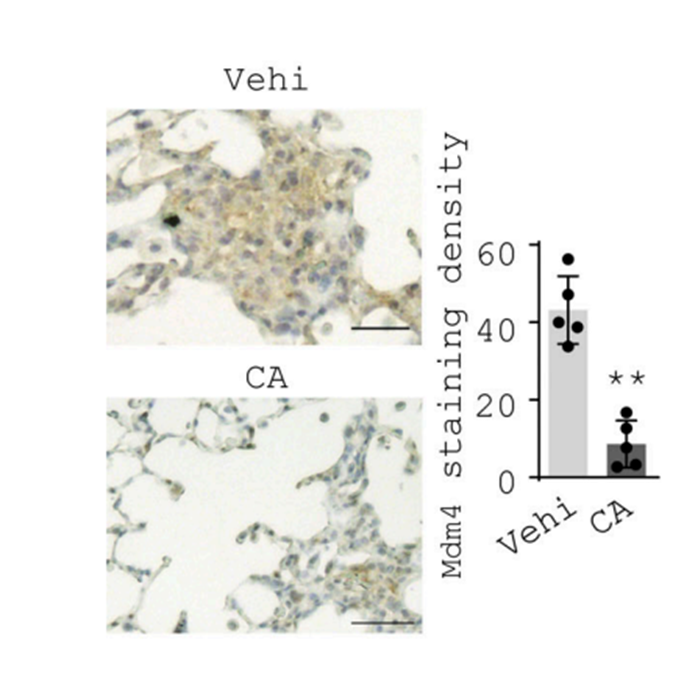
IHC analysis of Mdm4 expression in aged fibrotic mice treated by CA or vehicle at 4 mo treated with Chebulic acid (CA) (25 mg/kg, i.g.).
Chebulic acid purchased from MedChemExpress. Usage Cited in: J Exp Med. 2021 May 3;218(5):e20202033. [Abstract]
Confocal IF microscopy to evaluate Ac-p53 expression in αSMA-expressing myofibroblasts in the fibrotic lungs of aged mice treated with Chebulic acid (CA) (25 mg/kg, i.g.) or vehicle.

Chebulic acid purchased from MedChemExpress. Usage Cited in: J Exp Med. 2021 May 3;218(5):e20202033. [Abstract]
Levels of CX3CL1 in the BAL fluids of aged fibrotic mice treated with Chebulic acid ( CA) (25 mg/kg, i.g.) or vehicle were quantified by ELISA.
-
J Ethnopharmacol
Protecting the brain from stroke: Huoxue Rongluo formula (HXRLF) targets ferroptosis for neuroprotection. [Abstract]2025 Jul 29;353(Pt A):120329. PMID: 40744419


Solvent & Solubility
In Vitro:
DMSO : 50 mg/mL (140.35 mM; Need ultrasonic; Hygroscopic DMSO has a significant impact on the solubility of product, please use newly opened DMSO)
Please refer to the solubility information to select the appropriate solvent. Once prepared, please aliquot and store the solution to prevent product inactivation from repeated freeze-thaw cycles.
Storage method and period of stock solution: -80°C, 6 months; -20°C, 1 month. When stored at -80°C, please use it within 6 months. When stored at -20°C, please use it within 1 month.
Please refer to the solubility information to select the appropriate solvent. Once prepared, please aliquot and store the solution to prevent product inactivation from repeated freeze-thaw cycles.
Storage method and period of stock solution: -80°C, 6 months; -20°C, 1 month. When stored at -80°C, please use it within 6 months. When stored at -20°C, please use it within 1 month.
Concentration (start) × Volume (start) = Concentration (final) × Volume (final)
In Vivo:
Select the appropriate dissolution method based on your experimental animal and administration route.
- For the following dissolution methods, please ensure to first prepare a clear stock solution using an In Vitro approach and then sequentially add co-solvents:
- To ensure reliable experimental results, the clarified stock solution can be appropriately stored based on storage conditions. As for the working solution for In Vivo experiments, it is recommended to prepare freshly and use it on the same day.
- The percentages shown for the solvents indicate their volumetric ratio in the final prepared solution. If precipitation or phase separation occurs during preparation, heat and/or sonication can be used to aid dissolution.
Add each solvent one by one: 10% DMSO 40% PEG300 5% Tween-80 45% Saline
Solubility: ≥ 2.17 mg/mL (6.09 mM); Clear solution
This protocol yields a clear solution of ≥ 2.17 mg/mL (saturation unknown).
Taking 1 mL working solution as an example, add 100 μL DMSO stock solution (21.7 mg/mL) to 400 μL PEG300, and mix evenly; then add 50 μL Tween-80 and mix evenly; then add 450 μL Saline to adjust the volume to 1 mL.
Preparation of Saline: Dissolve 0.9 g sodium chloride in ddH₂O and dilute to 100 mL to obtain a clear Saline solution.
Add each solvent one by one: 10% DMSO 90% (20% SBE-β-CD in Saline)
Solubility: ≥ 2.17 mg/mL (6.09 mM); Clear solution
This protocol yields a clear solution of ≥ 2.17 mg/mL (saturation unknown).
Taking 1 mL working solution as an example, add 100 μL DMSO stock solution (21.7 mg/mL) to 900 μL 20% SBE-β-CD in Saline, and mix evenly.
Preparation of 20% SBE-β-CD in Saline (4°C, storage for one week): 2 g SBE-β-CD powder is dissolved in 10 mL Saline, completely dissolve until clear.
In Vivo Dissolution Calculator
Please enter the basic information of animal experiments:
-
-
-
-
Recommended: Prepare an additional quantity of animals to account for potential losses during experiments.
Please enter your animal formula composition:
-
%DMSO +
Recommended: Keep the proportion of DMSO in working solution below 2% if your animal is weak.
-
%+
-
+%Tween-80 + +
-
%Saline +
The co-solvents required include: DMSO, . All of co-solvents are available by MedChemExpress (MCE). , Tween 80. All of co-solvents are available by MedChemExpress (MCE).
Working solution concentration: 0.22 mg/mL
Method for preparing stock solution: mg drug dissolved in μL DMSO. Stock solution concentration: mg/mL.
1. Take μL DMSO stock solution;
2. Add μL .
μL , mix evenly;
3. Then add μL Tween 80, mix evenly;
4. Then add μL
Please ensure that the stock solution in the first step is dissolved to a clear state, and add co-solvents in sequence. You can use ultrasonic heating (ultrasonic cleaner, recommended frequency 20-40 kHz), vortexing, etc. to assist dissolution.

Protocols
-
ROS/oxidative-stress fluorescent staining
ROS/oxidative-stress fluorescent staining uses cell-permeant fluorogenic probes that become fluorescent after oxidation inside cells or tissues; commonly used examples include DCFH-DA/DCFDA for broad cellular oxidant detection, DHE for superoxide-related signal detection, MitoSOX for mitochondrial superoxide-related signal detection, and CellROX probes for oxidative-stress-associated fluorescence readouts. The assay detects probe oxidation rather than a single ROS species unless the probe and analysis method have been chemically validated for that species. DCFH-DA enters cells, is deacetylated by intracellular esterases to DCFH, and produces fluorescent DCF after oxidation, so the readout is used as an operational measure of total cellular oxidative stress rather than a species-specific ROS measurement. DHE and MitoSOX can report superoxide-related oxidation, but red fluorescence alone can include non-specific ethidium-like oxidation products; HPLC or optimized spectral approaches are
-
Hepatotoxicity Study
This protocol evaluates hepatotoxicity using complementary in vivo mouse APAP acute liver injury and in vitro hepatocyte-based cytotoxicity readouts. In vivo APAP injury is assessed by serum ALT/AST, liver histology, hepatic glutathione, protein adducts, necrosis, inflammation, and regeneration-related endpoints. In vitro hepatotoxicity is assessed by loss of viability, leakage of ALT/AST/LDH, oxidative-stress markers, mitochondrial function, nuclear morphology, intracellular calcium, and high-content imaging endpoints.
-
Research Protocol for Metabolic Diseases
AMP-activated protein kinase, AMPK, is a conserved cellular energy sensor that responds to reduced cellular energy status and coordinates metabolism by increasing ATP-generating catabolic pathways while suppressing ATP-consuming anabolic processes. In metabolic disease research, the AMPK pathway is experimentally relevant because it regulates hepatic lipid synthesis, fatty acid oxidation, glucose production, skeletal-muscle glucose disposal, mTORC1-linked biosynthesis, autophagy, mitochondrial homeostasis, and whole-body energy balance. The central pathway logic is that energy stress, metformin, exercise-like stimulation, or direct AMPK activators increase AMPKα Thr172 phosphorylation and downstream substrate phosphorylation, including ACC and RAPTOR. Phosphorylation of ACC suppresses lipogenesis and supports fatty acid oxidation, whereas phosphorylation of RAPTOR suppresses mTORC1 signaling and links cellular energy status to growth and protein synthesis control. The pathway is linked


Purity & Documentation
-
Data Sheet (286 KB)
-
SDS (392 KB)
- English - EN (392 KB)
- Français - FR (392 KB)
- Deutsch - DE (392 KB)
- Norwegian - NO (392 KB)
- Español - ES (392 KB)
- Swedish - SV (392 KB)
- Italian - IT (392 KB)
- Korean - KR (392 KB)
- Portuguese - PT (392 KB)
-
Handling Instructions (2659 KB)
References
[1]. Lee KW, et al. Protective effects of chebulic acid on alveolar epithelial damage induced by urban particulate matter. BMC Complement Altern Med. 2017 Jul 19;17(1):373. [Content Brief]
[2]. Silawat N, et al. Chebulic acid attenuates ischemia reperfusion induced biochemical alteration in diabetic rats. Pharm Biol. 2013 Jan;51(1):23-9. [Content Brief]
[3]. Lee H S, et al. Preventive effects of chebulic acid isolated from Terminalia chebula on advanced glycation endproduct-induced endothelial cell dysfunction[J]. Journal of Ethnopharmacology, 2010, 131(3): 567-574. [Content Brief]
[4]. Lee H S, et al. Isolation of chebulic acid from Terminalia chebula Retz. and its antioxidant effect in isolated rat hepatocytes[J]. Archives of Toxicology, 2007, 81: 211-218. [Content Brief]
[5]. Feng X H, et al. In vivo hepatoprotective activity and the underlying mechanism of chebulinic acid from Terminalia chebula fruit[J]. Phytomedicine, 2021, 83: 153479. [Content Brief]


Complete Stock Solution Preparation Table
Please refer to the solubility information to select the appropriate solvent. Once prepared, please aliquot and store the solution to prevent product inactivation from repeated freeze-thaw cycles.
Storage method and period of stock solution: -80°C, 6 months; -20°C, 1 month. When stored at -80°C, please use it within 6 months. When stored at -20°C, please use it within 1 month.
| Optional Solvent | Concentration Solvent Mass | 1 mg | 5 mg | 10 mg | 25 mg |
|---|---|---|---|---|---|
| DMSO | 1 mM | 2.8071 mL | 14.0355 mL | 28.0710 mL | 70.1774 mL |
| 5 mM | 0.5614 mL | 2.8071 mL | 5.6142 mL | 14.0355 mL | |
| 10 mM | 0.2807 mL | 1.4035 mL | 2.8071 mL | 7.0177 mL | |
| 15 mM | 0.1871 mL | 0.9357 mL | 1.8714 mL | 4.6785 mL | |
| 20 mM | 0.1404 mL | 0.7018 mL | 1.4035 mL | 3.5089 mL | |
| 25 mM | 0.1123 mL | 0.5614 mL | 1.1228 mL | 2.8071 mL | |
| 30 mM | 0.0936 mL | 0.4678 mL | 0.9357 mL | 2.3392 mL | |
| 40 mM | 0.0702 mL | 0.3509 mL | 0.7018 mL | 1.7544 mL | |
| 50 mM | 0.0561 mL | 0.2807 mL | 0.5614 mL | 1.4035 mL | |
| 60 mM | 0.0468 mL | 0.2339 mL | 0.4678 mL | 1.1696 mL | |
| 80 mM | 0.0351 mL | 0.1754 mL | 0.3509 mL | 0.8772 mL | |
| 100 mM | 0.0281 mL | 0.1404 mL | 0.2807 mL | 0.7018 mL |


Chebulic acid Related Classifications
HY-N4170 Related Classifications
 Powered by Bioz