



Isosorbide (Standard)
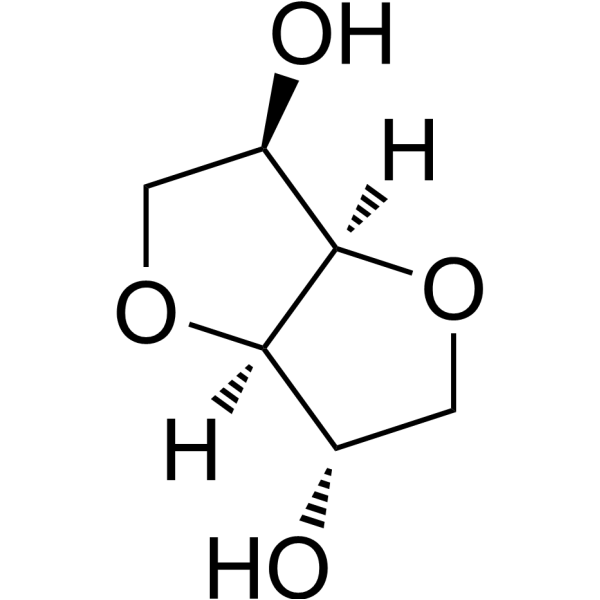
Isosorbide (Standard) is the analytical standard of Isosorbide. This product is intended for research and analytical applications. Isosorbide (D-Isosorbide), an orally active vasodilating agent that can be used for the research of heart failure and angina (chest pain). Isosorbide is also an oral hyperosmotic diuretic.
For research use only. We do not sell to patients.
- Purity: 98%
- CAS No.: 652-67-5
- Formula: C6H10O4
- Molecular Weight:146.14
-
Storage:
Please store the product under the recommended conditions in the Certificate of Analysis.


To place orders, for customer services and technical support, please contact: MedChemExpress USA
Tel: 609-228-6898 E-mail: [email protected] [email protected]


-
 Product Information
-
Chemical Information
- Purity & Documentation
-
 Help & FAQs




Product Information
Information
Application
The compound is the grade of analytical standard, which is the reference standard supplied assay. It is commonly used in qualitative, quantitative and methodological research experiments in HPLC, GC and MS.


Chemical Information
-
CAS No. 652-67-5
-
Appearance Solid
-
Molecular Weight 146.14
-
Formula C6H10O4
-
Color White to off-white
-
SMILES
O[C@H]1[C@]2([H])[C@]([C@@H](O)CO2)([H])OC1
-
Synonyms
D-Isosorbide (Standard); Dianhydro-D-glucitol (Standard)
-
Shipping
Room temperature in continental US; may vary elsewhere.
-
Storage
Please store the product under the recommended conditions in the Certificate of Analysis.


Purity & Documentation
-
SDS (252 KB)
- Français - FR (252 KB)
- Deutsch - DE (252 KB)
- Norwegian - NO (252 KB)
- Español - ES (252 KB)
- Swedish - SV (252 KB)
- Italian - IT (252 KB)
- Korean - KR (252 KB)
- Portuguese - PT (252 KB)
-
Handling Instructions (2659 KB)
References
[1]. Rose M, et, al. Isosorbide as a renewable platform chemical for versatile applications--quo vadis? ChemSusChem. 2012 Jan 9;5(1):167-76. [Content Brief]
[2]. Nozawa I, et, al. Efficacy of long-term administration of isosorbide for Ménière's disease. ORL J Otorhinolaryngol Relat Spec. May-Jun 1995;57(3):135-40. [Content Brief]
[3]. Newman RA, et, al. Gallium nitrate (NSC-15200) induced toxicity in the rat: a pharmacologic, histopathologic and microanalytical investigation. Cancer. 1979 Nov;44(5):1728-40. [Content Brief]

Calculators
Concentration (start) × Volume (start) = Concentration (final) × Volume (final)


Isosorbide (Standard) Related Classifications
HY-B1469R Related Classifications
 Powered by Bioz