



ABA Receptor
Abscisic Acid (ABA) Receptor
When plants are challenged by various abiotic and biotic stresses, the endogenous ABA content increases and then exquisitely initiates some cellular signaling network to switch on adaptive responses and to regulate numerous developmental processes. ABA binds to PYR/PYL/RCAR (PYLs) and then the binary complex physically interacts with PP2Cs. The PYLs-PP2Cs heterodimer precludes substrate SnRK2s binding to PP2Cs, and thus stimulates SnRK2s kinase activity, which was formerly inhibited by PP2Cs. So far, 14 members of PYLs, six to nine group-A PP2Cs, three subclass III SnRK2s and four to nine group-A bZIP TFs are involved in the core ABA signaling pathway. There are 14 PYLs family members, named PYR1 and PYL1-PYL13 in Arabidopsis, that belong to the START superfamily. To date, the crystal structures of PYR1, PYL1, PYL2, PYL3, PYL5, PYL9, PYL10, and PYL13 have been reported. PYLs-mediated ABA signaling could play a crucial role in favoring stress adaptation and growth development for plants[1].
ABA Receptor Isoform Specific Products
All Product Categories
-
Productos relacionados con ABA Receptor (9)
Productos relacionados con (9)

-
ABA Receptor Isoform Comparison
-
Abscisic acid
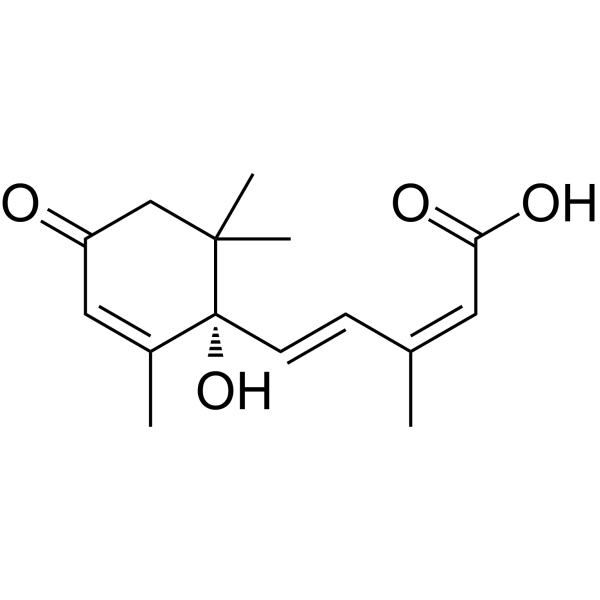 0 ImagesSynonyms: (S)-(+)-Abscisic acid; ABAAbscisic acid ((S)-(+)-Abscisic acid), an orally active phytohormone in fruits and vegetables, is an endogenously produced mammalian hormone. Abscisic acid is a growth inhibitor and can regulate many aspects of plant growth and development. Abscisic acid inhibits proton pump (H+-ATPase) and leads to the plasma membrane depolarization in a Ca2+-dependent manner. Abscisic acid, a LANCL2 natural ligand, is a potent insulin-sensitizing compound and has the potential for pre-diabetes, type 2 diabetes and metabolic syndrome.
-
Omilancor
 0 ImagesSynonyms: BT-11Omilancor (BT-11) is an orally active lanthionine synthetase cyclase-like receptor 2 (LANCL2) activator. Omilancor can be used for the study of psoriasis, inflammatory bowel disease (IBD), and Crohn's disease (CD).
-
Abscisic acid-d6
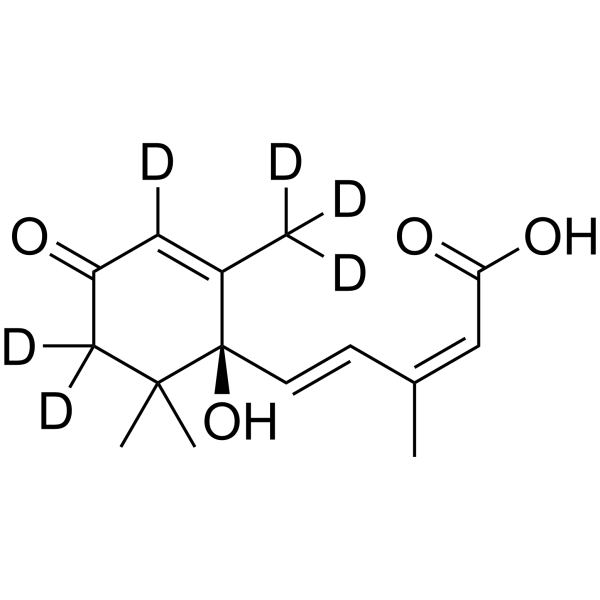 0 ImagesSynonyms: (S)-(+)-Abscisic acid-d6; ABA-d6Abscisic acid-d6 is deuterium labeled Abscisic acid. Abscisic acid inhibits proton pump (H+-ATPase).
-
Abscisic acid (Standard)
 0 ImagesSynonyms: (S)-(+)-Abscisic acid (Standard); ABA (Standard)Abscisic acid (Standard) is the analytical standard of Abscisic acid. This product is intended for research and analytical applications. Abscisic acid ((S)-(+)-Abscisic acid), an orally active phytohormone in fruits and vegetables, is an endogenously produced mammalian hormone. Abscisic acid is a growth inhibitor and can regulate many aspects of plant growth and development. Abscisic acid inhibits proton pump (H+-ATPase) and leads to the plasma membrane depolarization in a Ca2+-dependent manner. Abscisic acid, a LANCL2 natural ligand, is a potent insulin-sensitizing compound and has the potential for pre-diabetes, type 2 diabetes and metabolic syndrome.
-
AS6
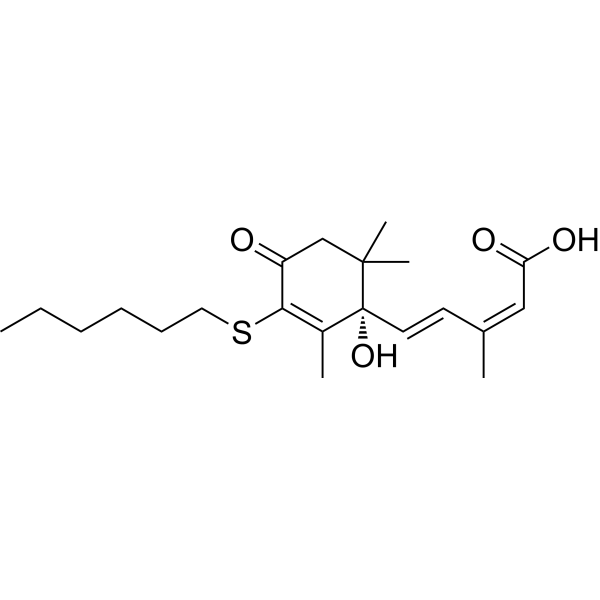 0 ImagesReferencia número: HY-120161No. CAS: 1609660-14-1Synonyms: 3'-Hexylsulfanylabscisic acidAS6 (3'-Hexylsulfanylabscisic acid) is a PYL antagonist with a Kd value of 0.48 μM for Arabidopsis PYL5. AS6 binds to PYL proteins, and its S-hexyl chain blocks PP2C binding via steric hindrance. AS6 alleviates the inhibitory effect of ABA on seed germination in Arabidopsis and lettuce.
-
SPH7050
 0 ImagesReferencia número: HY-189377SPH7050 is an orally active LANCL2 agonist with a Kd of 3.73 μM. SPH7050 inhibits PGE2 production. SPH7050 attenuates the disease activity index and colonic inflammation in TNBS-induced colitis in mice. SPH7050 can be used for research on inflammatory bowel disease.
-
Antabactin
 0 ImagesAntabactin is an ABA receptor antagonist. Antabactin blocks the ABA receptor-PP2C interaction thereby reducing ABA signaling. Antabactin restores germination of thermoinhibited lettuce.
-
CLE25 Peptide
 0 ImagesReferencia número: HY-P10670No. CAS: 911319-15-8CLE25 peptide moves from the roots to the leaves and modulates NCED3 expression in leaves in association with the receptor-like kinases BAM1 and BAM3. CLE25 peptide induces stomatal closure by modulating abscisic acid accumulation and thereby enhances resistance to dehydration stress.
-
Omilancor (Standard)
 0 ImagesReferencia número: HY-102013RNo. CAS: 1912399-75-7Synonyms: BT-11 (Standard)Omilancor (Standard) is the analytical standard of Omilancor. This product is intended for research and analytical applications. BT-11 is an orally available LANCL2 binding compound for treating inflammatory bowel disease.



