



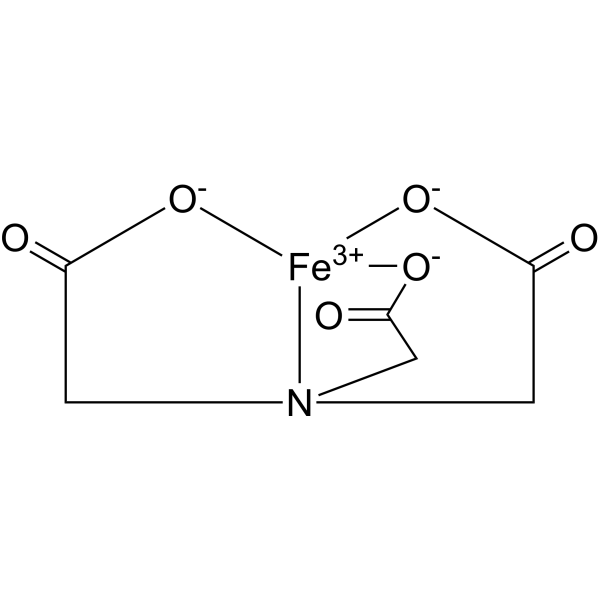
Ferric nitrilotriacetate

Based on 1 Customer Validation
Ferric nitrilotriacetate (Fe-NTA), a complexation of nitriloacetic acid with iron, is a highly reactive compound used to induce degenerative disorders through oxidative stress (OS). Ferric nitrilotriacetate is also used in several studies to induce hyperglycemia, glycosuria, and both renal and liver carcinogenesis.
Nos produits utilisent uniquement pour la recherche. Nous ne vendons pas aux patients.
- Pureté : 98.0%
- CAS No.: 16448-54-7
- Formule: C6H6FeNO6
- Masse moléculaire:243.96
-
Stockage:
4°C, stored under nitrogen
* In solvent : -80°C, 6 months; -20°C, 1 month (stored under nitrogen)

To place orders, for customer services and technical support, please contact: MedChemExpress USA
Tel: 609-228-6898 E-mail: [email protected] [email protected]


-
 Activité biologique
-
Chemical Information
- Protocole
- Pureté et documentation
- Références
-
 Help & FAQs




Activité biologique
Description
Induced Disease Models
Please do not refer to only one article to determine the experimental conditions. It is recommended to determine the optimal experimental conditions (animal strain, age, dosage, frequency and cycle, detection time and indicators, etc.) through preliminary experiments before the formal experiment.
Ferric nitrilotriacetate can be used in animal modeling to create renal tumor and diabetes models. After intraperitoneal injection into mice, it deposits heavily in the liver and pancreas[1][2][3][4].
Administration: 1.8-2.7 mg of Fe/kg • ip • once daily, 6 days a week for 12 weeks
Phenotypic Observations: Renal tubular cell tumors develop. The appearance of renal tumors includes solid, cystic, or hemorrhagic forms. Microscopic examination reveals tumor cells with clear, granular, or spindle shapes, forming solid aggregates, papillae, cysts, or glandular patterns.
Administration: 200 mg/rat • ip • once daily, Specifics of the administration method are detailed in the note
Weeks 1-3: 2 mg Fe/kg, once daily;
Weeks 3-6: 6 mg Fe/kg, once daily;
Next 2 months: 10 mg Fe/kg, once daily.
Phenotypic Observations: Mice exhibited diabetic symptoms, including hyperglycemia, glycosuria, ketonemia, and ketonuria.
MedChemExpress (MCE) has not independently confirmed the accuracy of these methods. They are for reference only.


Chemical Information
-
CAS No. 16448-54-7
-
Appearance Solid
-
Masse moléculaire 243.96
-
Formule C6H6FeNO6
-
Color Light yellow to yellow
-
SMILES
O=C1[O-][Fe+3]([O-]C2=O)([O-]3)[N](C2)(C1)CC3=O
-
Livraison
Room temperature in continental US; may vary elsewhere.
-
Stockage
4°C, stored under nitrogen
* In solvent : -80°C, 6 months; -20°C, 1 month (stored under nitrogen)

Protocole
-
ROS/oxidative-stress fluorescent staining
ROS/oxidative-stress fluorescent staining uses cell-permeant fluorogenic probes that become fluorescent after oxidation inside cells or tissues; commonly used examples include DCFH-DA/DCFDA for broad cellular oxidant detection, DHE for superoxide-related signal detection, MitoSOX for mitochondrial superoxide-related signal detection, and CellROX probes for oxidative-stress-associated fluorescence readouts. The assay detects probe oxidation rather than a single ROS species unless the probe and analysis method have been chemically validated for that species. DCFH-DA enters cells, is deacetylated by intracellular esterases to DCFH, and produces fluorescent DCF after oxidation, so the readout is used as an operational measure of total cellular oxidative stress rather than a species-specific ROS measurement. DHE and MitoSOX can report superoxide-related oxidation, but red fluorescence alone can include non-specific ethidium-like oxidation products; HPLC or optimized spectral approaches are


Pureté et documentation
-
Fiche technique (277 KB)
-
SDS (252 KB)
- English - EN (252 KB)
- Français - FR (252 KB)
- Deutsch - DE (252 KB)
- Norwegian - NO (252 KB)
- Español - ES (252 KB)
- Swedish - SV (252 KB)
- Italian - IT (252 KB)
- Korean - KR (252 KB)
- Portuguese - PT (252 KB)
-
Instruction de manipulation (2659 KB)
Références
[1]. Joël Essogo J, et al. Zanthoxylum heitzii Modulates Ferric Nitrilotriacetate-Dependent Oxidative Alterations in Four Vital Organs: An In Vitro Organoprotective Model. Evid Based Complement Alternat Med. 2017;2017:6058150. [Content Brief]
[2]. Inoue S, et al. Hydroxyl radical production and human DNA damage induced by ferric nitrilotriacetate and hydrogen peroxide. Cancer Res. 1987 Dec 15;47(24 Pt 1):6522-7. [Content Brief]
[3]. Li JL, et al. Subacute nephrotoxicity and induction of renal cell carcinoma in mice treated with ferric nitrilotriacetate. Cancer Res. 1987 Apr 1;47(7):1867-9. [Content Brief]
[4]. Awai M, et al. Induction of diabetes in animals by parenteral administration of ferric nitrilotriacetate. A model of experimental hemochromatosis. Am J Pathol. 1979 Jun;95(3):663-73. PMID: 377994; [Content Brief]

Calculators
Concentration (start) × Volume (start) = Concentration (final) × Volume (final)


Ferric nitrilotriacetate Related Classifications
HY-145157 Related Classifications
 Powered by Bioz