



PBOX 6

Based on 1 Customer Validation
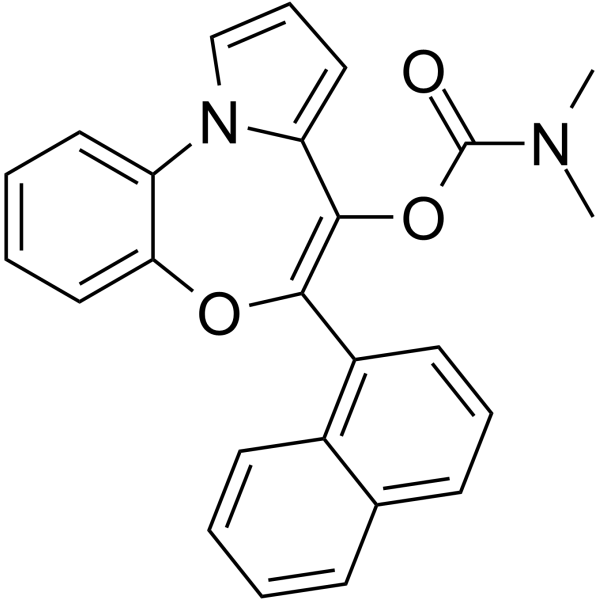
PBOX 6 is a pyrrolo-1,5-benzoxazepine (PBOX) compound, acts as a microtubule-depolymerizing agent and an apoptotic agent.
For research use only. We do not sell to patients.
- Purity : 99.75%
- CAS No.: 290814-68-5
- Formula: C25H20N2O3
- Molecular Weight:396.44
-
Storage:Powder -20°C, 3 years , 4°C, 2 years ; In solvent -80°C, 6 months , -20°C, 1 month

To place orders, for customer services and technical support, please contact: MedChemExpress USA
Tel: 609-228-6898 E-mail: [email protected] [email protected]


-
 Biological Activity
-
Chemical Information
-
Solvent & Solubility
- Protocols
- Purity & Documentation
- References
-
 Help & FAQs




Biological Activity
Description
IC50 & Target
Cellular Effect
|
Cell Line

|
Type | Value | Description | References |
|---|---|---|---|---|
| Ca9-22 | IC50 |
0.17 μM
Compound: 27; PBOX-6
|
Cytotoxicity against human Ca9-22 cells assessed as reduction in cell viability measured after 48 hrs by alamar blue viability assay
Cytotoxicity against human Ca9-22 cells assessed as reduction in cell viability measured after 48 hrs by alamar blue viability assay
|
[PMID: 35344902] |
| SCC-4 | IC50 |
0.16 μM
Compound: 27; PBOX-6
|
Cytotoxicity against human SCC-4 cells assessed as reduction in cell viability measured after 48 hrs by alamar blue viability assay
Cytotoxicity against human SCC-4 cells assessed as reduction in cell viability measured after 48 hrs by alamar blue viability assay
|
[PMID: 35344902] |
In Vitro
PBOX 6 is a potent apoptotic PBOX, but does not elicit a general toxic effect in a rat R2C Leydig cell line. PBOX 6 (0-25 μM, 16 h) results in dose- and time-dependent induction of apoptosis, and also causes DNA fragmentation at 10 μM in HL-60 cells. PBOX 6 (10 μM) induces apoptosis through activation of caspase 3-like proteases in HL-60 cells. PBOX 6 (10 μM) induces apoptosis and exerts an accumulation of cytochromec in the cytosol, but this effect is not triggered by oxidative stress, and is independent of peripheral-type benzodiazepine receptor (PBR) and NF-κB[1]. PBOX 6 (25 μM) induces apoptosis in MCF-7 cells through activation of caspase-7[2]. PBOX 6 (10 μM) induces the redistribution of cypA from the nucleus to the cytosol of the cell in K562 cells. PBOX 6 (10 μM) induces nucleocytoplasmic redistribution of cypA and pin1 through a JNK-dependent manner, also dependent on upstream activation of a trypsin-like serine protease, and this effect correlates with G2/M arrest in K562 cells[3].
MedChemExpress (MCE) has not independently confirmed the accuracy of these methods. They are for reference only. Further protocols information, click here.


Chemical Information
-
CAS No. 290814-68-5
-
Appearance Solid
-
Molecular Weight 396.44
-
Formula C25H20N2O3
-
Color White to off-white
-
SMILES
O=C(OC1=C(C2=C3C=CC=CC3=CC=C2)OC4=CC=CC=C4N5C1=CC=C5)N(C)C
-
Shipping
Room temperature in continental US; may vary elsewhere.
-
Storage
Powder -20°C 3 years 4°C 2 years In solvent -80°C 6 months -20°C 1 month


Solvent & Solubility
In Vitro:
DMSO : 33.33 mg/mL (84.07 mM; Need ultrasonic; Hygroscopic DMSO has a significant impact on the solubility of product, please use newly opened DMSO)
Please refer to the solubility information to select the appropriate solvent. Once prepared, please aliquot and store the solution to prevent product inactivation from repeated freeze-thaw cycles.
Storage method and period of stock solution: -80°C, 6 months; -20°C, 1 month. When stored at -80°C, please use it within 6 months. When stored at -20°C, please use it within 1 month.
Please refer to the solubility information to select the appropriate solvent. Once prepared, please aliquot and store the solution to prevent product inactivation from repeated freeze-thaw cycles.
Storage method and period of stock solution: -80°C, 6 months; -20°C, 1 month. When stored at -80°C, please use it within 6 months. When stored at -20°C, please use it within 1 month.
Concentration (start) × Volume (start) = Concentration (final) × Volume (final)
In Vivo:
Select the appropriate dissolution method based on your experimental animal and administration route.
- For the following dissolution methods, please ensure to first prepare a clear stock solution using an In Vitro approach and then sequentially add co-solvents:
- To ensure reliable experimental results, the clarified stock solution can be appropriately stored based on storage conditions. As for the working solution for In Vivo experiments, it is recommended to prepare freshly and use it on the same day.
- The percentages shown for the solvents indicate their volumetric ratio in the final prepared solution. If precipitation or phase separation occurs during preparation, heat and/or sonication can be used to aid dissolution.
In Vivo Dissolution Calculator
Please enter the basic information of animal experiments:
-
-
-
-
Recommended: Prepare an additional quantity of animals to account for potential losses during experiments.
Please enter your animal formula composition:
-
%DMSO +
Recommended: Keep the proportion of DMSO in working solution below 2% if your animal is weak.
-
%+
-
+%Tween-80 + +
-
%Saline +
The co-solvents required include: DMSO, . All of co-solvents are available by MedChemExpress (MCE). , Tween 80. All of co-solvents are available by MedChemExpress (MCE).
Working solution concentration: 0.22 mg/mL
Method for preparing stock solution: mg drug dissolved in μL DMSO. Stock solution concentration: mg/mL.
1. Take μL DMSO stock solution;
2. Add μL .
μL , mix evenly;
3. Then add μL Tween 80, mix evenly;
4. Then add μL
Please ensure that the stock solution in the first step is dissolved to a clear state, and add co-solvents in sequence. You can use ultrasonic heating (ultrasonic cleaner, recommended frequency 20-40 kHz), vortexing, etc. to assist dissolution.

Protocols
-
Detection of Apoptosis
Apoptosis, also called programmed cell death, is generally characterized by distinct morphological characteristics.
-
Apoptosis Solutions
Apoptosis is a regulated, generally non-lytic cell-death pathway that removes unwanted, damaged, infected, or abnormal cells through coordinated morphological changes, caspase activation, DNA fragmentation, and membrane remodeling. The intrinsic apoptosis pathway is controlled mainly by mitochondrial outer membrane permeabilization, BCL-2 family proteins, cytochrome c release, apoptosome formation, caspase-9 activation, and downstream executioner caspase-3/7 activation. The extrinsic apoptosis pathway is initiated by death receptors such as Fas, TNFR, and TRAIL receptors, which recruit adaptor proteins and activate caspase-8 before engaging executioner caspases or mitochondrial amplification through BID cleavage. Apoptosis is linked to many phenotypes, including cancer cell killing, tissue homeostasis, immune regulation, neurodegeneration, infection response, and treatment-induced cytotoxicity; unresolved questions include how apoptosis interacts with necroptosis, pyroptosis, ferroptos


Purity & Documentation
-
Data Sheet (286 KB)
-
SDS (251 KB)
- English - EN (251 KB)
- Français - FR (251 KB)
- Deutsch - DE (251 KB)
- Norwegian - NO (251 KB)
- Español - ES (251 KB)
- Swedish - SV (251 KB)
- Italian - IT (251 KB)
- Korean - KR (251 KB)
- Portuguese - PT (251 KB)
-
Handling Instructions (2659 KB)
References
[1]. Zisterer DM, et al. Pyrrolo-1,5-benzoxazepines induce apoptosis in HL-60, Jurkat, and Hut-78 cells: a new class of apoptotic agents. J Pharmacol Exp Ther. 2000 Apr;293(1):48-59. [Content Brief]
[2]. Mc Gee MM, et al. Caspase-3 is not essential for DNA fragmentation in MCF-7 cells during apoptosis induced by the pyrrolo-1,5-benzoxazepine, PBOX-6. FEBS Lett. 2002 Mar 27;515(1-3):66-70. [Content Brief]
[3]. Bane FT, et al. The microtubule-targeting agents, PBOX-6 [pyrrolobenzoxazepine 7-[(dimethylcarbamoyl)oxy]-6-(2-naphthyl)pyrrolo-[2,1-d] (1,5)-benzoxazepine] and paclitaxel, induce nucleocytoplasmic redistribution of the peptidyl-prolyl isomerases, cyclophilin A and pin1, in malignant hematopoietic cells. J Pharmacol Exp Ther. 2009 Apr;329(1):38-47. [Content Brief]


Complete Stock Solution Preparation Table
Please refer to the solubility information to select the appropriate solvent. Once prepared, please aliquot and store the solution to prevent product inactivation from repeated freeze-thaw cycles.
Storage method and period of stock solution: -80°C, 6 months; -20°C, 1 month. When stored at -80°C, please use it within 6 months. When stored at -20°C, please use it within 1 month.
| Optional Solvent | Concentration Solvent Mass | 1 mg | 5 mg | 10 mg | 25 mg |
|---|---|---|---|---|---|
| DMSO | 1 mM | 2.5224 mL | 12.6122 mL | 25.2245 mL | 63.0612 mL |
| 5 mM | 0.5045 mL | 2.5224 mL | 5.0449 mL | 12.6122 mL | |
| 10 mM | 0.2522 mL | 1.2612 mL | 2.5224 mL | 6.3061 mL | |
| 15 mM | 0.1682 mL | 0.8408 mL | 1.6816 mL | 4.2041 mL | |
| 20 mM | 0.1261 mL | 0.6306 mL | 1.2612 mL | 3.1531 mL | |
| 25 mM | 0.1009 mL | 0.5045 mL | 1.0090 mL | 2.5224 mL | |
| 30 mM | 0.0841 mL | 0.4204 mL | 0.8408 mL | 2.1020 mL | |
| 40 mM | 0.0631 mL | 0.3153 mL | 0.6306 mL | 1.5765 mL | |
| 50 mM | 0.0504 mL | 0.2522 mL | 0.5045 mL | 1.2612 mL | |
| 60 mM | 0.0420 mL | 0.2102 mL | 0.4204 mL | 1.0510 mL | |
| 80 mM | 0.0315 mL | 0.1577 mL | 0.3153 mL | 0.7883 mL |


PBOX 6 Related Classifications
HY-U00446 Related Classifications
 Powered by Bioz