



Ecnoglutide

Based on 1 Customer Validation
Ecnoglutide (XW003) is a long-acting, cAMP-biased glucagon-like peptide 1 (GLP-1) receptor agonist. Ecnoglutide can be used for research of T2DM and obesity.
For research use only. We do not sell to patients.
- Purity : 99.93%
- CAS No.: 2459531-73-6
- Formula: C194H304N48O61
- Molecular Weight:4284.76
-
Storage:
Sealed storage, away from moisture.
Powder -80°C, 2 years , -20°C, 1 year* In solvent : -80°C, 6 months; -20°C, 1 month (sealed storage, away from moisture)


To place orders, for customer services and technical support, please contact: MedChemExpress USA
Tel: 609-228-6898 E-mail: [email protected] [email protected]


-
 Biological Activity
-
Chemical Information
-
Solvent & Solubility
- Protocols
- Purity & Documentation
- References
-
 Help & FAQs


-

HY-114118
SemaglutideGLP-1R Agonist -

HY-P3375
MazdutideGLP-1R/GCGR Agonist -

HY-13443
Exendin-4GLP-1 Receptor Agonist -

HY-114118CP
Semaglutide (crude)Crude Semaglutide -

HY-P3506
RetatrutideGCGR/GIPR/GLP-1R Agonist -
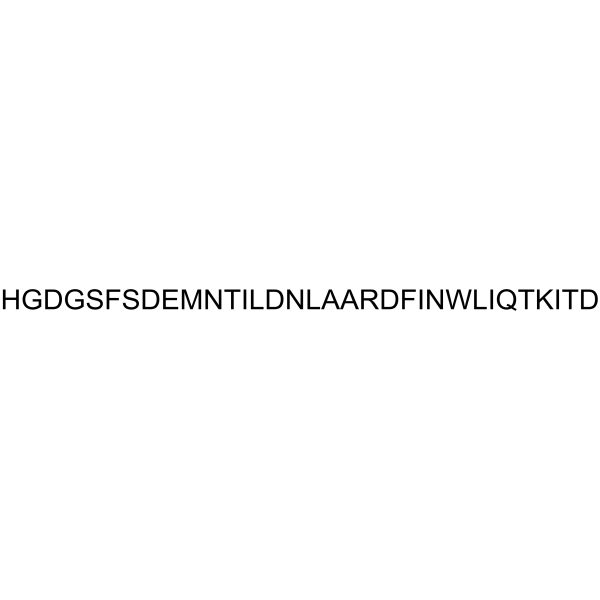
HY-P1624
TeduglutideGLP-2 Analogue -

HY-P0054
GLP-1(7-36), amide acetateInsulinotropic Peptide -

HY-P3388
UtreglutideGLP-1 Receptor Agonit -
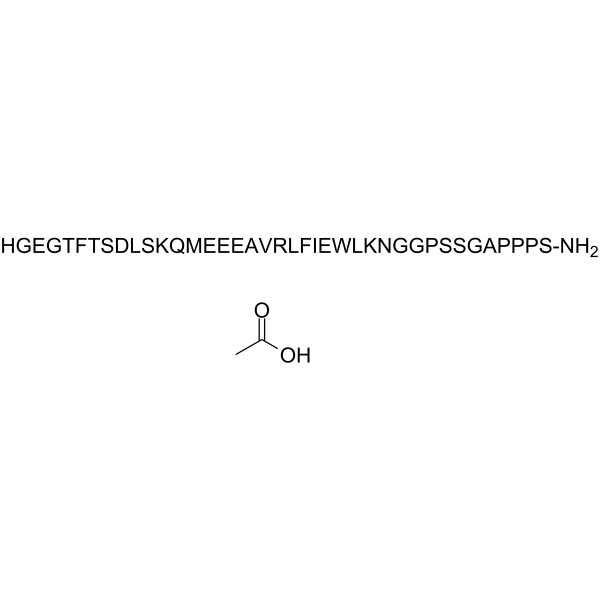
HY-13443A
Exendin-4 acetateGLP-1 Receptor Agonist -
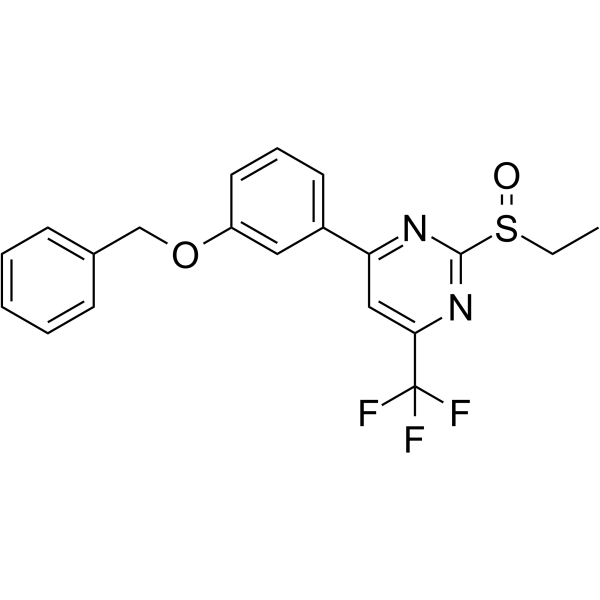
HY-103546
BETPGLP-1 Agonist -
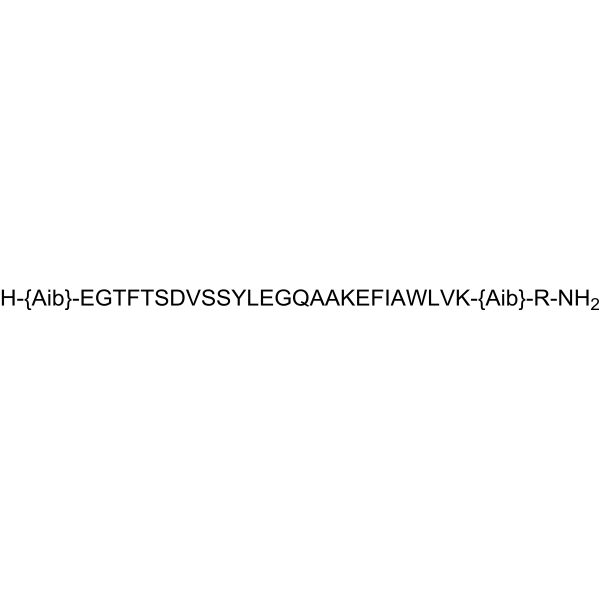
HY-P0165
TaspoglutideGCGR Agonist -
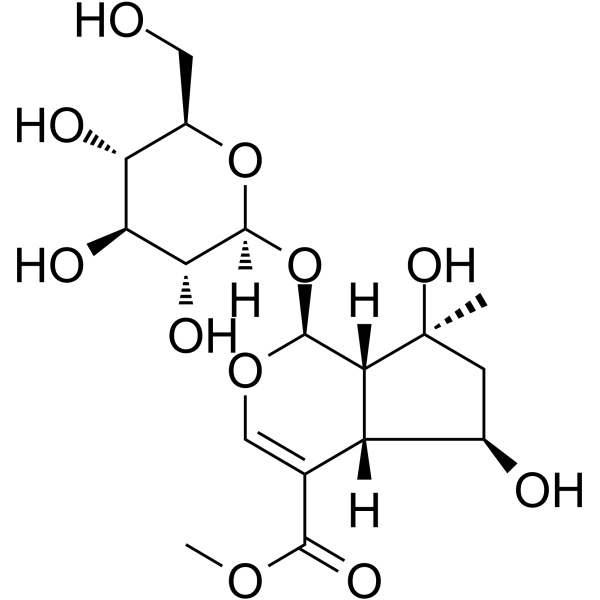
HY-N0630
Shanzhiside methyl esterGLP-1 Receptor Agonist


Biological Activity
Description
In Vitro
Ecnoglutide induces cAMP but not GLP-1 receptor internalization (EC50 = 0.018 nM)[2].
MedChemExpress (MCE) has not independently confirmed the accuracy of these methods. They are for reference only.
In Vivo
Ecnoglutide (1 mg/kg, s.c., rats) shows the T1/2 (h), Tmax (h), Cmax (nM), AUClast (h*nM), MRT (h) values of 11.7, 18 .0, 387.3, 16274.8, 25.4 respectively[2].
MedChemExpress (MCE) has not independently confirmed the accuracy of these methods. They are for reference only.
Clinical Trial
| NCT Number | Sponsor | Condition | Start Date |
Phase

|
|---|---|---|---|---|
| NCT01329991 | Plexxikon| | 2011-05 | PHASE1 |


Chemical Information
-
CAS No. 2459531-73-6
-
Appearance Solid
-
Molecular Weight 4284.76
-
Formula C194H304N48O61
-
Color White to off-white
-
Synonyms
XW003
-
Sequence
His-Val-Glu-Gly-Thr-Phe-Thr-Ser-Asp-Val-Ser-Ser-Tyr-Leu-Glu-Glu-Gln-Ala-Ala-Arg-Glu-Phe-Ile-Lys-(AEEA-AEEA-{γ-Glu}-C18 diacid)-Trp-Leu-Val-Arg-Gly-Arg-Gly
-
Sequence Shortening
HVEGTFTSDVSSYLEEQAAREFIK-(AEEA-AEEA-{γ-Glu}-C18 diacid)-WLVRGRG
-
Shipping
Room temperature in continental US; may vary elsewhere.
-
Storage
Sealed storage, away from moisture
Powder -80°C 2 years -20°C 1 year * In solvent : -80°C, 6 months; -20°C, 1 month (sealed storage, away from moisture)


Solvent & Solubility
In Vitro:
H2O : 20 mg/mL (4.67 mM; ultrasonic and adjust pH to 12 with 1M NaOH)
Please refer to the solubility information to select the appropriate solvent. Once prepared, please aliquot and store the solution to prevent product inactivation from repeated freeze-thaw cycles.
Storage method and period of stock solution: -80°C, 6 months; -20°C, 1 month (sealed storage, away from moisture). When stored at -80°C, please use it within 6 months. When stored at -20°C, please use it within 1 month.
* Note: If you choose water as the stock solution, please dilute it to the working solution, then filter and sterilize it with a 0.22 μm filter before use.
Please refer to the solubility information to select the appropriate solvent. Once prepared, please aliquot and store the solution to prevent product inactivation from repeated freeze-thaw cycles.
Storage method and period of stock solution: -80°C, 6 months; -20°C, 1 month (sealed storage, away from moisture). When stored at -80°C, please use it within 6 months. When stored at -20°C, please use it within 1 month.
* Note: If you choose water as the stock solution, please dilute it to the working solution, then filter and sterilize it with a 0.22 μm filter before use.
Concentration (start) × Volume (start) = Concentration (final) × Volume (final)


Purity & Documentation
-
Data Sheet (285 KB)
-
SDS (254 KB)
- English - EN (254 KB)
- Français - FR (254 KB)
- Deutsch - DE (254 KB)
- Norwegian - NO (254 KB)
- Español - ES (254 KB)
- Swedish - SV (254 KB)
- Italian - IT (254 KB)
- Korean - KR (254 KB)
- Portuguese - PT (254 KB)
-
Handling Instructions (2659 KB)
References


Complete Stock Solution Preparation Table
Please refer to the solubility information to select the appropriate solvent. Once prepared, please aliquot and store the solution to prevent product inactivation from repeated freeze-thaw cycles.
Storage method and period of stock solution: -80°C, 6 months; -20°C, 1 month (sealed storage, away from moisture). When stored at -80°C, please use it within 6 months. When stored at -20°C, please use it within 1 month.
| Optional Solvent | Concentration Solvent Mass | 1 mg | 5 mg | 10 mg | 25 mg |
|---|---|---|---|---|---|
| H2O | 1 mM | 0.2334 mL | 1.1669 mL | 2.3339 mL | 5.8346 mL |
* Note: If you choose water as the stock solution, please dilute it to the working solution, then filter and sterilize it with a 0.22 μm filter before use.


Ecnoglutide Related Classifications
HY-P3366 Related Classifications
 Powered by Bioz