



Emiglitate

Based on 1 Customer Validation
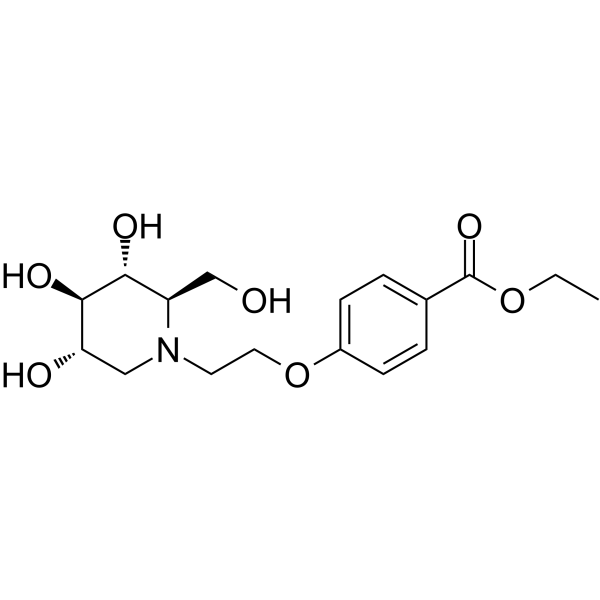
Emiglitate (BAY o 1248) is a potent, selective and competitive inhibitor of α-glucoside hydrolase.
Para uso exclusivo en investigación. No vendemos a pacientes.
- Pureza : 98.0%
- No. CAS: 80879-63-6
- Fòrmula: C17H25NO7
- Peso molecular:355.38
-
Almacenamiento:Powder -20°C, 3 years , 4°C, 2 years ; In solvent -80°C, 6 months , -20°C, 1 month

To place orders, for customer services and technical support, please contact: MedChemExpress USA
Tel: 609-228-6898 E-mail: [email protected] [email protected]


-
 Actividad biológica
-
Chemical Information
- Pureza y Documentación
- Referencias
-
 Help & FAQs




Actividad biológica
Descripciòn
In Vitro
Emiglitate greatly suppresses the glucose-stimulated insulin release in parallel with an inhibitory effect on the activities of acid glucan-1,4-α-glucosidase and acid α-glucosidase. In contrast, the activities of acid phosphatase and N-acetyl-β-D-glucosaminidase tend to increase in the presence of the α-glucoside hydrolase inhibitor. The CO-induced amplification of the glucose-stimulated insulin release as well as of the increased activities of the acid α-glucoside hydrolases are abrogated by emiglitate and displayed the same levels as in the absence of CO. The CO-induced rise in the activities of acid phosphatase and acid N-acetyl-β-D-glucosaminidase is not appreciably affected by emiglitate[1].
MedChemExpress (MCE) has not independently confirmed the accuracy of these methods. They are for reference only.
In Vivo
MedChemExpress (MCE) has not independently confirmed the accuracy of these methods. They are for reference only.


Chemical Information
-
No. CAS 80879-63-6
-
Appearance Solid
-
Peso molecular 355.38
-
Fòrmula C17H25NO7
-
Color White to off-white
-
SMILES
O=C(OCC)C1=CC=C(OCCN2[C@H](CO)[C@@H](O)[C@H](O)[C@@H](O)C2)C=C1
-
Synonyms
BAY o 1248
-
Envío
Room temperature in continental US; may vary elsewhere.
-
Almacenamiento
Powder -20°C 3 years 4°C 2 years In solvent -80°C 6 months -20°C 1 month


Pureza y Documentación
-
Ficha de datos (270 KB)
-
SDS (251 KB)
- English - EN (251 KB)
- Français - FR (251 KB)
- Deutsch - DE (251 KB)
- Norwegian - NO (251 KB)
- Español - ES (251 KB)
- Swedish - SV (251 KB)
- Italian - IT (251 KB)
- Korean - KR (251 KB)
- Portuguese - PT (251 KB)
-
Instrucciones de manejo (2659 KB)
Referencias
[1]. Mosén H, et al. Nitric oxide inhibits, and carbon monoxide activates, islet acid alpha-glucoside hydrolase activitiesin parallel with glucose-stimulated insulin secretion. J Endocrinol. 2006 Sep;190(3):681-93. [Content Brief]
[2]. Lembcke B, et al. Lysosomal storage of glycogen as a sequel of alpha-glucosidase inhibition by the absorbed deoxynojirimycin derivative emiglitate (BAYo1248). A drug-induced pattern of hepatic glycogen storage mimicking Pompe's disease (glycogenosis type II). Res Exp Med (Berl). 1991;191(6):389-404. [Content Brief]

Calculators
Concentration (start) × Volume (start) = Concentration (final) × Volume (final)


Emiglitate Related Classifications
HY-16194 Related Classifications
 Powered by Bioz