



MF 5137
Based on 1 publication(s) in Google Scholar
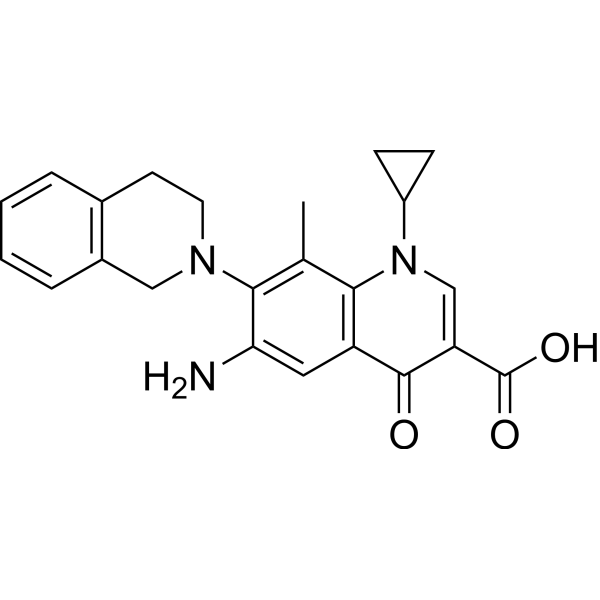
MF 5137 is a potent antibacterial agent.
Para uso exclusivo en investigación. No vendemos a pacientes.
- No. CAS: 148927-23-5
- Fòrmula: C23H23N3O3
- Peso molecular:389.45
-
Almacenamiento:
Please store the product under the recommended conditions in the Certificate of Analysis.

To place orders, for customer services and technical support, please contact: MedChemExpress USA
Tel: 609-228-6898 E-mail: [email protected] [email protected]


-
 Actividad biológica
-
Chemical Information
- Protocolo
- Pureza y Documentación
- Referencias
-
 Help & FAQs


Publications Citing Use of MedChemExpress (MCE) MF 5137
More

Actividad biológica
Descripciòn
IC50 & Target
Antibacterial[1]
Cellular Effect
|
Cell Line

|
Type | Value | Description | References |
|---|---|---|---|---|
| C8166 | EC50 |
80 μM
Compound: 23
|
In vitro antiviral activity against HIV-1 IIIB in C8166 (human CD4) cells.
In vitro antiviral activity against HIV-1 IIIB in C8166 (human CD4) cells.
|
[PMID: 11020296] |
In Vitro
MF 5137 (Compound 2) is rapidly photodegraded upon UVA irradiation, yielding a toxic photoproduct. MF 5137 rapidly decreases the emission of the protein by about 80% after irradiation for 15 min. This effect is markedly reduced in anaerobic conditions[1].
MedChemExpress (MCE) has not independently confirmed the accuracy of these methods. They are for reference only. Further protocols information, click here.


Chemical Information
-
No. CAS 148927-23-5
-
Peso molecular 389.45
-
Fòrmula C23H23N3O3
-
SMILES
O=C(C1=CN(C2CC2)C3=C(C=C(N)C(N4CC5=C(C=CC=C5)CC4)=C3C)C1=O)O
-
Envío
Room temperature in continental US; may vary elsewhere.
-
Almacenamiento
Please store the product under the recommended conditions in the Certificate of Analysis.


Publications (1)
-
Journal Impact Factor
-
Most Recent

Protocolo
-
Research Protocol for Infectious Diseases
Infectious-disease experiments test how pathogens interact with host barriers, innate immune receptors, inflammatory signaling, pathogen replication, and tissue injury; pattern-recognition receptors such as TLRs, RIG-I-like receptors, NOD-like receptors, and inflammasomes detect microbial molecules and activate NF-κB, interferon, and cytokine responses. The central hypothesis is that infection severity reflects the balance between pathogen burden and host response: protective inflammation restricts pathogen growth, whereas excessive or mislocalized inflammation contributes to tissue damage and disease phenotype. Unresolved questions include which host pathways are protective versus pathogenic, why some infection models fail to translate to human disease, and which combined readouts best predict clinically relevant infection outcomes.


Pureza y Documentación
Referencias

Calculators
Concentration (start) × Volume (start) = Concentration (final) × Volume (final)


MF 5137 Related Classifications
HY-100289 Related Classifications
 Powered by Bioz