



Benzquinamide
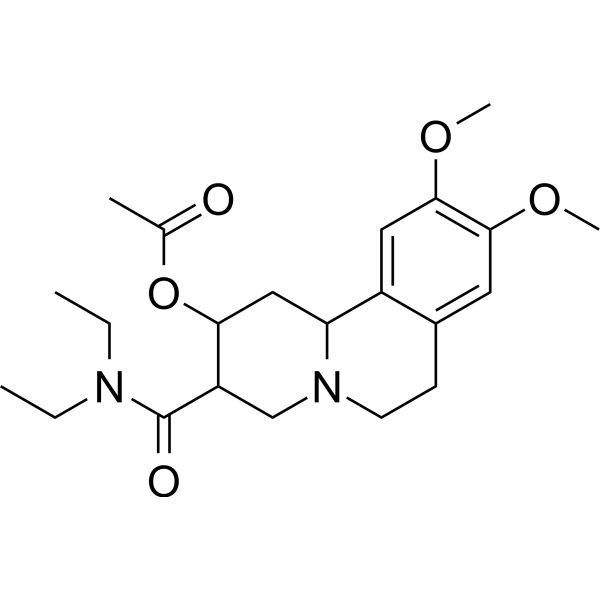
Benzquinamide (P2647; BZQ; Benzoquinamide) is an orally active binder of dopamine receptors and adrenergic receptors. Benzquinamide specifically targets dopamine D2, D3, D4 receptors and α-2A, α-2B, α-2C adrenergic receptors. Benzquinamide regulates blood pressure and heart rate, attenuates the pressor effect of adrenaline, and exhibits activities such as antiemesis, anxiolysis, and reduction of histamine-induced bronchoconstriction. Benzquinamide has good safety and does not deplete serotonin or norepinephrine in the brain. Benzquinamide can be used in studies related to nausea/vomiting, mental disorders, anxiety states, neurosis, and psychosis.
Para uso exclusivo en investigación. No vendemos a pacientes.
- No. CAS: 63-12-7
- Fòrmula: C22H32N2O5
- Peso molecular:404.50
-
Almacenamiento:
Please store the product under the recommended conditions in the Certificate of Analysis.

To place orders, for customer services and technical support, please contact: MedChemExpress USA
Tel: 609-228-6898 E-mail: [email protected] [email protected]


-
 Actividad biológica
-
Chemical Information
- Pureza y Documentación
- Referencias
-
 Help & FAQs


Ver todos los productos específicos de isoformas Adrenergic Receptor
MoreVer todos los productos específicos de isoformas Dopamine Receptor
More

Actividad biológica
Descripciòn
IC50 & Target
|
α adrenergic receptor |
D2 Receptor |
D3 Receptor |
D4 Receptor |
In Vitro
Benzquinamide binds to human dopamine D2, D3, and D4 receptors, with the highest affinity for the D4 subtype (Ki=574 nM)[1].
Benzquinamide (10 μM) binds to human α2A, α2B, and α2C adrenergic receptors, with the highest affinity for the α2C subtype (Ki=545 nM), and does not produce meaningful binding to histamine H1 receptors or muscarinic M1-M5 receptors[1].
MedChemExpress (MCE) has not independently confirmed the accuracy of these methods. They are for reference only.
In Vivo
Benzquinamide (5-20 mg/kg; i.p.) inhibits isolation-induced fighting behavior in male mice starting at 5 mg/kg (i.p.) without causing muscle relaxation or impaired coordination[2].
Benzquinamide (0.4-1.6 mg/kg; i.v.; 4.0-6.0 mg/kg; p.o.) blocks apomorphine-induced emesis in dogs with an intravenous ED50 of approximately 0.9 mg/kg, and fully blocks emesis at 6.0 mg/kg (p.o.)[2].
Benzquinamide (10-25 mg/kg; i.v.) does not deplete brain serotonin or norepinephrine concentrations in dogs at doses up to 25 mg/kg (i.v.)[2].
Benzquinamide (10 mg/kg; i.v.) does not exhibit neuromuscular activity in Felis catus at 10 mg/kg (i.v.)[2].
MedChemExpress (MCE) has not independently confirmed the accuracy of these methods. They are for reference only.
-
Animal Model:Rat with anxiety-related behavior[2]
-
Dosage:16.5 mg/kg (disrupting avoidance behavior); 60.5 mg/kg (disrupting escape behavior)
-
Administration:i.p.
-
Result:Disrupted conditioned avoidance behavior with an ED50 of 16.5 mg/kg (i.p.).
Disrupted escape behavior with an ED50 of 60.5 mg/kg (i.p.).
Achieved a specificity score (escape ED50 to avoidance ED50 ratio) of 3.7.
-
Animal Model:Mature aggressio nmale mice[2]
-
Dosage:5 mg/kg; 10 mg/kg; 20 mg/kg
-
Administration:i.p.
-
Result:Inhibited isolation-induced fighting behavior starting at 5 mg/kg (i.p.).
Caused no muscle relaxation or interference with muscular coordination at doses that reduced or prevented fighting.


Chemical Information
-
No. CAS 63-12-7
-
Peso molecular 404.50
-
Fòrmula C22H32N2O5
-
SMILES
O=C(C1CN2CCC3=CC(OC)=C(OC)C=C3C2CC1OC(C)=O)N(CC)CC
-
Synonyms
P2647; BZQ; Benzoquinamide
-
Envío
Room temperature in continental US; may vary elsewhere.
-
Almacenamiento
Please store the product under the recommended conditions in the Certificate of Analysis.


Pureza y Documentación
Referencias

Calculators
Concentration (start) × Volume (start) = Concentration (final) × Volume (final)


Benzquinamide Related Classifications
HY-U00244 Related Classifications
 Powered by Bioz