



AR03

Based on 1 Customer Validation
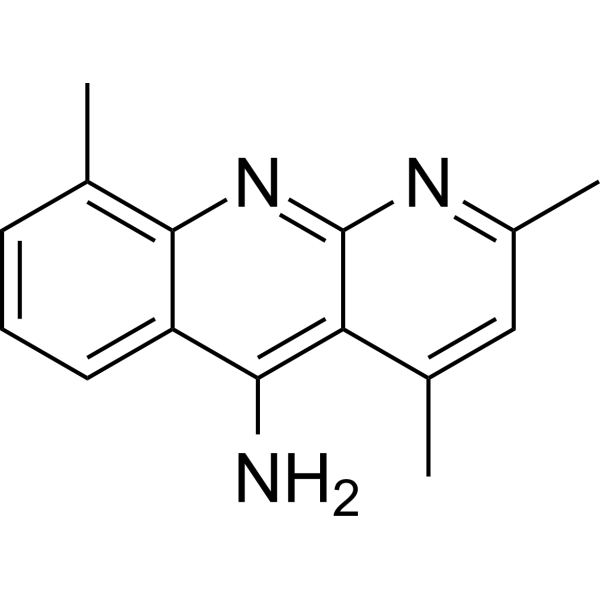
AR03 (BMH-23) is an apurinic/apyrimidinic endonuclease 1 (Ape1) inhibitor with an IC50 of 2.1 µM. AR03 has low affinity for double-stranded DNA. AR03 potentiates the cytotoxicity of methyl methanesulfonate and temozolomide in SF767 cells.
Para uso exclusivo en investigación. No vendemos a pacientes.
- Pureza : 99.1%
- No. CAS: 510721-85-4
- Fòrmula: C15H15N3
- Peso molecular:237.30
-
Almacenamiento:Powder -20°C, 3 years , 4°C, 2 years ; In solvent -80°C, 6 months , -20°C, 1 month

To place orders, for customer services and technical support, please contact: MedChemExpress USA
Tel: 609-228-6898 E-mail: [email protected] [email protected]


-
 Actividad biológica
-
Chemical Information
-
Solvente y solubilidad
- Protocolo
- Pureza y Documentación
- Referencias
-
 Help & FAQs



Ver todos los productos específicos de isoformas DNA/RNA Synthesis
More

Actividad biológica
Descripciòn
IC50 & Target
IC50: 2.1 µM (Ape1)[1]


Chemical Information
-
No. CAS 510721-85-4
-
Appearance Solid
-
Peso molecular 237.30
-
Fòrmula C15H15N3
-
Color Light yellow to yellow
-
SMILES
CC1=C2N=C3N=C(C=C(C3=C(C2=CC=C1)N)C)C
-
Synonyms
BMH-23
-
Envío
Room temperature in continental US; may vary elsewhere.
-
Almacenamiento
Powder -20°C 3 years 4°C 2 years In solvent -80°C 6 months -20°C 1 month


Solvente y solubilidad
In Vitro:
DMSO : 24.1 mg/mL (101.56 mM; Need ultrasonic and warming; Hygroscopic DMSO has a significant impact on the solubility of product, please use newly opened DMSO)
Please refer to the solubility information to select the appropriate solvent. Once prepared, please aliquot and store the solution to prevent product inactivation from repeated freeze-thaw cycles.
Storage method and period of stock solution: -80°C, 6 months; -20°C, 1 month. When stored at -80°C, please use it within 6 months. When stored at -20°C, please use it within 1 month.
Please refer to the solubility information to select the appropriate solvent. Once prepared, please aliquot and store the solution to prevent product inactivation from repeated freeze-thaw cycles.
Storage method and period of stock solution: -80°C, 6 months; -20°C, 1 month. When stored at -80°C, please use it within 6 months. When stored at -20°C, please use it within 1 month.
Concentration (start) × Volume (start) = Concentration (final) × Volume (final)


Pureza y Documentación
-
Ficha de datos (273 KB)
-
SDS (251 KB)
- English - EN (251 KB)
- Français - FR (251 KB)
- Deutsch - DE (251 KB)
- Norwegian - NO (251 KB)
- Español - ES (251 KB)
- Swedish - SV (251 KB)
- Italian - IT (251 KB)
- Korean - KR (251 KB)
- Portuguese - PT (251 KB)
-
Instrucciones de manejo (2659 KB)
Referencias


Complete Stock Solution Preparation Table
Please refer to the solubility information to select the appropriate solvent. Once prepared, please aliquot and store the solution to prevent product inactivation from repeated freeze-thaw cycles.
Storage method and period of stock solution: -80°C, 6 months; -20°C, 1 month. When stored at -80°C, please use it within 6 months. When stored at -20°C, please use it within 1 month.
| Optional Solvent | Concentration Solvent Mass | 1 mg | 5 mg | 10 mg | 25 mg |
|---|---|---|---|---|---|
| DMSO | 1 mM | 4.2141 mL | 21.0704 mL | 42.1407 mL | 105.3519 mL |
| 5 mM | 0.8428 mL | 4.2141 mL | 8.4281 mL | 21.0704 mL | |
| 10 mM | 0.4214 mL | 2.1070 mL | 4.2141 mL | 10.5352 mL | |
| 15 mM | 0.2809 mL | 1.4047 mL | 2.8094 mL | 7.0235 mL | |
| 20 mM | 0.2107 mL | 1.0535 mL | 2.1070 mL | 5.2676 mL | |
| 25 mM | 0.1686 mL | 0.8428 mL | 1.6856 mL | 4.2141 mL | |
| 30 mM | 0.1405 mL | 0.7023 mL | 1.4047 mL | 3.5117 mL | |
| 40 mM | 0.1054 mL | 0.5268 mL | 1.0535 mL | 2.6338 mL | |
| 50 mM | 0.0843 mL | 0.4214 mL | 0.8428 mL | 2.1070 mL | |
| 60 mM | 0.0702 mL | 0.3512 mL | 0.7023 mL | 1.7559 mL | |
| 80 mM | 0.0527 mL | 0.2634 mL | 0.5268 mL | 1.3169 mL | |
| 100 mM | 0.0421 mL | 0.2107 mL | 0.4214 mL | 1.0535 mL |


AR03 Related Classifications
HY-119993 Related Classifications
 Powered by Bioz