



Gemcabene calcium

Based on 1 Customer Validation
Gemcabene calcium (PD-72953 calcium), a first-in-class lipid-lowering agent, lowers low-density lipoprotein cholesterol (LDL-C), decreases triglycerides, and raises high-density lipoprotein cholesterol (HDL-C) and lowers pro-inflammatory acute-phase protein, C-reactive protein (CRP), exerting anti-inflammatory activity.
For research use only. We do not sell to patients.
- Purity : 98.0%
- CAS No.: 209789-08-2
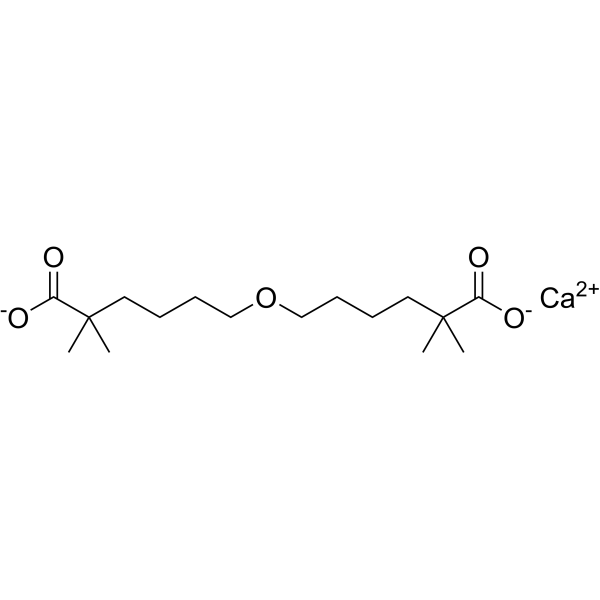
- Formula: C16H28CaO5
- Molecular Weight:340.47
-
Storage:
4°C, sealed storage, away from moisture
* In solvent : -80°C, 6 months; -20°C, 1 month (sealed storage, away from moisture)

To place orders, for customer services and technical support, please contact: MedChemExpress USA
Tel: 609-228-6898 E-mail: [email protected] [email protected]


-
 Biological Activity
-
Chemical Information
-
Solvent & Solubility
- Protocols
- Purity & Documentation
- References
-
 Help & FAQs




Biological Activity
Description
In Vitro
Gemcabene calcium (PD-72953 calcium) significantly downregulates hepatic mRNA markers of inflammation (TNF-α, MCP-1, MIP-1β, CCR5, CCR2, NF-κB), lipogenesis and lipid modulation (ApoC-III, ACC1, ADH-4, Sulf-2), and fibrosis (TIMP-1 and MMP-2)[3].
MedChemExpress (MCE) has not independently confirmed the accuracy of these methods. They are for reference only.


Chemical Information
-
CAS No. 209789-08-2
-
Appearance Solid
-
Molecular Weight 340.47
-
Formula C16H28CaO5
-
Color White to off-white
-
SMILES
O=C([O-])C(C)(C)CCCCOCCCCC(C)(C([O-])=O)C.[Ca+2]
-
Synonyms
PD-72953 calcium
-
Shipping
Room temperature in continental US; may vary elsewhere.
-
Storage
4°C, sealed storage, away from moisture
* In solvent : -80°C, 6 months; -20°C, 1 month (sealed storage, away from moisture)


Solvent & Solubility
In Vitro:
H2O : 10 mg/mL (29.37 mM; Need ultrasonic)
Please refer to the solubility information to select the appropriate solvent. Once prepared, please aliquot and store the solution to prevent product inactivation from repeated freeze-thaw cycles.
Storage method and period of stock solution: -80°C, 6 months; -20°C, 1 month (sealed storage, away from moisture). When stored at -80°C, please use it within 6 months. When stored at -20°C, please use it within 1 month.
* Note: If you choose water as the stock solution, please dilute it to the working solution, then filter and sterilize it with a 0.22 μm filter before use.
Please refer to the solubility information to select the appropriate solvent. Once prepared, please aliquot and store the solution to prevent product inactivation from repeated freeze-thaw cycles.
Storage method and period of stock solution: -80°C, 6 months; -20°C, 1 month (sealed storage, away from moisture). When stored at -80°C, please use it within 6 months. When stored at -20°C, please use it within 1 month.
* Note: If you choose water as the stock solution, please dilute it to the working solution, then filter and sterilize it with a 0.22 μm filter before use.
Concentration (start) × Volume (start) = Concentration (final) × Volume (final)


Purity & Documentation
-
Data Sheet (268 KB)
-
SDS (252 KB)
- English - EN (252 KB)
- Français - FR (252 KB)
- Deutsch - DE (252 KB)
- Norwegian - NO (252 KB)
- Español - ES (252 KB)
- Swedish - SV (252 KB)
- Italian - IT (252 KB)
- Korean - KR (252 KB)
- Portuguese - PT (252 KB)
-
Handling Instructions (2659 KB)
References
[1]. Mandema JW, et al. Model-based development of gemcabene, a new lipid-altering agent. AAPS J. 2005 Oct 7;7(3):E513-22. [Content Brief]
[2]. Srivastava RAK, et al. Gemcabene, a First-in-Class Hypolipidemic Small Molecule in Clinical Development, Attenuates Osteoarthritis and Pain in Animal Models of Arthritis and Pain. Front Pharmacol. 2018 May 11;9:471. [Content Brief]
[3]. Oniciu DC, et al. Gemcabene downregulates inflammatory, lipid-altering and cell-signaling genes in the STAM™ model of NASH. PLoS One. 2018 May 30;13(5):e0194568. [Content Brief]


Complete Stock Solution Preparation Table
Please refer to the solubility information to select the appropriate solvent. Once prepared, please aliquot and store the solution to prevent product inactivation from repeated freeze-thaw cycles.
Storage method and period of stock solution: -80°C, 6 months; -20°C, 1 month (sealed storage, away from moisture). When stored at -80°C, please use it within 6 months. When stored at -20°C, please use it within 1 month.
| Optional Solvent | Concentration Solvent Mass | 1 mg | 5 mg | 10 mg | 25 mg |
|---|---|---|---|---|---|
| H2O | 1 mM | 2.9371 mL | 14.6856 mL | 29.3712 mL | 73.4279 mL |
| 5 mM | 0.5874 mL | 2.9371 mL | 5.8742 mL | 14.6856 mL | |
| 10 mM | 0.2937 mL | 1.4686 mL | 2.9371 mL | 7.3428 mL | |
| 15 mM | 0.1958 mL | 0.9790 mL | 1.9581 mL | 4.8952 mL | |
| 20 mM | 0.1469 mL | 0.7343 mL | 1.4686 mL | 3.6714 mL | |
| 25 mM | 0.1175 mL | 0.5874 mL | 1.1748 mL | 2.9371 mL |
* Note: If you choose water as the stock solution, please dilute it to the working solution, then filter and sterilize it with a 0.22 μm filter before use.


Gemcabene calcium Related Classifications
HY-109567A Related Classifications
 Powered by Bioz