



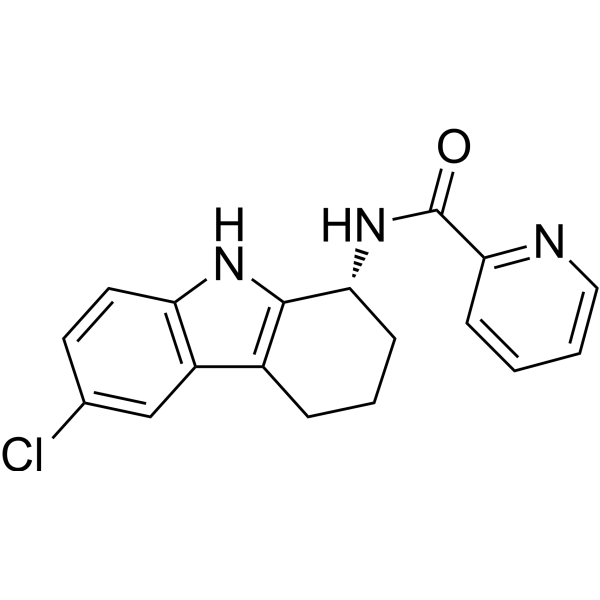
GSK983

Based on 1 Customer Validation
GSK983 is a broad-spectrum antiviral agent. GSK983 inhibits the replication of adenovirus-5 (Ad-5) and polyoma virus SV40. GSK983 inhibits the growth of cell lines immortalized by EBV, HTLV1, HPV. GSK983 induces the expression of interferon-stimulated genes.
Nur für Forschungszwecke. Wir verkaufen nicht an Patienten.
- Reinheit : 99.8%
- CAS. Nr.: 827591-02-6
- Formel: C18H16ClN3O
- Molecular Weight:325.79
-
Speicherung:Powder -20°C, 3 years , 4°C, 2 years ; In solvent -80°C, 6 months , -20°C, 1 month

To place orders, for customer services and technical support, please contact: MedChemExpress USA
Tel: 609-228-6898 E-mail: [email protected] [email protected]


-
 Biologische Aktivität
-
Chemical Information
-
Lösungsmittel & Löslichkeit
- Protokoll
- Reinheit & Dokumentation
- Verweise
-
 Help & FAQs




Biologische Aktivität
Beschreibung
Cellular Effect
|
Cell Line

|
Type | Value | Description | References |
|---|---|---|---|---|
| HFF | CC50 |
16 μM
Compound: 41
|
Cytotoxicity against HFF cells
Cytotoxicity against HFF cells
|
[PMID: 19556128] |
In Vitro
GSK983 (0-10000 nM; 2 h) inhibits replication of adenovirus-5 (Ad-5) in primary human fibroblasts (HFF) and polyoma virus SV40 in Vero cells with the median effect concentration (K) of 21 nM, 7.5 nM; and maximum inhibition (I max) of 99%, 88%, respectively[1].
GSK983 (0-10000 nM; 72 h) inhibits the growth of cell lines immortalized by viral infection with the median effect concentration (K) of 16, 14, 7.5 nM for IM9 (EBV), B-LCL 5/2/1 (EBV), MT4 (HTLV1) cells, respectively[1].
GSK983 (10, 100 nM; 24, 48 h) induces the expression of interferon-stimulated genes in W12, HKC cells[1].
MedChemExpress (MCE) has not independently confirmed the accuracy of these methods. They are for reference only.
-
Cell Line:W12, HKC cells
-
Concentration:10, 100 nM
-
Incubation Time:24, 48 h
-
Result:Induced the expression of interferon-stimulated genes in infected and immortalized cells, increased the gene expression of CSF2, IFIT1 (ISG56), IL6, ISG15, OAS1, OAS2, OASL and TNFSF10 (TRAIL).


Chemical Information
-
CAS. Nr. 827591-02-6
-
Appearance Solid
-
Molecular Weight 325.79
-
Formel C18H16ClN3O
-
Color White to light yellow
-
SMILES
O=C(C1=NC=CC=C1)N[C@H]2C3=C(CCC2)C(C=C(C=C4)Cl)=C4N3
-
Versand
Room temperature in continental US; may vary elsewhere.
-
Speicherung
Powder -20°C 3 years 4°C 2 years In solvent -80°C 6 months -20°C 1 month


Lösungsmittel & Löslichkeit
In Vitro:
DMSO : ≥ 10 mg/mL (30.69 mM; Hygroscopic DMSO has a significant impact on the solubility of product, please use newly opened DMSO)
* "≥" means soluble, but saturation unknown.
Please refer to the solubility information to select the appropriate solvent. Once prepared, please aliquot and store the solution to prevent product inactivation from repeated freeze-thaw cycles.
Storage method and period of stock solution: -80°C, 6 months; -20°C, 1 month. When stored at -80°C, please use it within 6 months. When stored at -20°C, please use it within 1 month.
Please refer to the solubility information to select the appropriate solvent. Once prepared, please aliquot and store the solution to prevent product inactivation from repeated freeze-thaw cycles.
Storage method and period of stock solution: -80°C, 6 months; -20°C, 1 month. When stored at -80°C, please use it within 6 months. When stored at -20°C, please use it within 1 month.
Konzentration (Stammlösung) × Volumen (Stammlösung) = Konzentration (Ziellösung) × Volumen (Ziellösung)


Reinheit & Dokumentation
-
Data Sheet (275 KB)
-
SDS (393 KB)
- English - EN (393 KB)
- Français - FR (393 KB)
- Deutsch - DE (393 KB)
- Norwegian - NO (393 KB)
- Español - ES (393 KB)
- Swedish - SV (393 KB)
- Italian - IT (393 KB)
- Korean - KR (393 KB)
- Portuguese - PT (393 KB)
-
Handling Instructions (2659 KB)
Verweise


Complete Stock Solution Preparation Table
Please refer to the solubility information to select the appropriate solvent. Once prepared, please aliquot and store the solution to prevent product inactivation from repeated freeze-thaw cycles.
Storage method and period of stock solution: -80°C, 6 months; -20°C, 1 month. When stored at -80°C, please use it within 6 months. When stored at -20°C, please use it within 1 month.
| Optional Solvent | Concentration Solvent Mass | 1 mg | 5 mg | 10 mg | 25 mg |
|---|---|---|---|---|---|
| DMSO | 1 mM | 3.0695 mL | 15.3473 mL | 30.6946 mL | 76.7365 mL |
| 5 mM | 0.6139 mL | 3.0695 mL | 6.1389 mL | 15.3473 mL | |
| 10 mM | 0.3069 mL | 1.5347 mL | 3.0695 mL | 7.6737 mL | |
| 15 mM | 0.2046 mL | 1.0232 mL | 2.0463 mL | 5.1158 mL | |
| 20 mM | 0.1535 mL | 0.7674 mL | 1.5347 mL | 3.8368 mL | |
| 25 mM | 0.1228 mL | 0.6139 mL | 1.2278 mL | 3.0695 mL | |
| 30 mM | 0.1023 mL | 0.5116 mL | 1.0232 mL | 2.5579 mL |


GSK983 Related Classifications
HY-119098 Related Classifications
 Powered by Bioz