



Hydrocinchonine

Based on 1 Customer Validation
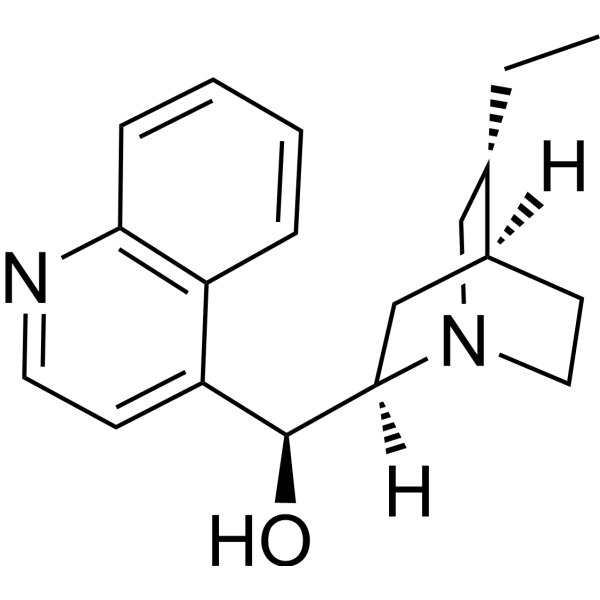
Hydrocinchonine (Dihydrocinchonine) is a multidrug resistance (MDR)-reversal agent. Hydrocinchonine directly inhibits the function and expression of P-gp, which is the mechanism by which it reverses MDR. Hydrocinchonine exerts synergistic apoptotic effect with Paclitaxel (HY-B0015) in MES-SA/DX5 cells. Hydrocinchonine can be used for the study of gynecological malignant tumors (such as uterine sarcoma) with drug resistance caused by excessive expression of P-gp.
For research use only. We do not sell to patients.
- Purity : 98.33%
- CAS No.: 485-65-4
- Formula: C19H24N2O
- Molecular Weight:296.41
-
Storage:Powder -20°C, 3 years , 4°C, 2 years ; In solvent -80°C, 6 months , -20°C, 1 month

To place orders, for customer services and technical support, please contact: MedChemExpress USA
Tel: 609-228-6898 E-mail: [email protected] [email protected]


-
 Biological Activity
-
Chemical Information
-
Solvent & Solubility
- Protocols
- Purity & Documentation
- References
-
 Help & FAQs


-
HY-B0997
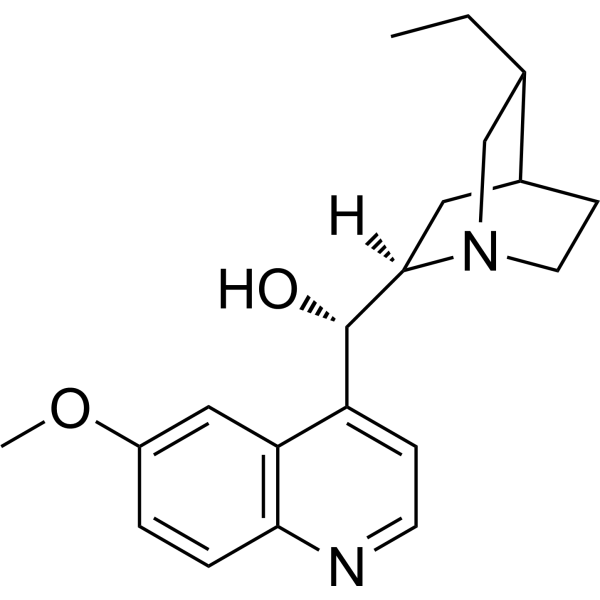
HydroquinidineAntiarrhythmic Agent -

HY-W035709R
Hydrocinchonine (Standard)Standard of Hydrocinchonine -

HY-W002502
(DHQ)2PHALBiochemical Assay Reagent -

HY-W008033
(DHQD)2PHALDihydroxylation Reaction -

HY-B0997R
Hydroquinidine (Standard)Antiarrhythmic Agent -

HY-W007880
(R)-D2PMPyrrolidine Analog


Biological Activity
Description
In Vitro
Hydrocinchonine (10 μM, 24 h) potentiates Paclitaxel (TAX)-induced cytotoxicity in P-gp expressing MES-SA (IC50 = 18.59 nM)/DX5 (IC50 = 632.64 nM) cells and shows no significant toxicity to either of the two cell lines at 100 μM[1].
Hydrocinchonine (10 μM, 24 h) effectively makes drug-resistant cancer cells regain sensitivity to apoptosis induced by TAX, leading to a large number of cell deaths in MES-SA/DX5 cells[1].
Hydrocinchonine (10 μM, 1 h) effectively inhibits the function of P-gp, preventing it from pumping the substrate out of the cell, thereby allowing the drugs to accumulate within the MES-SA/DX5 cells[1].
MedChemExpress (MCE) has not independently confirmed the accuracy of these methods. They are for reference only. Further protocols information, click here.
-
Cell Line:MES-SA and MES-DX5 cells
-
Concentration:10 μM
-
Incubation Time:24 h
-
Result:Significantly increased the proportion of Sub-G1 cells with TAX.
Activated Caspase-3 and induced PARP cleavage with combined treatment.
-
Cell Line:MES-SA and MES-DX5 cells
-
Concentration:10 μM
-
Incubation Time:1 h
-
Result:Treated cells exhibited intense green fluorescence, indicating a potent inhibition of P-gp function.
-
Cell Line:MES-SA and MES-DX5 cells
-
Concentration:10 μM
-
Incubation Time:24 h
-
Result:Downregulated the protein expression level of P-gp.


Chemical Information
-
CAS No. 485-65-4
-
Appearance Solid
-
Molecular Weight 296.41
-
Formula C19H24N2O
-
Color White to off-white
-
SMILES
O[C@@H](C1=CC=NC2=C1C=CC=C2)[C@]3([H])[N@@](CC4)C[C@H](CC)[C@]4([H])C3
-
Synonyms
Dihydrocinchonine
-
Structure Classification
-
Initial Source
-
Shipping
Room temperature in continental US; may vary elsewhere.
-
Storage
Powder -20°C 3 years 4°C 2 years In solvent -80°C 6 months -20°C 1 month


Solvent & Solubility
In Vitro:
Ethanol : 4 mg/mL (13.49 mM; ultrasonic and warming and heat to 60°C)
Please refer to the solubility information to select the appropriate solvent. Once prepared, please aliquot and store the solution to prevent product inactivation from repeated freeze-thaw cycles.
Storage method and period of stock solution: -80°C, 6 months; -20°C, 1 month. When stored at -80°C, please use it within 6 months. When stored at -20°C, please use it within 1 month.
Please refer to the solubility information to select the appropriate solvent. Once prepared, please aliquot and store the solution to prevent product inactivation from repeated freeze-thaw cycles.
Storage method and period of stock solution: -80°C, 6 months; -20°C, 1 month. When stored at -80°C, please use it within 6 months. When stored at -20°C, please use it within 1 month.
Concentration (start) × Volume (start) = Concentration (final) × Volume (final)

Protocols
-
RNA extraction experimental
By lysing cells, releasing RNA, and removing impurities such as proteins and DNA, high-purity RNA products are finally obtained. The commonly used traditional method is the guanidine isothiocyanate/phenol/chloroform method (Trizol), which is suitable for a variety of animal materials including animal tissues, microorganisms, cultured cells, etc., and most plant materials.
-
Apoptosis
Apoptosis, also called programmed cell death, is generally characterized by distinct morphological characteristics.
-
Apoptosis Solutions
Apoptosis is a regulated, generally non-lytic cell-death pathway that removes unwanted, damaged, infected, or abnormal cells through coordinated morphological changes, caspase activation, DNA fragmentation, and membrane remodeling. The intrinsic apoptosis pathway is controlled mainly by mitochondrial outer membrane permeabilization, BCL-2 family proteins, cytochrome c release, apoptosome formation, caspase-9 activation, and downstream executioner caspase-3/7 activation. The extrinsic apoptosis pathway is initiated by death receptors such as Fas, TNFR, and TRAIL receptors, which recruit adaptor proteins and activate caspase-8 before engaging executioner caspases or mitochondrial amplification through BID cleavage. Apoptosis is linked to many phenotypes, including cancer cell killing, tissue homeostasis, immune regulation, neurodegeneration, infection response, and treatment-induced cytotoxicity; unresolved questions include how apoptosis interacts with necroptosis, pyroptosis, ferroptos


Purity & Documentation
-
Data Sheet (282 KB)
-
SDS (392 KB)
- English - EN (392 KB)
- Français - FR (392 KB)
- Deutsch - DE (392 KB)
- Norwegian - NO (392 KB)
- Español - ES (392 KB)
- Swedish - SV (392 KB)
- Italian - IT (392 KB)
- Korean - KR (392 KB)
- Portuguese - PT (392 KB)
-
Handling Instructions (2659 KB)
References


Complete Stock Solution Preparation Table
Please refer to the solubility information to select the appropriate solvent. Once prepared, please aliquot and store the solution to prevent product inactivation from repeated freeze-thaw cycles.
Storage method and period of stock solution: -80°C, 6 months; -20°C, 1 month. When stored at -80°C, please use it within 6 months. When stored at -20°C, please use it within 1 month.
| Optional Solvent | Concentration Solvent Mass | 1 mg | 5 mg | 10 mg | 25 mg |
|---|---|---|---|---|---|
| Ethanol | 1 mM | 3.3737 mL | 16.8685 mL | 33.7371 mL | 84.3426 mL |
| 5 mM | 0.6747 mL | 3.3737 mL | 6.7474 mL | 16.8685 mL | |
| 10 mM | 0.3374 mL | 1.6869 mL | 3.3737 mL | 8.4343 mL |


Hydrocinchonine Related Classifications
HY-W035709 Related Classifications
 Powered by Bioz