



iNOs-IN-1
Based on 1 publication(s) in Google Scholar
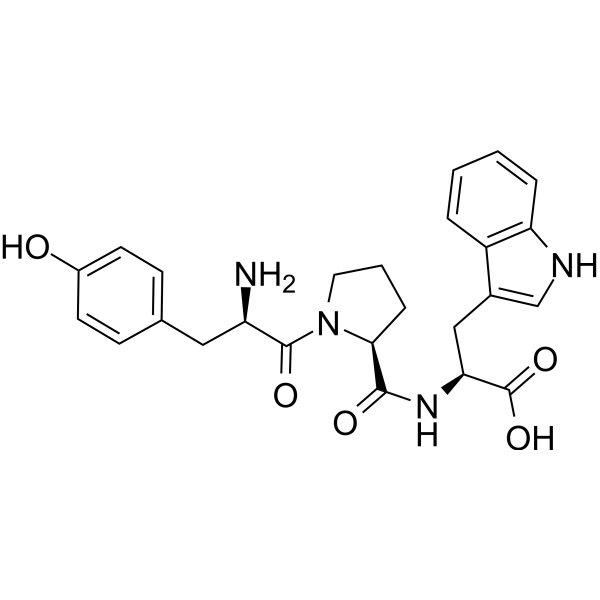
iNOs-IN-1 (YPW) is a potent inducible nitric oxide synthase (iNOS) inhibitor. iNOs-IN-1 can significantly inhibit the expression of IL-6 and iNOS, as well as reduce LPS-induced NO generation with dose-dependent manner in mouse macrophages. Anti-inflammatory effects.
For research use only. We do not sell to patients.
- Purity : 98.07%
- Formula: C25H28N4O5
- Molecular Weight:464.51
-
Storage:
-20°C, protect from light
* In solvent : -80°C, 6 months; -20°C, 1 month (protect from light)

To place orders, for customer services and technical support, please contact: MedChemExpress USA
Tel: 609-228-6898 E-mail: [email protected] [email protected]


-
 Biological Activity
-
Chemical Information
-
Solvent & Solubility
- Protocols
- Purity & Documentation
- References
-
 Help & FAQs


Publications Citing Use of MedChemExpress (MCE) iNOs-IN-1
More

Biological Activity
Description
IC50 & Target
|
iNOS |
IL-6 |
In Vitro
iNOs-IN-1 (YPW) (12.5, 25 and 50 µM; 2 hours) can significantly reduce NO production in LPS-treated RAW 264.7 cells[1].
iNOs-IN-1 (12.5, 25 and 50 µM; 2 hours) inhibits IL-6 production and iNOS protein expression in LPS-treated RAW 264.7 mouse macrophages[1].
MedChemExpress (MCE) has not independently confirmed the accuracy of these methods. They are for reference only. Further protocols information, click here.
-
Cell Line:RAW 264.7 mouse macrophages[1]
-
Concentration:12.5, 25 and 50 µM
-
Incubation Time:2 hours
-
Result:Had a significant inhibitory effect on LPS-induced iNOS expression at 50 μM (p<0.01).


Chemical Information
-
Appearance Solid
-
Molecular Weight 464.51
-
Formula C25H28N4O5
-
Color White to off-white
-
SMILES
N[C@@H](C(N1CCC[C@H]1C(N[C@H](C(O)=O)CC2=CNC3=C2C=CC=C3)=O)=O)CC4=CC=C(C=C4)O
-
Shipping
Room temperature in continental US; may vary elsewhere.
-
Storage
-20°C, protect from light
* In solvent : -80°C, 6 months; -20°C, 1 month (protect from light)


Publications (1)
-
Journal Impact Factor
-
Most Recent
-
J Hazard Mater
1,2-bis(2,4,6-tribromophenoxy) ethane, a novel brominated flame retardant, disrupts intestinal barrier function via the IRX3/NOS2 axis in rat small intestine. [Abstract]2024 Jan 5:461:132597. PMID: 37804762


Solvent & Solubility
In Vitro:
DMSO : 50 mg/mL (107.64 mM; Need ultrasonic; Hygroscopic DMSO has a significant impact on the solubility of product, please use newly opened DMSO)
H2O : 50 mg/mL (107.64 mM; Need ultrasonic)
Please refer to the solubility information to select the appropriate solvent. Once prepared, please aliquot and store the solution to prevent product inactivation from repeated freeze-thaw cycles.
Storage method and period of stock solution: -80°C, 6 months; -20°C, 1 month (protect from light). When stored at -80°C, please use it within 6 months. When stored at -20°C, please use it within 1 month.
* Note: If you choose water as the stock solution, please dilute it to the working solution, then filter and sterilize it with a 0.22 μm filter before use.
Please refer to the solubility information to select the appropriate solvent. Once prepared, please aliquot and store the solution to prevent product inactivation from repeated freeze-thaw cycles.
Storage method and period of stock solution: -80°C, 6 months; -20°C, 1 month (protect from light). When stored at -80°C, please use it within 6 months. When stored at -20°C, please use it within 1 month.
* Note: If you choose water as the stock solution, please dilute it to the working solution, then filter and sterilize it with a 0.22 μm filter before use.
Concentration (start) × Volume (start) = Concentration (final) × Volume (final)

Protocols
-
RNA extraction experimental
By lysing cells, releasing RNA, and removing impurities such as proteins and DNA, high-purity RNA products are finally obtained. The commonly used traditional method is the guanidine isothiocyanate/phenol/chloroform method (Trizol), which is suitable for a variety of animal materials including animal tissues, microorganisms, cultured cells, etc., and most plant materials.
-
Research Protocol for Inflammation-related Diseases
The NLRP3 inflammasome is a cytosolic innate immune signaling platform that integrates priming signals and danger-signal activation to promote caspase-1 activation, maturation of IL-1β and IL-18, and gasdermin D-mediated pyroptotic cell death. The core experimental logic is to determine whether inflammatory disease phenotypes are driven by increased NLRP3 expression, ASC-containing inflammasome assembly, caspase-1 cleavage, GSDMD cleavage, and extracellular release of IL-1β/IL-18 rather than by nonspecific cell injury alone. The pathway is strongly linked to inflammation-related disease phenotypes because monosodium urate crystals activate NALP3/NLRP3 inflammasome signaling in gout-like crystal inflammation, cholesterol crystals activate NLRP3 inflammasomes in atherogenesis models, and DSS-induced intestinal inflammation has been reported to involve NLRP3 inflammasome activity. However, experimental colitis studies also show context-dependent protective effects of NLRP3 inflammasome co


Purity & Documentation
-
Data Sheet (276 KB)
-
SDS (251 KB)
- English - EN (251 KB)
- Français - FR (251 KB)
- Deutsch - DE (251 KB)
- Norwegian - NO (251 KB)
- Español - ES (251 KB)
- Swedish - SV (251 KB)
- Italian - IT (251 KB)
- Korean - KR (251 KB)
- Portuguese - PT (251 KB)
-
Handling Instructions (2659 KB)
References


Complete Stock Solution Preparation Table
Please refer to the solubility information to select the appropriate solvent. Once prepared, please aliquot and store the solution to prevent product inactivation from repeated freeze-thaw cycles.
Storage method and period of stock solution: -80°C, 6 months; -20°C, 1 month (protect from light). When stored at -80°C, please use it within 6 months. When stored at -20°C, please use it within 1 month.
| Optional Solvent | Concentration Solvent Mass | 1 mg | 5 mg | 10 mg | 25 mg |
|---|---|---|---|---|---|
| DMSO / H2O | 1 mM | 2.1528 mL | 10.7640 mL | 21.5281 mL | 53.8202 mL |
| 5 mM | 0.4306 mL | 2.1528 mL | 4.3056 mL | 10.7640 mL | |
| 10 mM | 0.2153 mL | 1.0764 mL | 2.1528 mL | 5.3820 mL | |
| 15 mM | 0.1435 mL | 0.7176 mL | 1.4352 mL | 3.5880 mL | |
| 20 mM | 0.1076 mL | 0.5382 mL | 1.0764 mL | 2.6910 mL | |
| 25 mM | 0.0861 mL | 0.4306 mL | 0.8611 mL | 2.1528 mL | |
| 30 mM | 0.0718 mL | 0.3588 mL | 0.7176 mL | 1.7940 mL | |
| 40 mM | 0.0538 mL | 0.2691 mL | 0.5382 mL | 1.3455 mL | |
| 50 mM | 0.0431 mL | 0.2153 mL | 0.4306 mL | 1.0764 mL | |
| 60 mM | 0.0359 mL | 0.1794 mL | 0.3588 mL | 0.8970 mL | |
| 80 mM | 0.0269 mL | 0.1346 mL | 0.2691 mL | 0.6728 mL | |
| 100 mM | 0.0215 mL | 0.1076 mL | 0.2153 mL | 0.5382 mL |
* Note: If you choose water as the stock solution, please dilute it to the working solution, then filter and sterilize it with a 0.22 μm filter before use.


iNOs-IN-1 Related Classifications
HY-145846 Related Classifications
 Powered by Bioz