



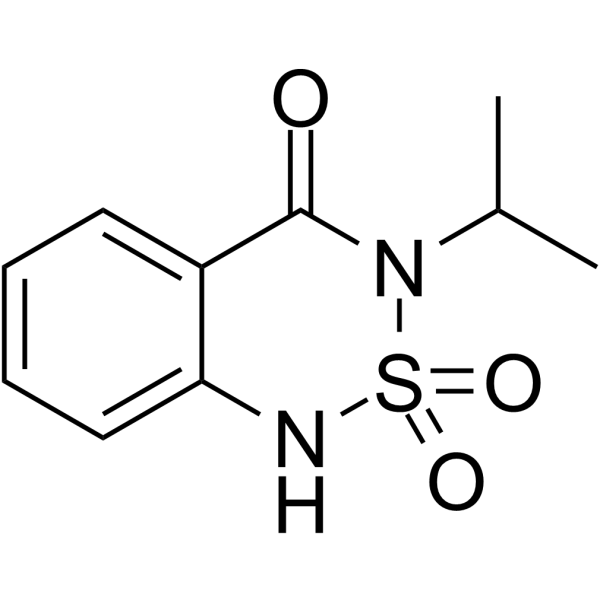
Bentazone

Based on 1 Customer Validation
Bentazone is a selective post-emergence herbicide and a Photosystem II inhibitor targeting the quinone B binding site, with activity against broadleaf weeds. Bentazone interferes with photosynthetic electron transport, blocks sunlight-dependent energy production, and acts as a phytotoxin to induce leaf damage, growth inhibition, lipid peroxidation, and reduced chlorophyll content.
商品は「研究用試薬」です。人や動物の医療用・臨床診断用・食品用の製品ではありません。
研究用途以外に使用した場合、当社は一切の責任を負いかねます。
- 純度 : 99.84%
- CAS 番号: 25057-89-0
- 分子式: C10H12N2O3S
- 分子量:240.28
-
保管条件:Powder -20°C, 3 years ; In solvent -80°C, 6 months , -20°C, 1 month

To place orders, for customer services and technical support, please contact: MedChemExpress USA
Tel: 609-228-6898 E-mail: [email protected] [email protected]


-
 生物活性
生物活性
-
化学情報
-
溶剤 & 溶解度
- プロトコル
- 純度とドキュメンテーション
- 参考文献
-
 Help & FAQs




生物活性
製品説明
体外実験
Bentazone (0.8 mg/L; 6 days) alters global gene expression in three-leaf stage japonica rice seedlings, with more DEGs in roots than shoots, and upregulates genes involved in oxidative stress response, xenobiotic metabolism, and detoxification pathways[3].
Bentazone (0-1.0 mg/L; 2-6 days) impairs growth, membrane integrity, chlorophyll synthesis, and photosynthetic function in three-leaf stage japonica rice seedlings in a concentration- and time-dependent manner, with the strongest inhibitory effects observed at 1.0 mg/L for 6 days[3].
Bentazone (0-1.0 mg/L; 2-6 days) accumulates in three-leaf stage japonica rice seedlings in a concentration- and time-dependent manner, with higher accumulation in roots than shoots, limited translocation to shoots, and decreasing bioconcentration at higher exposure concentrations[3].
Bentazone (0.8 mg/L; 6 days) is metabolized in three-leaf stage japonica rice seedlings via phase I reactions (hydroxylation, hydrolysis, demethylation) and phase II reactions (acetylation, glycosylation, amino acid conjugation), producing seven distinct metabolites and fourteen distinct conjugates[3].
MedChemExpress (MCE) has not independently confirmed the accuracy of these methods. They are for reference only.


化学情報
-
CAS 番号 25057-89-0
-
性状 Solid
-
分子量 240.28
-
分子式 C10H12N2O3S
-
Color White to off-white
-
SMILES
O=C1N(C(C)C)S(NC2=CC=CC=C12)(=O)=O
-
輸送条件
Room temperature in continental US; may vary elsewhere.
-
保管条件
Powder -20°C 3 years In solvent -80°C 6 months -20°C 1 month


溶剤 & 溶解度
体外:
DMSO : 100 mg/mL (416.18 mM; Need ultrasonic; Hygroscopic DMSO has a significant impact on the solubility of product, please use newly opened DMSO)
Please refer to the solubility information to select the appropriate solvent. Once prepared, please aliquot and store the solution to prevent product inactivation from repeated freeze-thaw cycles.
Storage method and period of stock solution: -80°C, 6 months; -20°C, 1 month. When stored at -80°C, please use it within 6 months. When stored at -20°C, please use it within 1 month.
Please refer to the solubility information to select the appropriate solvent. Once prepared, please aliquot and store the solution to prevent product inactivation from repeated freeze-thaw cycles.
Storage method and period of stock solution: -80°C, 6 months; -20°C, 1 month. When stored at -80°C, please use it within 6 months. When stored at -20°C, please use it within 1 month.
濃度 (開始) × 体積 (開始) = 濃度 (終了) × 体積 (終了)


純度とドキュメンテーション
-
データシート (291 KB)
-
SDS (558 KB)
- English - EN (558 KB)
- Français - FR (558 KB)
- Deutsch - DE (558 KB)
- Norwegian - NO (558 KB)
- Español - ES (558 KB)
- Swedish - SV (558 KB)
- Italian - IT (558 KB)
- Korean - KR (558 KB)
- Portuguese - PT (558 KB)
-
取扱説明書 (2659 KB)
参考文献
[2]. Shi L, et al. Herbicide applications increase greenhouse gas emissions of alfalfa pasture in the inland arid region of northwest China. PeerJ. 2020;8:e9231. [Content Brief]
[3]. Qiao Y, et al. Multiple Metabolism Pathways of Bentazone Potentially Regulated by Metabolic Enzymes in Rice. Journal of agricultural and food chemistry. 2023 Jul 26;71(29):11204-11216. [Content Brief]


Complete Stock Solution Preparation Table
Please refer to the solubility information to select the appropriate solvent. Once prepared, please aliquot and store the solution to prevent product inactivation from repeated freeze-thaw cycles.
Storage method and period of stock solution: -80°C, 6 months; -20°C, 1 month. When stored at -80°C, please use it within 6 months. When stored at -20°C, please use it within 1 month.
| Optional Solvent | Concentration Solvent Mass | 1 mg | 5 mg | 10 mg | 25 mg |
|---|---|---|---|---|---|
| DMSO | 1 mM | 4.1618 mL | 20.8091 mL | 41.6181 mL | 104.0453 mL |
| 5 mM | 0.8324 mL | 4.1618 mL | 8.3236 mL | 20.8091 mL | |
| 10 mM | 0.4162 mL | 2.0809 mL | 4.1618 mL | 10.4045 mL | |
| 15 mM | 0.2775 mL | 1.3873 mL | 2.7745 mL | 6.9364 mL | |
| 20 mM | 0.2081 mL | 1.0405 mL | 2.0809 mL | 5.2023 mL | |
| 25 mM | 0.1665 mL | 0.8324 mL | 1.6647 mL | 4.1618 mL | |
| 30 mM | 0.1387 mL | 0.6936 mL | 1.3873 mL | 3.4682 mL | |
| 40 mM | 0.1040 mL | 0.5202 mL | 1.0405 mL | 2.6011 mL | |
| 50 mM | 0.0832 mL | 0.4162 mL | 0.8324 mL | 2.0809 mL | |
| 60 mM | 0.0694 mL | 0.3468 mL | 0.6936 mL | 1.7341 mL | |
| 80 mM | 0.0520 mL | 0.2601 mL | 0.5202 mL | 1.3006 mL | |
| 100 mM | 0.0416 mL | 0.2081 mL | 0.4162 mL | 1.0405 mL |


Bentazone 関連分類
HY-B2039 関連分類
 Powered by Bioz