



Deacylketoconazole

Based on 1 Customer Validation
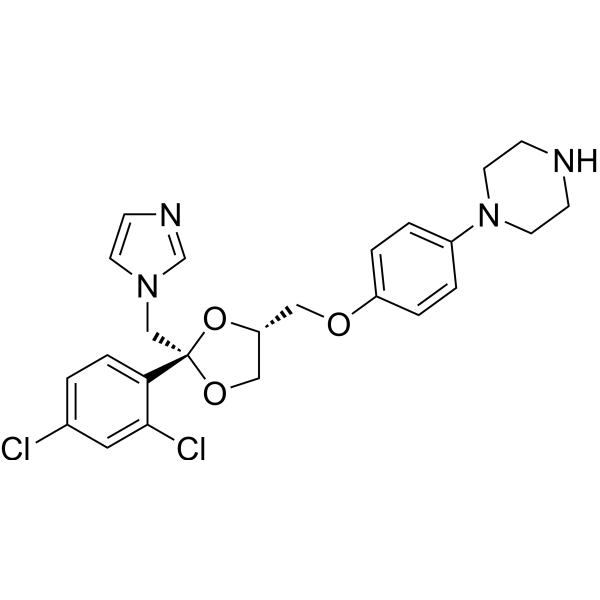
Deacylketoconazole (N-Deacetylketoconazole; R-39519) is an orally active metabolite of Ketoconazole (HY-B0105). Deacylketoconazole exhibits antifungal and antibacterial activity. Deacylketoconazole is cytotoxic in rats hepatocyte.
商品は「研究用試薬」です。人や動物の医療用・臨床診断用・食品用の製品ではありません。
研究用途以外に使用した場合、当社は一切の責任を負いかねます。
- 純度 : 99.60%
- CAS 番号: 67914-61-8
- 分子式: C24H26Cl2N4O3
- 分子量:489.39
-
保管条件:Powder -20°C, 3 years , 4°C, 2 years ; In solvent -80°C, 6 months , -20°C, 1 month

To place orders, for customer services and technical support, please contact: MedChemExpress USA
Tel: 609-228-6898 E-mail: [email protected] [email protected]


-
 生物活性
生物活性
-
化学情報
-
溶剤 & 溶解度
- プロトコル
- 純度とドキュメンテーション
- 参考文献
-
 Help & FAQs




生物活性
製品説明
体外実験
Deacylketoconazole exhibits antifungal and antibacterial efficacy against Staphylococcus aureus, Plasmodium falciparum, Candida albicans and Candida tropicalis with MIC50s of 25 μM, 0.4 μg/mL, 31 μg/mL and 62 μg/mL, respectively[1][2].
Deacylketoconazole (0-60 μM) exhibits cytotoxicity human liver derived HepaRG cells in a dose-dependent manner with EC50 of 22.8 μM[3].
MedChemExpress (MCE) has not independently confirmed the accuracy of these methods. They are for reference only.
-
Cell Line:HepaRG
-
Concentration:0-60 μM
-
Incubation Time:24 h
-
Result:Exhibited cytotoxicity in a dose-dependent manner.


化学情報
-
CAS 番号 67914-61-8
-
性状 Solid
-
分子量 489.39
-
分子式 C24H26Cl2N4O3
-
Color White to off-white
-
SMILES
ClC1=CC=C(C(Cl)=C1)[C@@]2(OC[C@H](O2)COC3=CC=C(C=C3)N4CCNCC4)CN5C=CN=C5
-
別名
N-Deacetylketoconazole; R-39519
-
輸送条件
Room temperature in continental US; may vary elsewhere.
-
保管条件
Powder -20°C 3 years 4°C 2 years In solvent -80°C 6 months -20°C 1 month


溶剤 & 溶解度
体外:
DMSO : 2.5 mg/mL (5.11 mM; ultrasonic and warming and heat to 60°C; Hygroscopic DMSO has a significant impact on the solubility of product, please use newly opened DMSO)
Please refer to the solubility information to select the appropriate solvent. Once prepared, please aliquot and store the solution to prevent product inactivation from repeated freeze-thaw cycles.
Storage method and period of stock solution: -80°C, 6 months; -20°C, 1 month. When stored at -80°C, please use it within 6 months. When stored at -20°C, please use it within 1 month.
Please refer to the solubility information to select the appropriate solvent. Once prepared, please aliquot and store the solution to prevent product inactivation from repeated freeze-thaw cycles.
Storage method and period of stock solution: -80°C, 6 months; -20°C, 1 month. When stored at -80°C, please use it within 6 months. When stored at -20°C, please use it within 1 month.
濃度 (開始) × 体積 (開始) = 濃度 (終了) × 体積 (終了)


純度とドキュメンテーション
-
データシート (273 KB)
-
SDS (393 KB)
- English - EN (393 KB)
- Français - FR (393 KB)
- Deutsch - DE (393 KB)
- Norwegian - NO (393 KB)
- Español - ES (393 KB)
- Swedish - SV (393 KB)
- Italian - IT (393 KB)
- Korean - KR (393 KB)
- Portuguese - PT (393 KB)
-
取扱説明書 (2659 KB)
参考文献
[1]. Pfaller MA, et al., Activity of ketoconazole and its deacyl derivative against Plasmodium falciparum and Candida isolates. Antimicrob Agents Chemother. 1982 Nov;22(5):917-9. [Content Brief]
[3]. Fukami T, et al., Human arylacetamide deacetylase hydrolyzes ketoconazole to trigger hepatocellular toxicity. Biochem Pharmacol. 2016 Sep 15;116:153-61. [Content Brief]


Complete Stock Solution Preparation Table
Please refer to the solubility information to select the appropriate solvent. Once prepared, please aliquot and store the solution to prevent product inactivation from repeated freeze-thaw cycles.
Storage method and period of stock solution: -80°C, 6 months; -20°C, 1 month. When stored at -80°C, please use it within 6 months. When stored at -20°C, please use it within 1 month.
| Optional Solvent | Concentration Solvent Mass | 1 mg | 5 mg | 10 mg | 25 mg |
|---|---|---|---|---|---|
| DMSO | 1 mM | 2.0434 mL | 10.2168 mL | 20.4336 mL | 51.0840 mL |
| 5 mM | 0.4087 mL | 2.0434 mL | 4.0867 mL | 10.2168 mL |


Deacylketoconazole 関連分類
HY-129315 関連分類
 Powered by Bioz