



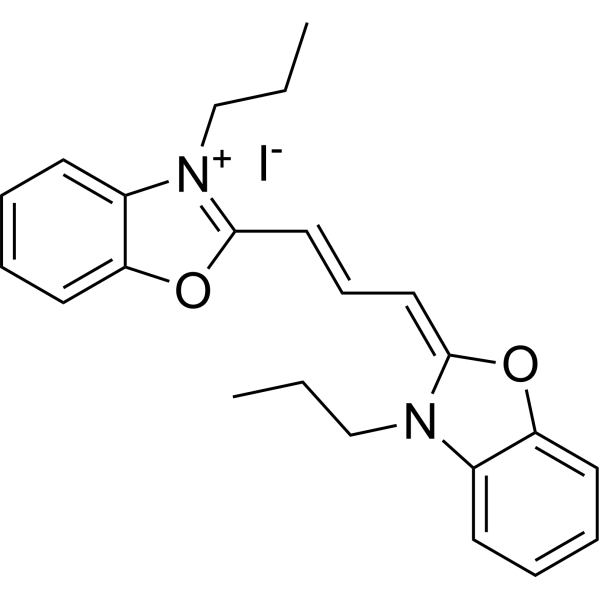
DiOC3(3)
DiOC3(3) (3,3'-Dipropyloxacarbocyanine iodide) is a green fluorescent lipophilic dye with cell membrane permeability. DiOC3(3) can be used to stain cell membranes and other lipid-soluble biological structures.
商品は「研究用試薬」です。人や動物の医療用・臨床診断用・食品用の製品ではありません。
研究用途以外に使用した場合、当社は一切の責任を負いかねます。
- CAS 番号: 53213-79-9
- 分子式: C23H25IN2O2
- 分子量:488.36
-
保管条件:
Please store the product under the recommended conditions in the Certificate of Analysis.

To place orders, for customer services and technical support, please contact: MedChemExpress USA
Tel: 609-228-6898 E-mail: [email protected] [email protected]


-
 生物活性
生物活性
-
化学情報
- プロトコル
- 純度とドキュメンテーション
- 参考文献
-
 Help & FAQs




生物活性
製品説明
体外実験
DiOC3(3) is effluxed to a marked degree relative to the DiOC5-7(3) in the KB85 cells[1].
MedChemExpress (MCE) has not independently confirmed the accuracy of these methods. They are for reference only. Further protocols information, click here.
Emission (Em)
525
Excitation (Ex)
495


化学情報
-
CAS 番号 53213-79-9
-
分子量 488.36
-
分子式 C23H25IN2O2
-
SMILES
CCCN1/C(OC2=CC=CC=C12)=C\C=C\C3=[N+](CCC)C4=CC=CC=C4O3.[I-]
-
別名
3,3'-Dipropyloxacarbocyanine iodide
-
輸送条件
Room temperature in continental US; may vary elsewhere.
-
保管条件
Please store the product under the recommended conditions in the Certificate of Analysis.

プロトコル
-
Transepithelial/transendothelial electrical resistance assay
TEER measures electrical resistance across epithelial or endothelial monolayers cultured on permeable supports, and the readout reflects ionic conductance through the cell barrier, especially the paracellular pathway regulated by junctional integrity. TEER can be measured without destroying the monolayer and is commonly used before or during transport, permeability, barrier-disruption, and barrier-maturation experiments. TEER values are influenced by biological maturation and technical conditions; reported factors include temperature, medium formulation, passage number, electrode geometry, membrane properties, and junctional length during early monolayer maturation. Therefore, TEER should be interpreted with blank-insert subtraction, area normalization, repeated readings, and, when possible, orthogonal barrier readouts such as FITC-dextran flux or tight-junction staining.


純度とドキュメンテーション
参考文献
[1]. Wadkins RM, et al. Kinetics of transport of dialkyloxacarbocyanines in multidrug-resistant cell lines overexpressing P-glycoprotein: interrelationship of dye alkyl chain length, cellular flux, and drug resistance. Biochemistry. 1995 Mar 21;34(11):3858-72. [Content Brief]
[2]. Kawabe Y, et al. Effects of DNA on the optical properties of cyanine dyes. Proc SPIE. 2010.

Calculators
濃度 (開始) × 体積 (開始) = 濃度 (終了) × 体積 (終了)


DiOC3(3) 関連分類
HY-D1074 関連分類
 Powered by Bioz