



Icopezil
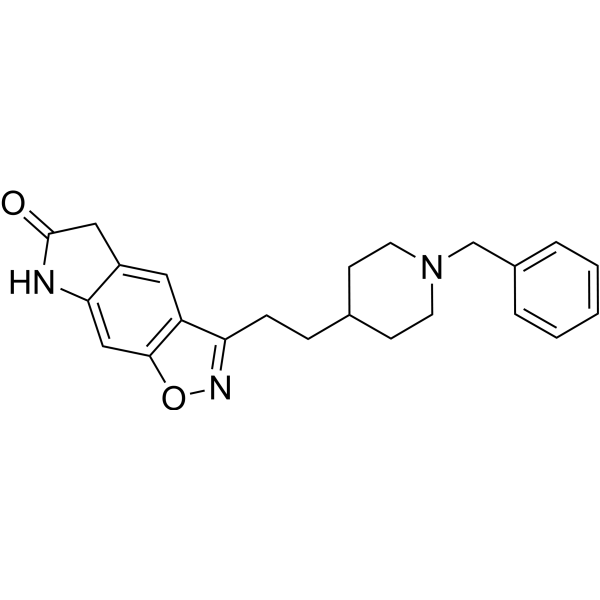
Icopezil (CP-118954) is an orally active, selective AchE inhibitor with an IC50 of 0.33 nM. Icopezil increases acetylcholine levels in the brain and striatum of mammals, induces centrally mediated tremors and peripherally mediated salivation, and improves working memory performance in aged dogs. Icopezil serves as a parent compound for radioiodine-labeled acetylcholinesterase imaging agents. Icopezil is applicable to research related to Alzheimer's disease.
商品は「研究用試薬」です。人や動物の医療用・臨床診断用・食品用の製品ではありません。
研究用途以外に使用した場合、当社は一切の責任を負いかねます。
- CAS 番号: 145508-78-7
- 分子式: C23H25N3O2
- 分子量:375.46
-
保管条件:
Please store the product under the recommended conditions in the Certificate of Analysis.

To place orders, for customer services and technical support, please contact: MedChemExpress USA
Tel: 609-228-6898 E-mail: [email protected] [email protected]


-
 生物活性
生物活性
-
化学情報
- プロトコル
- 純度とドキュメンテーション
- 参考文献
-
 Help & FAQs


Radionuclide-Drug Conjugates (RDCs) アイソフォーム固有の製品をすべて表示
More

生物活性
製品説明
IC50 & Target
|
AChE 0.33 nM (IC50) |
BChE 7200 nM (IC50) |
体外実験
Icopezil (15 min) potently and selectively inhibits acetylcholinesterase in vitro (IC50 = 0.33 nM), with an inhibitory activity far stronger than that against human butyrylcholinesterase (IC50 = 7200 nM)[1].
Icopezil exhibits no significant in vitro activity against a variety of central nervous system-related receptors and enzymes (IC50 > 1 μM)[1].
Icopezil is a sub-nanomolar acetylcholinesterase (AChE) inhibitor with over 10000-fold selectivity for butyrylcholinesterase (BChE)[3].
Icopezil potently inhibits erythrocyte acetylcholinesterase, with an IC50 of 0.33 nM, and exhibits much higher selectivity for AChE than for BuChE[4].
MedChemExpress (MCE) has not independently confirmed the accuracy of these methods. They are for reference only.
体内実験
Co-administration of Icopezil (1-10 mg/kg; p.o.) with iso-OMPA (HY-131922) enhances its peripheral salivary secretion response and acute lethality in mice[1].
Icopezil (0.02-0.12 mg/kg; p.o.) exerts only mild, statistically insignificant cognitive-enhancing effects in aged male Beagle dogs[2].
MedChemExpress (MCE) has not independently confirmed the accuracy of these methods. They are for reference only.
-
Animal Model:CD mice (male, 20-25 g)[1]
-
Dosage:0.32 mg/kg; 1 mg/kg; 3.2 mg/kg; 10 mg/kg; 32 mg/kg
-
Administration:p.o.
-
Result:Increased mouse brain acetylcholine levels in a dose-dependent manner, reaching 200% of control values at the 32 mg/kg dose.
Induced tremors with 3-fold greater potency than it induced salivation; at the 10 mg/kg dose, tremor rating reached ~3, while salivation rating reached ~0.5, and at the 32 mg/kg dose, tremor rating reached ~3.5-4, while salivation rating reached ~3.
-
Animal Model:CD mice (male, 20-25 g)[1]
-
Dosage:1 mg/kg; 3.2 mg/kg; 10 mg/kg (after 2 mg/kg s.c. iso-OMPA)
-
Administration:p.o.
-
Result:Did not alter icopezil-induced increases in brain acetylcholine levels or icopezil-induced tremor ratings.
Potentiated icopezil-induced salivation: at 10 mg/kg icopezil, salivation rating increased from ~0.5 (icopezil alone) to ~2.5 (icopezil + iso-OMPA).
Increased the acute lethality of icopezil: at 10 mg/kg icopezil, lethality reached 100% when combined with iso-OMPA, compared to 0% lethality with icopezil alone.
-
Animal Model:Beagle (aged, cognitively impaired due to natural aging)[2]
-
Dosage:0.02 mg/kg; 0.06 mg/kg; 0.12 mg/kg
-
Administration:p.o.
-
Result:Showed significant overall improvement in 2c-DNMP task performance compared to placebo run-in (F(2,12)=66.01, p<0.001).
Caused slight performance impairment during first five treatment sessions at medium and high doses, likely due to side effects.
Demonstrated greater effect on performance at the longest 110 s delay.
Showed only a small, non-significant effect on task performance in a subsequent counterbalanced within-subject control protocol.


化学情報
-
CAS 番号 145508-78-7
-
分子量 375.46
-
分子式 C23H25N3O2
-
SMILES
O=C1NC2=CC3=C(C=C2C1)C(CCC4CCN(CC4)CC5=CC=CC=C5)=NO3
-
別名
CP-118954
-
輸送条件
Room temperature in continental US; may vary elsewhere.
-
保管条件
Please store the product under the recommended conditions in the Certificate of Analysis.


純度とドキュメンテーション
参考文献
[1]. Liston DR, et al. Pharmacology of selective acetylcholinesterase inhibitors: implications for use in Alzheimer's disease. European journal of pharmacology. 2004 Feb 13;486(1):9-17. [Content Brief]
[2]. Studzinski CM, et al. The canine model of human cognitive aging and dementia: pharmacological validity of the model for assessment of human cognitive-enhancing drugs. Progress in neuro-psychopharmacology & biological psychiatry. 2005 Mar;29(3):489-98. [Content Brief]
[3]. Muñoz-Torrero D, et al. Dimeric and hybrid anti-Alzheimer drug candidates. Current medicinal chemistry. 2006;13(4):399-422. [Content Brief]
[4]. Lee I, et al. Synthesis and evaluation of radioiodine-labelled CP-118,954 for the in-vivo imaging of acetylcholinesterase. Nucl Med Commun. 2007 Jul;28(7):561-6. [Content Brief]

Calculators
濃度 (開始) × 体積 (開始) = 濃度 (終了) × 体積 (終了)


Icopezil 関連分類
HY-105157 関連分類
 Powered by Bioz