



Insulin icodec

Based on 1 Customer Validation
Insulin icodec is an Insulin (HY-P0035) analog that strongly but reversibly binds to albumin. Insulin icodec has long plasma half-life. Insulin icodec modulates insulin receptor activity, controls blood glucose levels, reduces HbA1c levels, and binds reversibly to human serum albumin. Insulin icodec can be used for the research of type 2 diabetes mellitus.
商品は「研究用試薬」です。人や動物の医療用・臨床診断用・食品用の製品ではありません。
研究用途以外に使用した場合、当社は一切の責任を負いかねます。
- 純度 : 95%
- CAS 番号: 1188379-43-2
- 分子式: C280H435N71O87S6
- 分子量:6380.26
-
保管条件:
Please store the product under the recommended conditions in the Certificate of Analysis.

To place orders, for customer services and technical support, please contact: MedChemExpress USA
Tel: 609-228-6898 E-mail: [email protected] [email protected]


-
 生物活性
生物活性
-
化学情報
- プロトコル
- 純度とドキュメンテーション
- 参考文献
-
 Help & FAQs




生物活性
製品説明
体外実験
Insulin icodec (48 h at 37°C) is stable in rat, monkey, and human plasma (retaining ≥89.76% after 48 h at 37°C) but showed reduced stability in mouse plasma (82.89% retention after 48 h at 37°C)[1].
MedChemExpress (MCE) has not independently confirmed the accuracy of these methods. They are for reference only.
Parmacokinetics
体内実験
MedChemExpress (MCE) has not independently confirmed the accuracy of these methods. They are for reference only.
-
Animal Model:BKS-db/db mice (male, 5-6 weeks old, 30-40 g, T2DM db/db model)[1]
-
Dosage:3 mg/kg; 6 mg/kg
-
Administration:s.c.; every two days; 52 days
-
Result:Showed similar blood glucose trend to TBE001-A-S033; reduced HbA1c levels by -7.96% (3 mg/kg) and -11.49% (6 mg/kg) relative to baseline.


化学情報
-
CAS 番号 1188379-43-2
-
性状 Liquid
-
分子量 6380.26
-
分子式 C280H435N71O87S6
-
Color Colorless to light yellow
-
配列
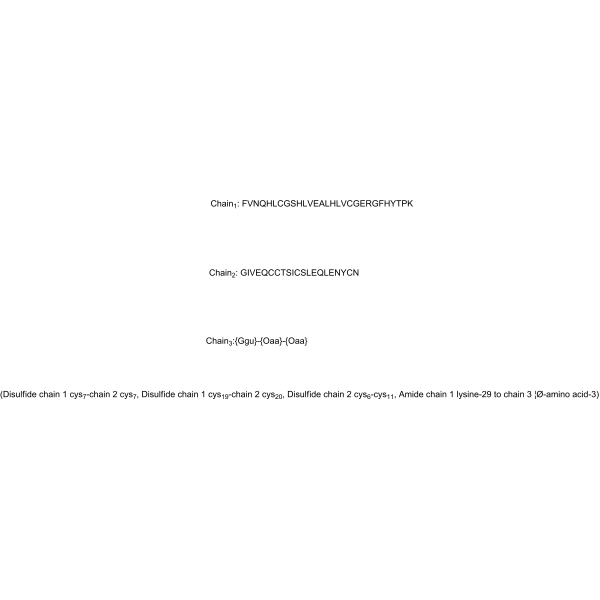
Chain1:Phe-Val-Asn-Gln-His-Leu-Cys-Gly-Ser-His-Leu-Val-Glu-Ala-Leu-His-Leu-Val-Cys-Gly-Glu-Arg-Gly-Phe-His-Tyr-Thr-Pro-{Lys(2OEG-γGlu-C20 diacid)} Chain2:Phe-Val-Asn-Gln-His-Leu-Cys-Gly-Ser-His-Leu-Val-Glu-Ala-Leu-His-Leu-Val-Cys-Gly-Glu-Arg-Gly-Phe-His-Tyr-Thr-Pro-Lys Chain3:{Ggu}-{Oaa}-{Oaa}(Disulfide:Chain1 Cys7-Chain2 Cys7, Disulfide:Chain1 Cys19-Chain2 Cys20, Disulfide:Chain 2 Cys6-Cys11, Amide bridge:Chain1 Lys29 to Chain3 ω-amino acid3)
-
シーケンスの短縮
Chain1:FVNQHLCGSHLVEALHLVCGERGFHYTP-{Lys(2OEG-γGlu-C20 diacid)}; Chain2:GIVEQCCTSICSLEQLENYCN; Chain3:{Ggu}-{Oaa}-{Oaa} (Disulfide:Chain1 Cys7-Chain2 Cys7, Disulfide:Chain1 Cys19-Chain2 Cys20, Disulfide:Chain2 Cys6-Cys11, Amide bridge:Chain1 Lys29 to Chain3 ω-amino acid3)
-
輸送条件
Room temperature in continental US; may vary elsewhere.
-
保管条件
Please store the product under the recommended conditions in the Certificate of Analysis.


純度とドキュメンテーション
-
データシート (266 KB)
-
SDS (251 KB)
- English - EN (251 KB)
- Français - FR (251 KB)
- Deutsch - DE (251 KB)
- Norwegian - NO (251 KB)
- Español - ES (251 KB)
- Swedish - SV (251 KB)
- Italian - IT (251 KB)
- Korean - KR (251 KB)
- Portuguese - PT (251 KB)
-
取扱説明書 (2659 KB)
参考文献
[1]. Yu M, et al. Design of a novel long-acting insulin analogs by acetylation modification and compared with insulin Icodec. Sci Rep. 2025;15(1):9408. Published 2025 Mar 19. [Content Brief]
[2]. Lingvay I, et al. A Randomized, Open-Label Comparison of Once-Weekly Insulin Icodec Titration Strategies Versus Once-Daily Insulin Glargine U100. Diabetes Care. 2021;44(7):1595-1603. [Content Brief]

Calculators
濃度 (開始) × 体積 (開始) = 濃度 (終了) × 体積 (終了)


Insulin icodec 関連分類
HY-P4070 関連分類
 Powered by Bioz