



Pefloxacin
Based on 3 publication(s) in Google Scholar
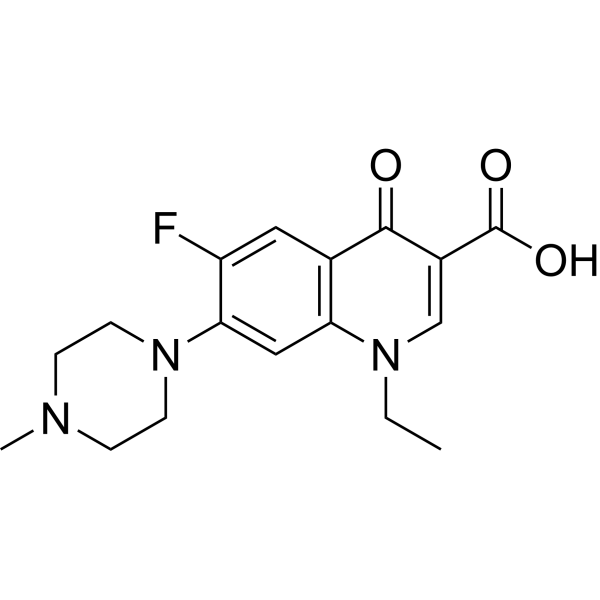
Pefloxacin (Pefloxacinium) is a broad spectrum antibiotic. Pefloxacin blocks DNA replication by inhibiting DNA gyrase. Pefloxacin inhibits DNA relaxation catalyzed by topoisomerase I with an IC50 of 45 μg/mL. Pefloxacin exhibits antibacterial activity against Escherichia coli, Pseudomonas aeruginosa, and Bacteroides fragilis with MIC90s of 0.12, 4, and 16 mg/L, respectively. Pefloxacin has anti-Plasmodium yoelii infection activity. Pefloxacin increase UVA-induced edema and immunesuppression. Pefloxacin can be used for infection studies.
商品は「研究用試薬」です。人や動物の医療用・臨床診断用・食品用の製品ではありません。
研究用途以外に使用した場合、当社は一切の責任を負いかねます。
- 純度: 99.37%
- CAS 番号: 70458-92-3
- 分子式: C17H20FN3O3
- 分子量:333.36
-
保管条件:Powder -20°C, 3 years , 4°C, 2 years ; In solvent -80°C, 6 months , -20°C, 1 month

To place orders, for customer services and technical support, please contact: MedChemExpress USA
Tel: 609-228-6898 E-mail: [email protected] [email protected]


-
 生物活性
生物活性
-
化学情報
-
溶剤 & 溶解度
- 純度とドキュメンテーション
- 参考文献
-
 Help & FAQs


MedChemExpress(MCE)の使用を引用している文献 Pefloxacin
MoreAntibiotic アイソフォーム固有の製品をすべて表示
MoreParasite アイソフォーム固有の製品をすべて表示
MoreDNA/RNA Synthesis アイソフォーム固有の製品をすべて表示
MoreTopoisomerase アイソフォーム固有の製品をすべて表示
More

生物活性
|
Topoisomerase I |
|
Cell Line

|
Type | Value | Description | References |
|---|---|---|---|---|
| Bone marrow cell | IC50 |
>50 μM
Compound: Pefloxacin
|
Antiresorptive activity against 1,25-dihydroxyvitamin D3-stimulated osteoclast formation in Swiss Webster mouse bone marrow cells assessed as reduction of tartrate-resistant acid phosphatase activity after 7 days
Antiresorptive activity against 1,25-dihydroxyvitamin D3-stimulated osteoclast formation in Swiss Webster mouse bone marrow cells assessed as reduction of tartrate-resistant acid phosphatase activity after 7 days
|
[PMID: 19630402] |
| HL-60 | IC50 |
>100 μM
Compound: Pefloxacin
|
Cytotoxicity against human HL60 cells assessed as reduction in cell viability
Cytotoxicity against human HL60 cells assessed as reduction in cell viability
|
[PMID: 30660827] |
| L1210 | IC50 |
>100 μM
Compound: Pefloxacin
|
Cytotoxicity against mouse L1210 cells assessed as reduction in cell viability
Cytotoxicity against mouse L1210 cells assessed as reduction in cell viability
|
[PMID: 30660827] |
| SMMC-7721 | IC50 |
>100 μM
Compound: Pefloxacin
|
Cytotoxicity against human SMMC7721 cells assessed as reduction in cell viability
Cytotoxicity against human SMMC7721 cells assessed as reduction in cell viability
|
[PMID: 30660827] |
| V79 | IC50 |
>500 μg/mL
Compound: 2 (Pefloxacin)
|
Mammalian cell cytotoxicity test in chinese hamster V79 cells (clonogenic cytotoxicity)
Mammalian cell cytotoxicity test in chinese hamster V79 cells (clonogenic cytotoxicity)
|
[PMID: 1469702] |
Pefloxacin inhibits 90% of strains such as Escherichia coli and Klebsiella pneumoniae at ≤0.5 mg/L, 90% of Pseudomonas aeruginosa at 4 mg/L, and 90% of the Bacteroides fragilis group at 16 mg/L[1].
Pefloxacin (0.06-64 mg/L) shows good activity against many bacteria such as staphylococci and E. coli, but poor activity against bacteria like Gardnerella vaginalis and Mobiluncus spp.[2].
Pefloxacin (5-60 μg/mL; 30 min) can inhibit the DNA relaxation reaction catalyzed by E. coli topoisomerase I, with an IC50 of 45 μg/mL[3].
MedChemExpress (MCE) has not independently confirmed the accuracy of these methods. They are for reference only.
Pefloxacin (200 mg/kg; s.c.; 2 h before and 5 h after UVA irradiation) can increase UVA-induced back skin swelling, the number of sunburn cells, reduce the number of epidermal Langerhans cells, and inhibit local contact hypersensitivity in mice[5].
Pefloxacin (up to 150 mg/kg; p.o.; daily) is ineffective against Mycobacterium tuberculosis infection in mice[6].
Pefloxacin (40-240 mg/kg; s.c.; every 8-12 h; 3 days) can significantly reduce parasitemia and increase the survival rate of Swiss albino mice infected with Plasmodium yoelii, with superior efficacy to Ciprofloxacin (HY-B0356)[7].
MedChemExpress (MCE) has not independently confirmed the accuracy of these methods. They are for reference only.
-
Animal Model:Swiss albino mice (female, NMRI line) + Plasmodium yoelii N67-infected model[7]
-
Dosage:40, 80, 160, 240 mg/kg
-
Administration:Subcutaneous injection, once every 8 h (40, 80, 160 mg/kg), once every 12 h (160, 240 mg/kg), 3 days
-
Result:Achieved a 92.8% reduction in parasitemia when given at 160 mg/kg every 8 h for 3 days, and all mice survived.
Was more active than Ciprofloxacin in reducing parasitemia and increasing the survival rate of infected mice.


化学情報
-
CAS 番号 70458-92-3
-
性状 Solid
-
分子量 333.36
-
分子式 C17H20FN3O3
-
Color White to off-white
-
SMILES
O=C(C1=CN(CC)C2=C(C=C(F)C(N3CCN(C)CC3)=C2)C1=O)O
-
別名
Pefloxacinium
-
輸送条件
Room temperature in continental US; may vary elsewhere.
-
保管条件
Powder -20°C 3 years 4°C 2 years In solvent -80°C 6 months -20°C 1 month


Publications (3)
-
Journal Impact Factor
-
Most Recent
-
Food Chem X
Machine learning prioritization of antibiotic residues in aquatic foods reveals exposure-driven genotoxic risk mediated by BCL2. [Abstract]2026 Feb 8:34:103646. PMID: 41756597 -
Xenobiotica
Human total clearance values and volumes of distribution of typical human cytochrome P450 2C9/19 substrates predicted by single-species allometric scaling using pharmacokinetic data sets from common marmosets genotyped for P450 2C19. [Abstract]2021 Apr;51(4):479-493. PMID: 33455494 -
Chemosphere
Mass-balance-model-based evaluation of sewage treatment plant contribution to residual pharmaceuticals in environmental waters. [Abstract]2019 Jun:225:378-387. PMID: 30884299


溶剤 & 溶解度
DMSO : 1 mg/mL (3.00 mM; ultrasonic and warming and heat to 60°C; Hygroscopic DMSO has a significant impact on the solubility of product, please use newly opened DMSO)
Please refer to the solubility information to select the appropriate solvent. Once prepared, please aliquot and store the solution to prevent product inactivation from repeated freeze-thaw cycles.
Storage method and period of stock solution: -80°C, 6 months; -20°C, 1 month. When stored at -80°C, please use it within 6 months. When stored at -20°C, please use it within 1 month.
Please refer to the solubility information to select the appropriate solvent. Once prepared, please aliquot and store the solution to prevent product inactivation from repeated freeze-thaw cycles.
Storage method and period of stock solution: -80°C, 6 months; -20°C, 1 month. When stored at -80°C, please use it within 6 months. When stored at -20°C, please use it within 1 month.
濃度 (開始) × 体積 (開始) = 濃度 (終了) × 体積 (終了)
Select the appropriate dissolution method based on your experimental animal and administration route.
- For the following dissolution methods, please ensure to first prepare a clear stock solution using an In Vitro approach and then sequentially add co-solvents:
- To ensure reliable experimental results, the clarified stock solution can be appropriately stored based on storage conditions. As for the working solution for In Vivo experiments, it is recommended to prepare freshly and use it on the same day.
- The percentages shown for the solvents indicate their volumetric ratio in the final prepared solution. If precipitation or phase separation occurs during preparation, heat and/or sonication can be used to aid dissolution.
Add each solvent one by one: 10% DMSO 40% PEG300 5% Tween-80 45% Saline
Solubility: 0.1 mg/mL (0.30 mM); Suspended solution; Need ultrasonic
This protocol yields a suspended solution of 0.1 mg/mL. Suspended solution can be used for oral and intraperitoneal injection.
Taking 1 mL working solution as an example, add 100 μL DMSO stock solution (1.0 mg/mL) to 400 μL PEG300, and mix evenly; then add 50 μL Tween-80 and mix evenly; then add 450 μL Saline to adjust the volume to 1 mL.
Preparation of Saline: Dissolve 0.9 g sodium chloride in ddH₂O and dilute to 100 mL to obtain a clear Saline solution.
Add each solvent one by one: 10% DMSO 90% (20% SBE-β-CD in Saline)
Solubility: ≥ 0.1 mg/mL (0.30 mM); Clear solution
This protocol yields a clear solution of ≥ 0.1 mg/mL (saturation unknown).
Taking 1 mL working solution as an example, add 100 μL DMSO stock solution (1.0 mg/mL) to 900 μL 20% SBE-β-CD in Saline, and mix evenly.
Preparation of 20% SBE-β-CD in Saline (4°C, storage for one week): 2 g SBE-β-CD powder is dissolved in 10 mL Saline, completely dissolve until clear.
Please enter the basic information of animal experiments:
-
-
-
-
Recommended: Prepare an additional quantity of animals to account for potential losses during experiments.
Please enter your animal formula composition:
-
%DMSO +
Recommended: Keep the proportion of DMSO in working solution below 2% if your animal is weak.
-
%+
-
+%Tween-80 + +
-
%Saline +
The co-solvents required include: DMSO, . All of co-solvents are available by MedChemExpress (MCE). , Tween 80. All of co-solvents are available by MedChemExpress (MCE).
Working solution concentration: 0.22 mg/mL
Method for preparing stock solution: mg drug dissolved in μL DMSO. Stock solution concentration: mg/mL.
1. Take μL DMSO stock solution;
2. Add μL .
μL , mix evenly;
3. Then add μL Tween 80, mix evenly;
4. Then add μL
Please ensure that the stock solution in the first step is dissolved to a clear state, and add co-solvents in sequence. You can use ultrasonic heating (ultrasonic cleaner, recommended frequency 20-40 kHz), vortexing, etc. to assist dissolution.


純度とドキュメンテーション
-
データシート (279 KB)
-
SDS (393 KB)
- English - EN (393 KB)
- Français - FR (393 KB)
- Deutsch - DE (393 KB)
- Norwegian - NO (393 KB)
- Español - ES (393 KB)
- Swedish - SV (393 KB)
- Italian - IT (393 KB)
- Korean - KR (393 KB)
- Portuguese - PT (393 KB)
-
取扱説明書 (2659 KB)
参考文献
[1]. Clarke AM, et al. In-vitro activity of pefloxacin compared to enoxacin, norfloxacin, gentamicin and new beta-lactams. J Antimicrob Chemother. 1985 Jan;15(1):39-44. [Content Brief]
[2]. Jones BM, et al. Activity of pefloxacin and thirteen other antimicrobial agents in vitro against isolates from hospital and genitourinary infections. J Antimicrob Chemother. 1986 Jun;17(6):739-46. [Content Brief]
[3]. Tabary X, et al. Effect of DNA gyrase inhibitors pefloxacin, five other quinolones, novobiocin, and clorobiocin on Escherichia coli topoisomerase I. Antimicrob Agents Chemother. 1987 Dec;31(12):1925-8. [Content Brief]
[4]. Fantin B, et al. Correlation between in vitro and in vivo activity of antimicrobial agents against gram-negative bacilli in a murine infection model. Antimicrob Agents Chemother. 1991 Jul;35(7):1413-22. [Content Brief]
[5]. Sun YW, et al. Pefloxacin and ciprofloxacin increase UVA-induced edema and immune suppression. Photodermatol Photoimmunol Photomed. 2001 Aug;17(4):172-7. [Content Brief]
[6]. Truffot-Pernot C, et al. Activities of pefloxacin and ofloxacin against mycobacteria: in vitro and mouse experiments. Tubercle. 1991 Mar;72(1):57-64. [Content Brief]
[7]. Salmon D, et al. Activities of pefloxacin and ciprofloxacin against experimental malaria in mice. Antimicrob Agents Chemother. 1990 Dec;34(12):2327-30. [Content Brief]
[8]. Drlica K, et al. DNA gyrase, topoisomerase IV, and the 4-quinolones. Microbiol Mol Biol Rev. 1997 Sep;61(3):377-92. [Content Brief]
[9]. Hussy P, et al. Effect of 4-quinolones and novobiocin on calf thymus DNA polymerase alpha primase complex, topoisomerases I and II, and growth of mammalian lymphoblasts. Antimicrob Agents Chemother. 1986 Jun;29(6):1073-8. [Content Brief]


Complete Stock Solution Preparation Table
Please refer to the solubility information to select the appropriate solvent. Once prepared, please aliquot and store the solution to prevent product inactivation from repeated freeze-thaw cycles.
Storage method and period of stock solution: -80°C, 6 months; -20°C, 1 month. When stored at -80°C, please use it within 6 months. When stored at -20°C, please use it within 1 month.
| Optional Solvent | Concentration Solvent Mass | 1 mg | 5 mg | 10 mg | 25 mg |
|---|---|---|---|---|---|
| DMSO | 1 mM | 2.9998 mL | 14.9988 mL | 29.9976 mL | 74.9940 mL |


Pefloxacin 関連分類
HY-B0147 関連分類
 Powered by Bioz