



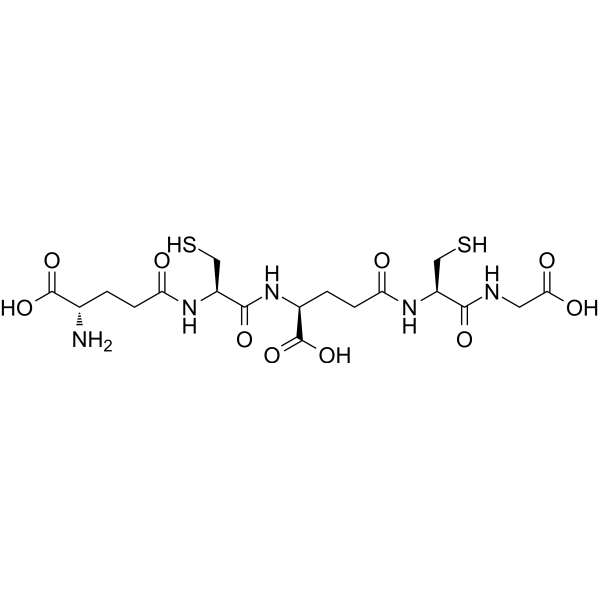
Phytochelatin 2 (PC2)
Phytochelatin 2, a short phytochelatin, is a key plant peptide binding heavy metals. Phytochelatins are a diverse set of plant compounds that chelate metals, protect against metal toxicity and function in metal homeostasis.
商品は「研究用試薬」です。人や動物の医療用・臨床診断用・食品用の製品ではありません。
研究用途以外に使用した場合、当社は一切の責任を負いかねます。
- CAS 番号: 95014-75-8
- 分子式: C18H29N5O10S2
- 分子量:539.60
-
保管条件:
Please store the product under the recommended conditions in the Certificate of Analysis.

To place orders, for customer services and technical support, please contact: MedChemExpress USA
Tel: 609-228-6898 E-mail: [email protected] [email protected]


-
 生物活性
生物活性
-
化学情報
-
溶剤 & 溶解度
- 純度とドキュメンテーション
- 参考文献
-
 Help & FAQs




生物活性
製品説明
体外実験
Phytochelatin synthase (PCS) uses the substrates glutathione (GSH, γGlu-Cys-Gly) and a cadmium (Cd)-bound GSH (Cd∙GS2) to produce the shortest phytochelatin product (PC2, (γGlu-Cys)2-Gly) through a ping-pong mechanism[3].
Phytochelatins and their glutathione (GSH) precursor are thiol-rich peptides that play an important role in heavy metal detoxification in plants and microorganisms[4].
MedChemExpress (MCE) has not independently confirmed the accuracy of these methods. They are for reference only.


化学情報
-
CAS 番号 95014-75-8
-
分子量 539.60
-
分子式 C18H29N5O10S2
-
配列
γGlu-Cys-γGlu-Cys-Gly
-
シーケンスの短縮
(γE-C)2-G
-
輸送条件
Room temperature in continental US; may vary elsewhere.
-
保管条件
Please store the product under the recommended conditions in the Certificate of Analysis.


溶剤 & 溶解度
体外
H2O
Peptide Solubility and Storage Guidelines:
1. Calculate the length of the peptide.
2. Calculate the overall charge of the entire peptide according to the following table:
| Contents | Assign value | |
|---|---|---|
| Acidic amino acid | Asp (D), Glu (E), and the C-terminal -COOH. | -1 |
| Basic amino acid | Arg (R), Lys (K), His (H), and the N-terminal -NH2 | +1 |
| Neutral amino acid | Gly (G), Ala (A), Leu (L), Ile (I), Val (V), Cys (C), Met (M), Thr (T), Ser (S), Phe (F), Tyr (Y), Trp (W), Pro (P), Asn (N), Gln (Q) | 0 |
3. Recommended solution:
| Overall charge of peptide | Details |
|---|---|
| Negative (<0) |
1. Try to dissolve the peptide in water first. 2. If water fails, add NH4OH (<50 μL). 3. If the peptide still does not dissolve, add DMSO (50-100 μL) to solubilize the peptide. |
| Positive (>0) |
1. Try to dissolve the peptide in water first. 2. If water fails, try dissolving the peptide in a 10%-30% acetic acid solution. 3. If the peptide still does not dissolve, try dissolving the peptide in a small amount of DMSO. |
| Zero (=0) |
1. Try to dissolve the peptide in organic solvent (acetonitrile, methanol, etc.) first. 2. For very hydrophobic peptides, try dissolving the peptide in a small amount of DMSO, and then dilute the solution with water to the desired concentration. |


純度とドキュメンテーション
参考文献
[1]. phytochelatin, heavy, metals, chelate, homeostasis, glutathione, microorganisms, toxicity
[2]. Dennis KK, et al. Phytochelatin database: a resource for phytochelatin complexes of nutritional and environmental metals. Database (Oxford). 2019;2019:baz083. [Content Brief]
[3]. Chia JC, et al. Tentative identification of the second substrate binding site in Arabidopsis phytochelatin synthase. PLoS One. 2013;8(12):e82675. Published 2013 Dec 5. [Content Brief]
[4]. Jacquart A, et al. Cd2+ and Pb2+ complexation by glutathione and the phytochelatins. Chem Biol Interact. 2017;267:2-10. [Content Brief]

Calculators
濃度 (開始) × 体積 (開始) = 濃度 (終了) × 体積 (終了)


Phytochelatin 2 (PC2) 関連分類
HY-P2512 関連分類
 Powered by Bioz