



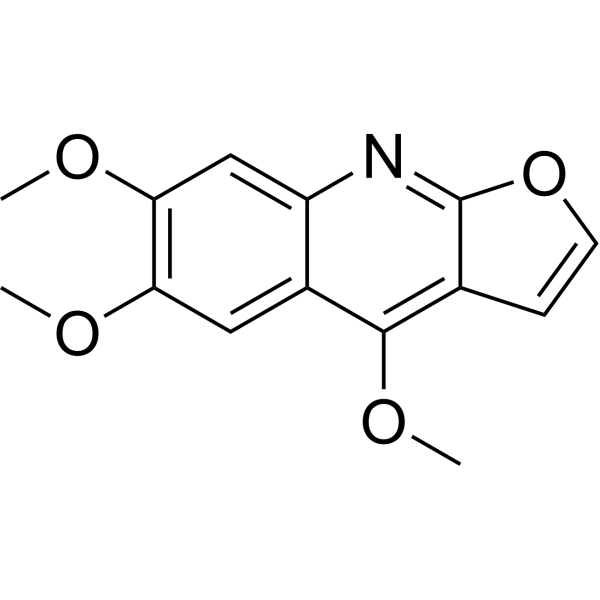
Kokusaginine

Based on 1 Customer Validation
Kokusaginine is a furoquinoline alkaloids, which exhibits inhibitory efficacy for acetylcholinesterase (AChE) with an IC50 of 28.2 μM. Kokusaginine exhibits anti-proliferative and apoptotic inducing effects in MCF-7/ADR cells.
연구목적의 판매만을 진행합니다. 환자를 대상으로 한 판매는 하지 않습니다.
- Purity : 98%
- CAS No.: 484-08-2
- 화학식: C14H13NO4
- 분자량:259.26
-
보관:
-20°C, sealed storage, away from moisture and light
* In solvent : -80°C, 6 months; -20°C, 1 month (sealed storage, away from moisture and light)

To place orders, for customer services and technical support, please contact: MedChemExpress USA
Tel: 609-228-6898 E-mail: [email protected] [email protected]


-
 Biological Activity
-
Chemical Information
- Protocol
- 순도&문서
- References
-
 Help & FAQs




Biological Activity
제품 설명
IC50 & Target
|
AChE 28.2 μM (IC50) |
Cellular Effect
|
Cell Line

|
Type | Value | Description | References |
|---|---|---|---|---|
| A2780 | IC50 |
3.5 μg/mL
Compound: 5
|
Cytotoxicity against human A2780 cells
Cytotoxicity against human A2780 cells
|
[PMID: 12713408] |
| BMDM | IC50 |
3.16 μM
Compound: AC-542/20643020
|
Inhibition of GST-tagged recombinant RANKL/M-CSF-induced osteoclastogenesis in C57BL/6 mouse bone marrow derived macrophages assessed as TRAcP enzymatic activity incubated for 5 days with subsequent replenishment of media for 2 days and measured by leucoc
Inhibition of GST-tagged recombinant RANKL/M-CSF-induced osteoclastogenesis in C57BL/6 mouse bone marrow derived macrophages assessed as TRAcP enzymatic activity incubated for 5 days with subsequent replenishment of media for 2 days and measured by leucoc
|
[PMID: 33158578] |
| MCF7 | IC50 |
7.23 μM
Compound: Kokusaginine
|
Growth inhibition of human MCF7 cells after 48 hrs by MTT assay
Growth inhibition of human MCF7 cells after 48 hrs by MTT assay
|
[PMID: 29903663] |
| MDA-MB-231 | IC50 |
9.01 μM
Compound: Kokusaginine
|
Growth inhibition of human MDA-MB-231 cells after 48 hrs by MTT assay
Growth inhibition of human MDA-MB-231 cells after 48 hrs by MTT assay
|
[PMID: 29903663] |
| N1E-115 | IC50 |
200 μM
Compound: 1a
|
Inhibition of N1E-115 cells Kv channels
Inhibition of N1E-115 cells Kv channels
|
[PMID: 11312924] |
| NCI/ADR-RES | IC50 |
4.62 μM
Compound: Kokusaginine
|
Growth inhibition of human MCF7/ADR cells after 48 hrs by MTT assay
Growth inhibition of human MCF7/ADR cells after 48 hrs by MTT assay
|
[PMID: 29903663] |
| Neutrophil | IC50 |
61.8 μM
Compound: 10
|
Immunomodulatory activity in polymorphoneutrophils assessed as inhibition of luminol-induced oxidative burst by chemiluminescence assay
Immunomodulatory activity in polymorphoneutrophils assessed as inhibition of luminol-induced oxidative burst by chemiluminescence assay
|
[PMID: 18950230] |
In Vitro
Kokusaginine (0-30 μM) inhibits proliferations of cells MCF-7, MDA-MB-231 and their multidrug resistant sublines MCF-7/ADR, MDA-MB-231/ADR, with IC50s of 7.23, 4.62, 9.01 and 10.19 μM through inhibition of tubulin polymerization[2].
Kokusaginine (6-24 μM) induces apoptosis in cells MCF-7 and MCF-7/ADR in a dose-dependent manner[2].
MedChemExpress (MCE) has not independently confirmed the accuracy of these methods. They are for reference only. Further protocols information, click here.


Chemical Information
-
CAS No. 484-08-2
-
Appearance Solid
-
분자량 259.26
-
화학식 C14H13NO4
-
Color White to off-white
-
SMILES
COC1=C(C=C2C(OC)=C3C(OC=C3)=NC2=C1)OC
-
Structure Classification
-
선적
Room temperature in continental US; may vary elsewhere.
-
보관
-20°C, sealed storage, away from moisture and light
* In solvent : -80°C, 6 months; -20°C, 1 month (sealed storage, away from moisture and light)

Protocol
-
Apoptosis
Apoptosis, also called programmed cell death, is generally characterized by distinct morphological characteristics.
-
Apoptosis Solutions
Apoptosis is a regulated, generally non-lytic cell-death pathway that removes unwanted, damaged, infected, or abnormal cells through coordinated morphological changes, caspase activation, DNA fragmentation, and membrane remodeling. The intrinsic apoptosis pathway is controlled mainly by mitochondrial outer membrane permeabilization, BCL-2 family proteins, cytochrome c release, apoptosome formation, caspase-9 activation, and downstream executioner caspase-3/7 activation. The extrinsic apoptosis pathway is initiated by death receptors such as Fas, TNFR, and TRAIL receptors, which recruit adaptor proteins and activate caspase-8 before engaging executioner caspases or mitochondrial amplification through BID cleavage. Apoptosis is linked to many phenotypes, including cancer cell killing, tissue homeostasis, immune regulation, neurodegeneration, infection response, and treatment-induced cytotoxicity; unresolved questions include how apoptosis interacts with necroptosis, pyroptosis, ferroptos
-
Cell Viability Determination by MTT Colorimetric Assay
The following protocol uses the MTT colorimetric assay as a classic literature-established method for assessing cell viability/metabolic activity in cultured mammalian cells. MTT[3-(4,5-dimethylthiazol-2-yl)-2,5-diphenyltetrazolium bromide] is reduced by metabolically active cells to a colored formazan product; the amount of formazan is quantified spectrophotometrically and provides an indirect measure of metabolically active viable cells. Importantly, MTT reduction reflects cellular oxidoreductase/metabolic activity rather than an absolute direct count of living cells, so changes in cellular metabolism can alter the signal independently of cell number.


순도&문서
-
Data Sheet (275 KB)
-
SDS (252 KB)
- English - EN (252 KB)
- Français - FR (252 KB)
- Deutsch - DE (252 KB)
- Norwegian - NO (252 KB)
- Español - ES (252 KB)
- Swedish - SV (252 KB)
- Italian - IT (252 KB)
- Korean - KR (252 KB)
- Portuguese - PT (252 KB)
-
Handling Instructions (2659 KB)
References
[1]. Sichaem J, et al., Furoquinoline Alkaloids from the Leaves of Evodia lepta as Potential Cholinesterase Inhibitors and their Molecular Docking. Nat Prod Commun. 2015 Aug;10(8):1359-62. [Content Brief]
[2]. Chen H, et al., The inhibitory effect of kokusaginine on the growth of human breast cancer cells and MDR-resistant cells is mediated by the inhibition of tubulin assembly. Bioorg Med Chem Lett. 2018 Aug 1;28(14):2490-2492. [Content Brief]

Calculators
Concentration (start) × Volume (start) = Concentration (final) × Volume (final)


Kokusaginine Related Classifications
HY-114803 Related Classifications
 Powered by Bioz