



GRA Ex-25

Based on 1 Customer Validation
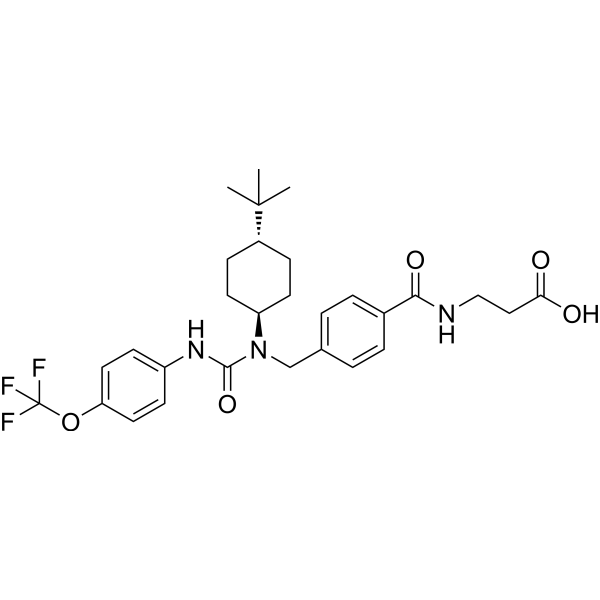
GRA Ex-25 is an inhibitor of glucagon receptor, with IC50 of 56 and 55 nM for rat and human glucagon receptors, respectively.
연구목적의 판매만을 진행합니다. 환자를 대상으로 한 판매는 하지 않습니다.
- Purity: 99.07%
- CAS No.: 307983-31-9
- 화학식: C29H36F3N3O5
- 분자량:563.61
-
보관:Powder -20°C, 3 years , 4°C, 2 years ; In solvent -80°C, 2 years , -20°C, 1 year

To place orders, for customer services and technical support, please contact: MedChemExpress USA
Tel: 609-228-6898 E-mail: [email protected] [email protected]


-
 Biological Activity
-
Chemical Information
-
용액&용해도
- Protocol
- 순도&문서
- References
-
 Help & FAQs
-

GPCR/G Protein Compound Library
HY-L006
-
Anti-diabetic Compound Library
HY-L040
-
Membrane Protein-targeted Compound Library
HY-L149
-
Membrane Receptor-targeted Compound Library
HY-L150
-
Bioactive Compound Library Max
HY-L181
-
MCE Bioactive Compound Library
HY-L001V
-
Bioactive Compound Library
HY-L001
-
Non-Alcoholic Fatty Liver Disease (NAFLD) Compound Library
HY-L199
-
High-Throughput Bioactive Compound Library
HY-L205
-
Lactylation Compound Library
HY-L249




Biological Activity
IC50: 56 nM (rat glucagon receptor), 55 nM (human glucagon receptor)[2]
|
Cell Line

|
Type | Value | Description | References |
|---|---|---|---|---|
| CHO | IC50 |
1300 nM
Compound: 1
|
Antagonist activity at human GIPR expressed in CHO cells assessed as inhibition of glucagon-induced cAMP accumulation
Antagonist activity at human GIPR expressed in CHO cells assessed as inhibition of glucagon-induced cAMP accumulation
|
[PMID: 21147532] |
| CHO | IC50 |
140 nM
Compound: 1
|
Antagonist activity at human GCGR expressed in CHO cells assessed as inhibition of glucagon-induced cAMP accumulation
Antagonist activity at human GCGR expressed in CHO cells assessed as inhibition of glucagon-induced cAMP accumulation
|
[PMID: 21147532] |
| CHO | IC50 |
21 nM
Compound: 1
|
Displacement of [125I]glucagon from human GCGR expressed in CHO cells
Displacement of [125I]glucagon from human GCGR expressed in CHO cells
|
[PMID: 21147532] |
GRA Ex-25 binds a human glucagon receptor (h-GlucRbind) with Ki of 63 nM and a moderate glucagon induced adenylate cyclase inhibition (h-GlucRcyclase) with Ki of 254 nM under our assay conditions[1]. GRA Ex-25 has similar affinity to the rat and human glucagon receptors (IC50=56 and 55 nM, respectively)[2].
MedChemExpress (MCE) has not independently confirmed the accuracy of these methods. They are for reference only.
MedChemExpress (MCE) has not independently confirmed the accuracy of these methods. They are for reference only.


Chemical Information
-
CAS No. 307983-31-9
-
Appearance Solid
-
분자량 563.61
-
화학식 C29H36F3N3O5
-
Color White to off-white
-
SMILES
O=C(O)CCNC(C1=CC=C(CN([C@H]2CC[C@H](C(C)(C)C)CC2)C(NC3=CC=C(OC(F)(F)F)C=C3)=O)C=C1)=O
-
선적
Room temperature in continental US; may vary elsewhere.
-
보관
Powder -20°C 3 years 4°C 2 years In solvent -80°C 2 years -20°C 1 year


용액&용해도
DMSO : ≥ 32 mg/mL (56.78 mM; Hygroscopic DMSO has a significant impact on the solubility of product, please use newly opened DMSO)
* "≥" means soluble, but saturation unknown.
Please refer to the solubility information to select the appropriate solvent. Once prepared, please aliquot and store the solution to prevent product inactivation from repeated freeze-thaw cycles.
Storage method and period of stock solution: -80°C, 2 years; -20°C, 1 year. When stored at -80°C, please use it within 2 years. When stored at -20°C, please use it within 1 year.
Please refer to the solubility information to select the appropriate solvent. Once prepared, please aliquot and store the solution to prevent product inactivation from repeated freeze-thaw cycles.
Storage method and period of stock solution: -80°C, 2 years; -20°C, 1 year. When stored at -80°C, please use it within 2 years. When stored at -20°C, please use it within 1 year.
Concentration (start) × Volume (start) = Concentration (final) × Volume (final)
Select the appropriate dissolution method based on your experimental animal and administration route.
- For the following dissolution methods, please ensure to first prepare a clear stock solution using an In Vitro approach and then sequentially add co-solvents:
- To ensure reliable experimental results, the clarified stock solution can be appropriately stored based on storage conditions. As for the working solution for In Vivo experiments, it is recommended to prepare freshly and use it on the same day.
- The percentages shown for the solvents indicate their volumetric ratio in the final prepared solution. If precipitation or phase separation occurs during preparation, heat and/or sonication can be used to aid dissolution.
Add each solvent one by one: 10% DMSO 40% PEG300 5% Tween-80 45% Saline
Solubility: ≥ 2.5 mg/mL (4.44 mM); Clear solution
This protocol yields a clear solution of ≥ 2.5 mg/mL (saturation unknown).
Taking 1 mL working solution as an example, add 100 μL DMSO stock solution (25.0 mg/mL) to 400 μL PEG300, and mix evenly; then add 50 μL Tween-80 and mix evenly; then add 450 μL Saline to adjust the volume to 1 mL.
Preparation of Saline: Dissolve 0.9 g sodium chloride in ddH₂O and dilute to 100 mL to obtain a clear Saline solution.
Add each solvent one by one: 10% DMSO 90% (20% SBE-β-CD in Saline)
Solubility: ≥ 2.08 mg/mL (3.69 mM); Clear solution
This protocol yields a clear solution of ≥ 2.08 mg/mL (saturation unknown).
Taking 1 mL working solution as an example, add 100 μL DMSO stock solution (20.8 mg/mL) to 900 μL 20% SBE-β-CD in Saline, and mix evenly.
Preparation of 20% SBE-β-CD in Saline (4°C, storage for one week): 2 g SBE-β-CD powder is dissolved in 10 mL Saline, completely dissolve until clear.
Please enter the basic information of animal experiments:
-
-
-
-
Recommended: Prepare an additional quantity of animals to account for potential losses during experiments.
Please enter your animal formula composition:
-
%DMSO +
Recommended: Keep the proportion of DMSO in working solution below 2% if your animal is weak.
-
%+
-
+%Tween-80 + +
-
%Saline +
The co-solvents required include: DMSO, . All of co-solvents are available by MedChemExpress (MCE). , Tween 80. All of co-solvents are available by MedChemExpress (MCE).
Working solution concentration: 0.22 mg/mL
Method for preparing stock solution: mg drug dissolved in μL DMSO. Stock solution concentration: mg/mL.
1. Take μL DMSO stock solution;
2. Add μL .
μL , mix evenly;
3. Then add μL Tween 80, mix evenly;
4. Then add μL
Please ensure that the stock solution in the first step is dissolved to a clear state, and add co-solvents in sequence. You can use ultrasonic heating (ultrasonic cleaner, recommended frequency 20-40 kHz), vortexing, etc. to assist dissolution.

Protocol
Non-fasted male Sprague Dawley rats (200 g) are maintained in the anaesthetized state during the test by s.c. administration of a 1:1 mixture of Hypnorm (fentanyl, 0.05 mg/mL and fluanizone, 2.5 mg/mL) and Dormicum (Midazolam, 1.25 mg/mL). Acatheter is inserted in a jugular vein for administration of compounds. Approximately 60 min after initiation of anesthesia, test compounds (0, 1, 3, 10 and 30 mg/kg) and glucagon (3 μg/kg) are administered in 5 min intervals, respectively. Samples for determination of blood glucose concentrations are taken from the tail tip 25 and 5 min prior to administration of the compound to represent average basal values and again 10 min after administration of glucagon (time for peak response of glucagon). The results are expressed as delta values calculated as the value obtained 10 min after alucagon administration minus the average of the two basal values.
MedChemExpress (MCE) has not independently confirmed the accuracy of these methods. They are for reference only.


순도&문서
-
Data Sheet (271 KB)
-
SDS (393 KB)
- English - EN (393 KB)
- Français - FR (393 KB)
- Deutsch - DE (393 KB)
- Norwegian - NO (393 KB)
- Español - ES (393 KB)
- Swedish - SV (393 KB)
- Italian - IT (393 KB)
- Korean - KR (393 KB)
- Portuguese - PT (393 KB)
-
Handling Instructions (2659 KB)
References


Complete Stock Solution Preparation Table
Please refer to the solubility information to select the appropriate solvent. Once prepared, please aliquot and store the solution to prevent product inactivation from repeated freeze-thaw cycles.
Storage method and period of stock solution: -80°C, 2 years; -20°C, 1 year. When stored at -80°C, please use it within 2 years. When stored at -20°C, please use it within 1 year.
| Optional Solvent | Concentration Solvent Mass | 1 mg | 5 mg | 10 mg | 25 mg |
|---|---|---|---|---|---|
| DMSO | 1 mM | 1.7743 mL | 8.8714 mL | 17.7428 mL | 44.3570 mL |
| 5 mM | 0.3549 mL | 1.7743 mL | 3.5486 mL | 8.8714 mL | |
| 10 mM | 0.1774 mL | 0.8871 mL | 1.7743 mL | 4.4357 mL | |
| 15 mM | 0.1183 mL | 0.5914 mL | 1.1829 mL | 2.9571 mL | |
| 20 mM | 0.0887 mL | 0.4436 mL | 0.8871 mL | 2.2179 mL | |
| 25 mM | 0.0710 mL | 0.3549 mL | 0.7097 mL | 1.7743 mL | |
| 30 mM | 0.0591 mL | 0.2957 mL | 0.5914 mL | 1.4786 mL | |
| 40 mM | 0.0444 mL | 0.2218 mL | 0.4436 mL | 1.1089 mL | |
| 50 mM | 0.0355 mL | 0.1774 mL | 0.3549 mL | 0.8871 mL |


GRA Ex-25 Related Classifications
HY-50675 Related Classifications
 Powered by Bioz