



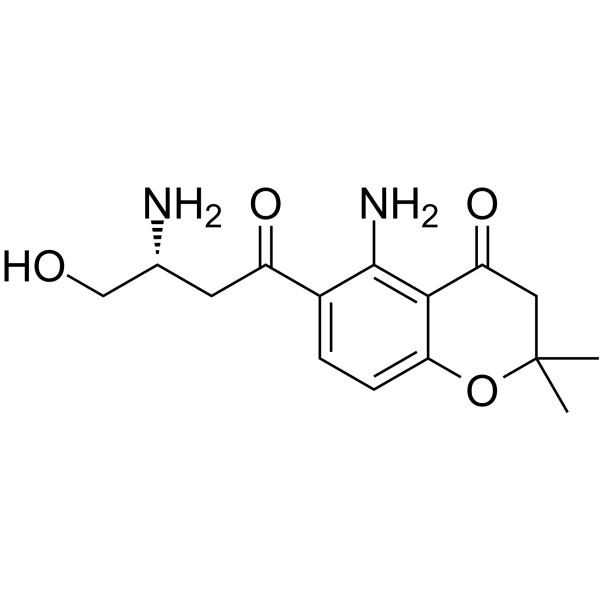
Fusarochromanone
Fusarochromanone (FC-101) is a fungal metabolite with potent anti-angiogenic and anti-cancer activity. Fusarochromanone-activated JNK pathway is attributed to induction of reactive oxygen species (ROS).
연구목적의 판매만을 진행합니다. 환자를 대상으로 한 판매는 하지 않습니다.
- CAS No.: 802915-53-3
- 화학식: C15H20N2O4
- 분자량:292.33
-
보관:
Please store the product under the recommended conditions in the Certificate of Analysis.

To place orders, for customer services and technical support, please contact: MedChemExpress USA
Tel: 609-228-6898 E-mail: [email protected] [email protected]


-
 Biological Activity
-
Chemical Information
- Protocol
- 순도&문서
- References
-
 Help & FAQs




Biological Activity
제품 설명
In Vitro
Fusarochromanone (FC101; 10 μM; 24 hours) induces apoptosis and an increase in proportion of cells in the sub-G1 phase in both HaCat and P9-WT cell lines[1].
Fusarochromanone (FC101; 0-1 μM; 24 h) induces the cleavage of both caspase-3 and PARP, a well-known substrate for activated caspases. FC101 does not affect the expression of the anti-apoptotic proteins, Bcl-2, Bcl-XL, Mcl-1, or the pro-apoptotic proteins BAD, BAK, BAX[1].
Fusarochromanone (FC101) exhibits very potent in-vitro growth inhibitory effects (IC50 ranging from 10 nM-2.5 μM) against HaCat (pre-malignant skin), P9-WT (malignant skin), MCF-7 (low malignant breast), MDA-231 (malignant breast), SV-HUC (premalignant bladder), UM-UC14 (malignant bladder), and PC3 (malignant prostate) in a time-course and dose-dependent manner, with the UM-UC14 cells being the most sensitive.
MedChemExpress (MCE) has not independently confirmed the accuracy of these methods. They are for reference only. Further protocols information, click here.
-
Cell Line:HaCat and P9-WT cell lines
-
Concentration:10 μM
-
Incubation Time:24 hours
-
Result:Showed cells in the G2 and M phases of the cell cycle for both cell lines.
-
Cell Line:MDA-MB-231 cells
-
Concentration:0.05 μM, 0.1 μM, 0.2 μM, 0.5 μM, 1 μM
-
Incubation Time:24 hours
-
Result:Induced the cleavage of both caspase-3 and PARP.
In Vivo
MedChemExpress (MCE) has not independently confirmed the accuracy of these methods. They are for reference only.
-
Animal Model:SCID Beige mice (CB17/Icr.Cg-PrkdcscidLystbg/Crl) injected with SRB12-p9 cells[1]
-
Dosage:8 mg/kg
-
Administration:IP; 5 days per week; for 3.5 weeks
-
Result:Achieved a 30% reduction in tumor size at a dose of 8 mg/kg/day.


Chemical Information
-
CAS No. 802915-53-3
-
분자량 292.33
-
화학식 C15H20N2O4
-
SMILES
O=C1CC(C)(C)OC2=CC=C(C(C[C@@H](N)CO)=O)C(N)=C12
-
Synonyms
FC-101
-
Structure Classification
-
Initial Source
-
선적
Room temperature in continental US; may vary elsewhere.
-
보관
Please store the product under the recommended conditions in the Certificate of Analysis.

Protocol
-
ROS/oxidative-stress fluorescent staining
ROS/oxidative-stress fluorescent staining uses cell-permeant fluorogenic probes that become fluorescent after oxidation inside cells or tissues; commonly used examples include DCFH-DA/DCFDA for broad cellular oxidant detection, DHE for superoxide-related signal detection, MitoSOX for mitochondrial superoxide-related signal detection, and CellROX probes for oxidative-stress-associated fluorescence readouts. The assay detects probe oxidation rather than a single ROS species unless the probe and analysis method have been chemically validated for that species. DCFH-DA enters cells, is deacetylated by intracellular esterases to DCFH, and produces fluorescent DCF after oxidation, so the readout is used as an operational measure of total cellular oxidative stress rather than a species-specific ROS measurement. DHE and MitoSOX can report superoxide-related oxidation, but red fluorescence alone can include non-specific ethidium-like oxidation products; HPLC or optimized spectral approaches are


순도&문서
References
[1]. Elahe Mahdavian, et al.Biological activities of fusarochromanone: a potent anti-cancer agent. BMC Res Notes. 2014 Sep 3;7:601. [Content Brief]
[2]. Ying Gu, et al.Fusarochromanone-induced reactive oxygen species results in activation of JNK cascade and cell death by inhibiting protein phosphatases 2A and 5. Oncotarget. 2015 Dec 8;6(39):42322-33. [Content Brief]

Calculators
Concentration (start) × Volume (start) = Concentration (final) × Volume (final)


Fusarochromanone Related Classifications
HY-136901 Related Classifications
 Powered by Bioz