



Triptohypol C

Based on 1 Customer Validation
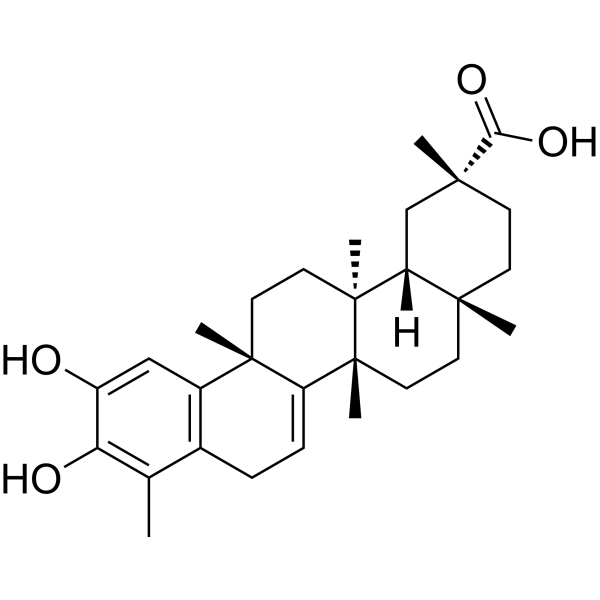
Triptohypol C, a Tripterin (HY-13067) derivative, is a potent Nur77-targeting anti-inflammatory agent with an Kd value of 0.87 μM. Triptohypol C inhibits inflammatory response by promoting the interactions of Nur77 with TRAF2 and p62/SQSTM1.
연구목적의 판매만을 진행합니다. 환자를 대상으로 한 판매는 하지 않습니다.
- Purity : 96.56%
- CAS No.: 193957-88-9
- 화학식: C29H40O4
- 분자량:452.63
-
보관:
-20°C, protect from light
* In solvent : -80°C, 6 months; -20°C, 1 month (protect from light)

To place orders, for customer services and technical support, please contact: MedChemExpress USA
Tel: 609-228-6898 E-mail: [email protected] [email protected]


-
 Biological Activity
-
Chemical Information
-
용액&용해도
- Protocol
- 순도&문서
- References
-
 Help & FAQs


All Nuclear Hormone Receptor 4A/NR4A Isoforms
More

Biological Activity
제품 설명
IC50 & Target
|
Nur77/NR4A1 |
Cellular Effect
|
Cell Line

|
Type | Value | Description | References |
|---|---|---|---|---|
| A549 | IC50 |
3.15 μM
Compound: 2
|
Antiproliferative activity against human A549 cells after 72 hrs by MTT assay
Antiproliferative activity against human A549 cells after 72 hrs by MTT assay
|
[PMID: 28688281] |
| A549 | IC50 |
3.15 μM
Compound: 2
|
Antiproliferative activity against human A549 cells after 72 hrs by MTT assay
Antiproliferative activity against human A549 cells after 72 hrs by MTT assay
|
[PMID: 28865279] |
| MIA PaCa-2 | IC50 |
0.72 μM
Compound: 2
|
Antiproliferative activity against human MIAPaCa2 cells after 72 hrs by MTT assay
Antiproliferative activity against human MIAPaCa2 cells after 72 hrs by MTT assay
|
[PMID: 28688281] |
| MIA PaCa-2 | IC50 |
0.72 μM
Compound: 2
|
Antiproliferative activity against human MIAPaCa2 cells after 72 hrs by MTT assay
Antiproliferative activity against human MIAPaCa2 cells after 72 hrs by MTT assay
|
[PMID: 28865279] |
In Vitro
Triptohypol C (compound 3a) (2 μM; 1 h) strongly antagonize the effect of TNFα on inducing IκBα degradation, and inhibits inflammatory response by promoting the interactions of Nur77 with TRAF2 and p62/SQSTM1[1].
Triptohypol C (2 μM; 10 h) cause 3.12% apoptosis in HepG2 cells, which is less toxic than Tripterin[1].
MedChemExpress (MCE) has not independently confirmed the accuracy of these methods. They are for reference only.
-
Cell Line:Lysates from HepG2 cells (incubated with 20 ng/mL TNFα for 30 min)
-
Concentration:2 μM
-
Incubation Time:1 h
-
Result:Strongly antagonized the effect of TNFα on inducing IκBα degradation
-
Cell Line:HepG2 cells (transfected with Myc-Nur77 and Flag-TRAF2 or Flag-p62)
-
Concentration:2 μM
-
Incubation Time:1 h
-
Result:Promoted the interactions between Nur77 and TRAF2 and p62/SQSTM1.
In Vivo
MedChemExpress (MCE) has not independently confirmed the accuracy of these methods. They are for reference only.


Chemical Information
-
CAS No. 193957-88-9
-
Appearance Solid
-
분자량 452.63
-
화학식 C29H40O4
-
Color Light yellow to yellow
-
SMILES
CC1=C(O)C(O)=CC2=C1CC=C3[C@@]2(C)CC[C@]4(C)[C@]3(C)CC[C@]5(C)[C@@]4([H])C[C@](C)(C(O)=O)CC5
-
Structure Classification
-
Initial Source
-
선적
Room temperature in continental US; may vary elsewhere.
-
보관
-20°C, protect from light
* In solvent : -80°C, 6 months; -20°C, 1 month (protect from light)


용액&용해도
In Vitro:
DMSO : 16.67 mg/mL (36.83 mM; Need ultrasonic; Hygroscopic DMSO has a significant impact on the solubility of product, please use newly opened DMSO)
Please refer to the solubility information to select the appropriate solvent. Once prepared, please aliquot and store the solution to prevent product inactivation from repeated freeze-thaw cycles.
Storage method and period of stock solution: -80°C, 6 months; -20°C, 1 month (protect from light). When stored at -80°C, please use it within 6 months. When stored at -20°C, please use it within 1 month.
Please refer to the solubility information to select the appropriate solvent. Once prepared, please aliquot and store the solution to prevent product inactivation from repeated freeze-thaw cycles.
Storage method and period of stock solution: -80°C, 6 months; -20°C, 1 month (protect from light). When stored at -80°C, please use it within 6 months. When stored at -20°C, please use it within 1 month.
Concentration (start) × Volume (start) = Concentration (final) × Volume (final)


순도&문서
-
Data Sheet (278 KB)
-
SDS (393 KB)
- English - EN (393 KB)
- Français - FR (393 KB)
- Deutsch - DE (393 KB)
- Norwegian - NO (393 KB)
- Español - ES (393 KB)
- Swedish - SV (393 KB)
- Italian - IT (393 KB)
- Korean - KR (393 KB)
- Portuguese - PT (393 KB)
-
Handling Instructions (2659 KB)
References


Complete Stock Solution Preparation Table
Please refer to the solubility information to select the appropriate solvent. Once prepared, please aliquot and store the solution to prevent product inactivation from repeated freeze-thaw cycles.
Storage method and period of stock solution: -80°C, 6 months; -20°C, 1 month (protect from light). When stored at -80°C, please use it within 6 months. When stored at -20°C, please use it within 1 month.
| Optional Solvent | Concentration Solvent Mass | 1 mg | 5 mg | 10 mg | 25 mg |
|---|---|---|---|---|---|
| DMSO | 1 mM | 2.2093 mL | 11.0466 mL | 22.0931 mL | 55.2328 mL |
| 5 mM | 0.4419 mL | 2.2093 mL | 4.4186 mL | 11.0466 mL | |
| 10 mM | 0.2209 mL | 1.1047 mL | 2.2093 mL | 5.5233 mL | |
| 15 mM | 0.1473 mL | 0.7364 mL | 1.4729 mL | 3.6822 mL | |
| 20 mM | 0.1105 mL | 0.5523 mL | 1.1047 mL | 2.7616 mL | |
| 25 mM | 0.0884 mL | 0.4419 mL | 0.8837 mL | 2.2093 mL | |
| 30 mM | 0.0736 mL | 0.3682 mL | 0.7364 mL | 1.8411 mL |


Triptohypol C Related Classifications
HY-117469 Related Classifications
 Powered by Bioz