



L-α-Phosphatidylinositol
Based on 1 publication(s) in Google Scholar
L-α-Phosphatidylinositol is a type of phospholipid. L-α-Phosphatidylinositol can serve as an antigen in ELISA assays for screening antiphospholipid antibodies. L-α-Phosphatidylinositol can be used in studies related to HIV-1 infection.
For research use only. We do not sell to patients.
- CAS No.: 97281-52-2
-
Storage:
-20°C, sealed storage, away from moisture
* In solvent : -80°C, 6 months; -20°C, 1 month (sealed storage, away from moisture)


To place orders, for customer services and technical support, please contact: MedChemExpress USA
Tel: 609-228-6898 E-mail: [email protected] [email protected]


-
 Biological Activity
-
Chemical Information
-
Solvent & Solubility
- Protocols
- Purity & Documentation
- References
-
 Help & FAQs


-

HY-125854
Phosphatidylcholines, eggPhosphatidylcholine -

HY-W251428
Phosphatidylglycerols (egg) sodium saltBiochemical Assay Reagent -

HY-113498
SphingomyelinEndogenous Metabolite -

HY-B2235B
L-α-Lecithin (egg yolk, Type XVI-E), 99%Biochemical Reagent -

HY-B2235
LecithinEndogenous Metabolite -
HY-112005
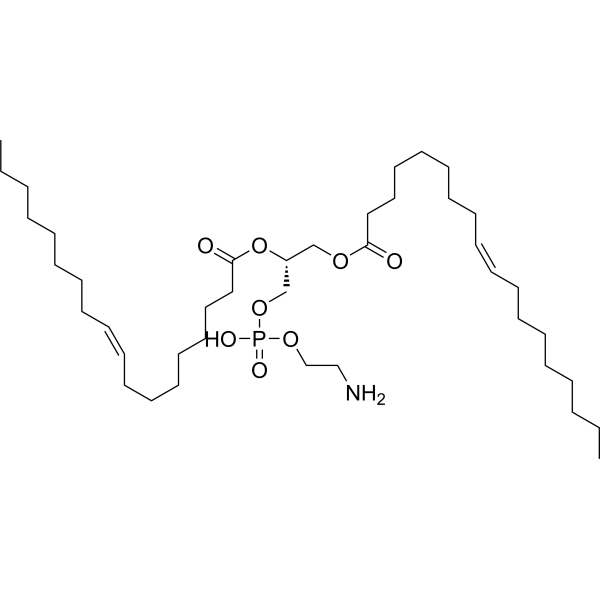
DOPEFerroptosis Inhibitor -

HY-125853
Phosphatidylcholines,soyaPhosphatidylcholine -

HY-W040193
DSPCLiposome Compound -

HY-139414
LysophosphatidylcholinesHemolytic Agent -

HY-109541
Colfosceril miristatePhospholipid Compound -

HY-42990
Hydrogenated soya phosphatidylcholinePhosphatidylcholine -

HY-B2235C
L-α-Lecithin (soybean)Lutein Bioavailability Enhancer
Publications Citing Use of MedChemExpress (MCE) L-α-Phosphatidylinositol
More

Biological Activity
Description
IC50 & Target
[1]|
HIV-1 |
In Vitro
L-α-Phosphatidylinositol serves as an antigen in ELISA assays for antiphospholipid antibody screening[1].
MedChemExpress (MCE) has not independently confirmed the accuracy of these methods. They are for reference only. Further protocols information, click here.


Chemical Information
-
CAS No. 97281-52-2
-
Appearance Solid
-
Color Off-white to light yellow
-
SMILES
O[C@@H]1[C@@H](O)[C@H](O)[C@@H](O)[C@H](OP(OC[C@H](OC([R2])=O)COC([R1])=O)(O)=O)[C@@H]1O.[R1,R2=Fatty acid residues]
-
Structure Classification
-
Initial Source
-
Shipping
Room temperature in continental US; may vary elsewhere.
-
Storage
-20°C, sealed storage, away from moisture
* In solvent : -80°C, 6 months; -20°C, 1 month (sealed storage, away from moisture)


Publications (1)
-
Journal Impact Factor
-
Most Recent
-
Free Radic Biol Med
NAD+ rescues Phosphatidylinositol-induced granulosa cell Pyroptosis to restore follicular development in PCOS. [Abstract]2025 Sep 11:S0891-5849(25)00976-1. PMID: 40945625


Solvent & Solubility
In Vitro:
H2O : 2 mg/mL (ultrasonic and warming and heat to 60°C)
DMSO : 1 mg/mL (ultrasonic and warming and heat to 60°C; Hygroscopic DMSO has a significant impact on the solubility of product, please use newly opened DMSO)

Protocols
-
Research Protocol for Infectious Diseases
Infectious-disease experiments test how pathogens interact with host barriers, innate immune receptors, inflammatory signaling, pathogen replication, and tissue injury; pattern-recognition receptors such as TLRs, RIG-I-like receptors, NOD-like receptors, and inflammasomes detect microbial molecules and activate NF-κB, interferon, and cytokine responses. The central hypothesis is that infection severity reflects the balance between pathogen burden and host response: protective inflammation restricts pathogen growth, whereas excessive or mislocalized inflammation contributes to tissue damage and disease phenotype. Unresolved questions include which host pathways are protective versus pathogenic, why some infection models fail to translate to human disease, and which combined readouts best predict clinically relevant infection outcomes.
-
Enzyme-Linked Immunosorbent Assay (ELISA)
Enzyme-linked immunosorbent assay (ELISA) is a biochemical technology widely used to detect and quantify proteins, antibodies, hormones and other biomolecules. This method uses enzyme-labeled antibodies or antigens to specifically bind to the test substance, and generates a measurable signal through an enzyme-catalyzed reaction. ELISA has the characteristics of high sensitivity, specificity and high-throughput, and is suitable for medical diagnosis, biomedical research and drug development and other fields.


Purity & Documentation
-
Data Sheet (281 KB)
-
SDS (393 KB)
- English - EN (393 KB)
- Français - FR (393 KB)
- Deutsch - DE (393 KB)
- Norwegian - NO (393 KB)
- Español - ES (393 KB)
- Swedish - SV (393 KB)
- Italian - IT (393 KB)
- Korean - KR (393 KB)
- Portuguese - PT (393 KB)
-
Handling Instructions (2659 KB)
References

Calculators
Concentration (start) × Volume (start) = Concentration (final) × Volume (final)


L-α-Phosphatidylinositol Related Classifications
HY-W020658 Related Classifications
 Powered by Bioz