



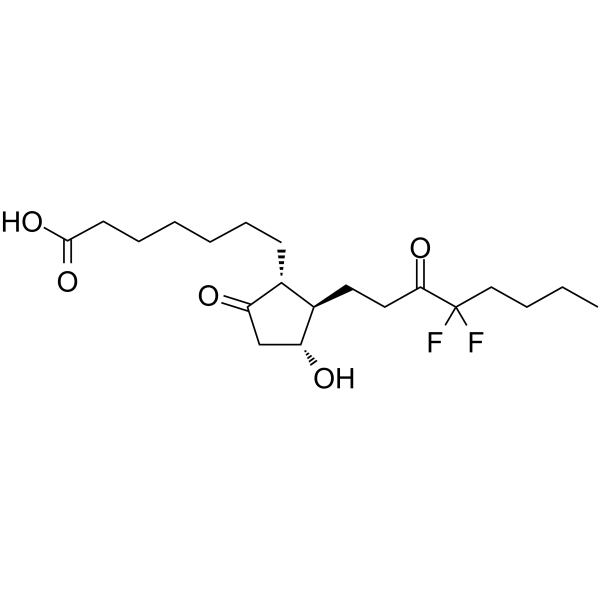
Lubiprostone
Based on 1 publication(s) in Google Scholar
Lubiprostone (SPI-0211) increases intestinal fluid secretion through generation of CIC-2/CFTR and activation of cAMP signaling pathway. Lubiprostone inhibits myeloperoxidase (MPO) activity, downregulates Indomethacin (HY-14397)-induced iNOS and TNFα expression. Lubiprostone can be used for chronic constipation research.
Nur für Forschungszwecke. Wir verkaufen nicht an Patienten.
- Reinheit : 99.09%
- CAS. Nr.: 136790-76-6
- Formel: C20H32F2O5
- Molecular Weight:390.46
-
Speicherung:Powder -20°C, 3 years , 4°C, 2 years ; In solvent -80°C, 2 years , -20°C, 1 year

To place orders, for customer services and technical support, please contact: MedChemExpress USA
Tel: 609-228-6898 E-mail: [email protected] [email protected]


-
 Biologische Aktivität
-
Chemical Information
-
Lösungsmittel & Löslichkeit
- Protokoll
- Reinheit & Dokumentation
- Verweise
-
 Help & FAQs


-

HY-114118
SemaglutideGLP-1R Agonist -
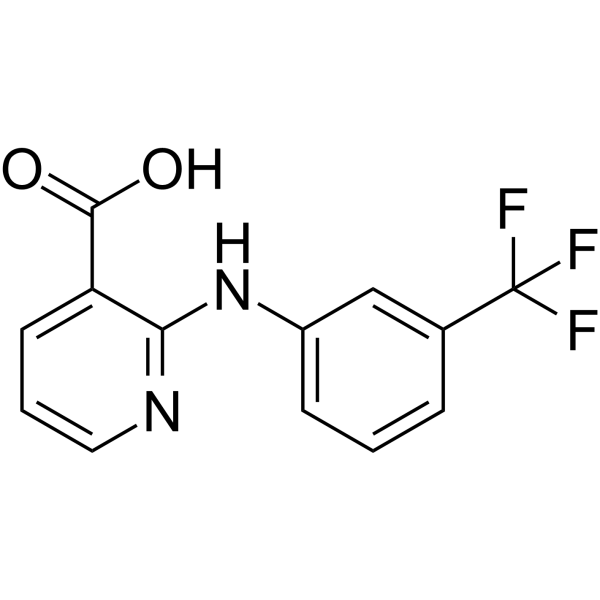
HY-B0493
Niflumic acidChloride Channel/COX Inhibitor -
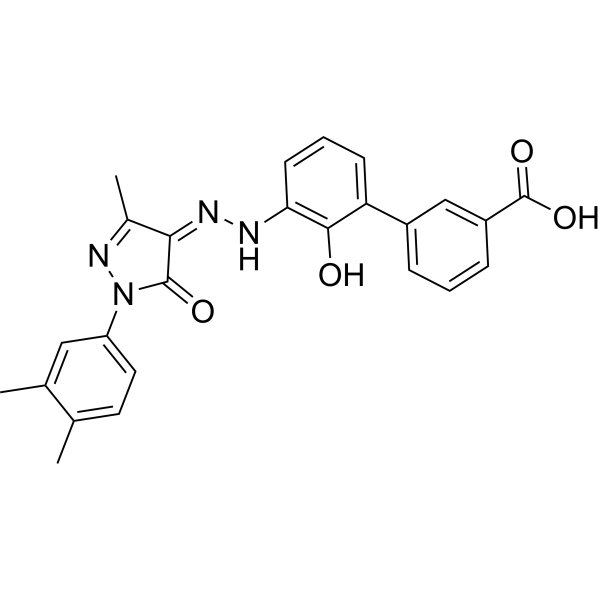
HY-15306
EltrombopagTPO Receptor Agonist -
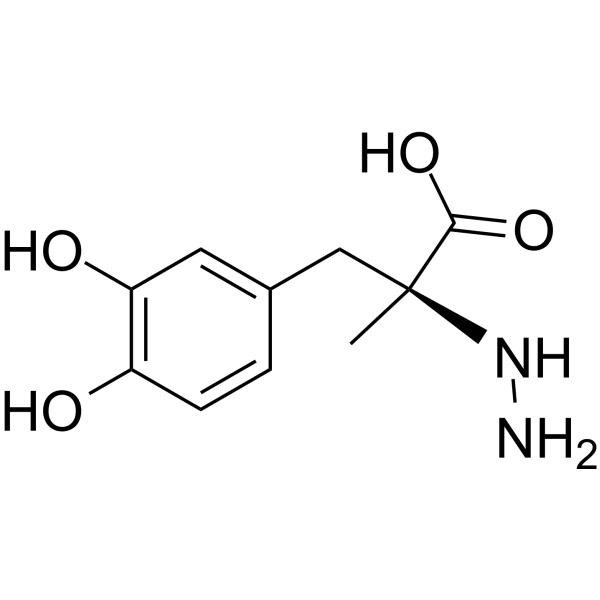
HY-B0311
CarbidopaDecarboxylase Inhibitor -
HY-16504
Treprostinil sodium -
HY-N0677A
Kalii Dehydrographolidi SuccinasAntibiotic -

HY-B0679R
Lubiprostone (Standard)Gastrointestinal Agent -
HY-101012
NPPBORCC Blocker -
HY-12693
R(+)-MethylindazoneChloride Channel Inhibitor -
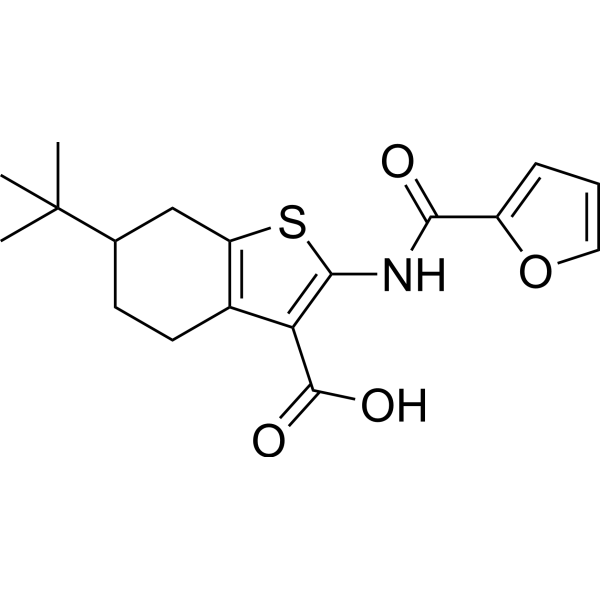
HY-100611
CaCCinh-A01TMEM16A Inhibitor -
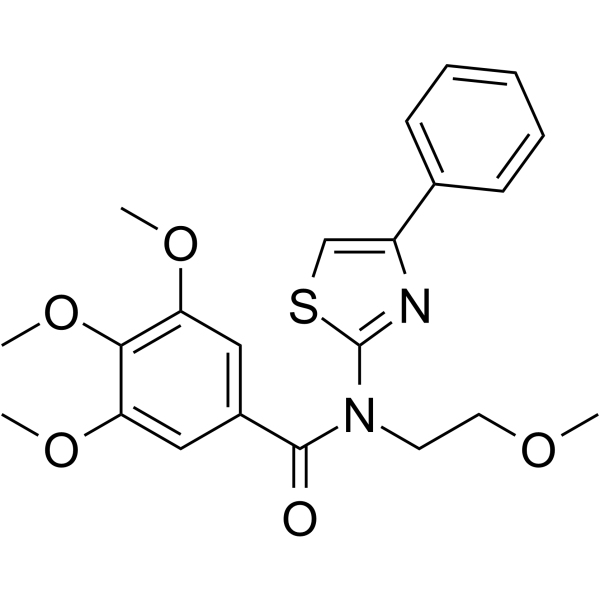
HY-103368
EactTMEM16A Activator -
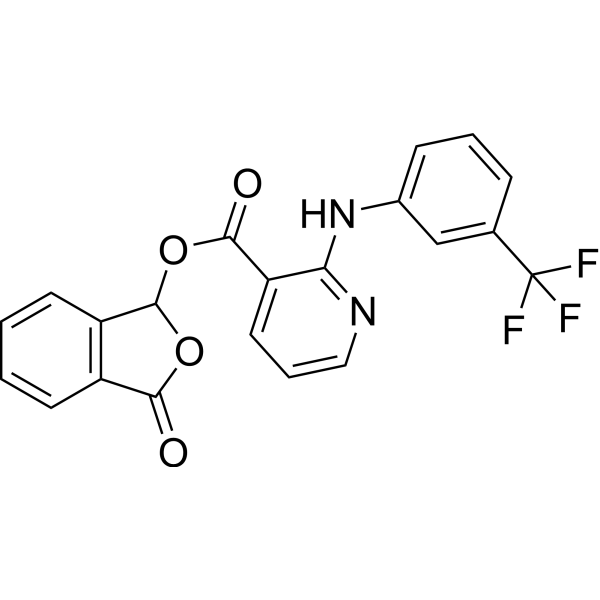
HY-103370
TalniflumateCaCC Blocker
Publications Citing Use of MedChemExpress (MCE) Lubiprostone
MoreAlle TNF Receptor Isoform-spezifische Produkte anzeigen
More

Biologische Aktivität
Beschreibung
In Vitro
Lubiprostone (250 nM, 20 min-4 h) induces the generation of cAMP and cystic fibrosis transmembrane conductance regulator (CFTR) in T84 cell, increases the secretion of chloride ions[1].
MedChemExpress (MCE) has not independently confirmed the accuracy of these methods. They are for reference only.
In Vivo
Lubiprostone (0.01-1 mg/kg, po, singe dose) reduces Indomethacin (HY-14397)-induced small intestinal damage and prevents enterobacterial invasion in rats models[3].
MedChemExpress (MCE) has not independently confirmed the accuracy of these methods. They are for reference only.
-
Animal Model:HFD-induced C57BL/6 NAFLD mouse model[2]
-
Dosage:0.1-0.5 mg/kg
-
Administration:po, once daily for 5 weeks
-
Result:Reduced liver weight, plasma liver injury markers, hepatic bacterial load, improved intestinal permeability, and increased portal high density lipoprotein (HDL) cholesterol levels.
-
Animal Model:Indomethacin (HY-14397)-induced small intestinal damage in Sprague-Dawley rats models[3]
-
Dosage:0.01-1 mg/kg
-
Administration:po, singe dose
-
Result:Reduced small intestinal damage.
Clinical Trial
| NCT Number | Sponsor | Condition | Start Date |
Phase

|
|---|---|---|---|---|
| NCT01329991 | 2011-05 | PHASE1 |


Chemical Information
-
CAS. Nr. 136790-76-6
-
Appearance Solid
-
Molecular Weight 390.46
-
Formel C20H32F2O5
-
Color White to off-white
-
SMILES
O=C(C(F)(F)CCCC)CC[C@@H]([C@@H](C1)O)[C@H](C1=O)CCCCCCC(O)=O
-
Synonyms
RU-0211; SPI-0211
-
Versand
Room temperature in continental US; may vary elsewhere.
-
Speicherung
Powder -20°C 3 years 4°C 2 years In solvent -80°C 2 years -20°C 1 year


Publications (1)
-
Journal Impact Factor
-
Most Recent
-
Dig Dis Sci
Functional Role of Basolateral ClC-2 Channels in the Regulation of Duodenal Anion Secretion in Mice. [Abstract]2019 Sep;64(9):2527-2537. PMID: 30874987


Lösungsmittel & Löslichkeit
In Vitro:
DMSO : 100 mg/mL (256.11 mM; Need ultrasonic; Hygroscopic DMSO has a significant impact on the solubility of product, please use newly opened DMSO)
Please refer to the solubility information to select the appropriate solvent. Once prepared, please aliquot and store the solution to prevent product inactivation from repeated freeze-thaw cycles.
Storage method and period of stock solution: -80°C, 2 years; -20°C, 1 year. When stored at -80°C, please use it within 2 years. When stored at -20°C, please use it within 1 year.
Please refer to the solubility information to select the appropriate solvent. Once prepared, please aliquot and store the solution to prevent product inactivation from repeated freeze-thaw cycles.
Storage method and period of stock solution: -80°C, 2 years; -20°C, 1 year. When stored at -80°C, please use it within 2 years. When stored at -20°C, please use it within 1 year.
Konzentration (Stammlösung) × Volumen (Stammlösung) = Konzentration (Ziellösung) × Volumen (Ziellösung)
In Vivo:
Select the appropriate dissolution method based on your experimental animal and administration route.
- For the following dissolution methods, please ensure to first prepare a clear stock solution using an In Vitro approach and then sequentially add co-solvents:
- To ensure reliable experimental results, the clarified stock solution can be appropriately stored based on storage conditions. As for the working solution for In Vivo experiments, it is recommended to prepare freshly and use it on the same day.
- The percentages shown for the solvents indicate their volumetric ratio in the final prepared solution. If precipitation or phase separation occurs during preparation, heat and/or sonication can be used to aid dissolution.
Add each solvent one by one: 10% DMSO 40% PEG300 5% Tween-80 45% Saline
Solubility: ≥ 3.25 mg/mL (8.32 mM); Clear solution
This protocol yields a clear solution of ≥ 3.25 mg/mL (saturation unknown).
Taking 1 mL working solution as an example, add 100 μL DMSO stock solution (32.5 mg/mL) to 400 μL PEG300, and mix evenly; then add 50 μL Tween-80 and mix evenly; then add 450 μL Saline to adjust the volume to 1 mL.
Preparation of Saline: Dissolve 0.9 g sodium chloride in ddH₂O and dilute to 100 mL to obtain a clear Saline solution.
Add each solvent one by one: 10% DMSO 90% (20% SBE-β-CD in Saline)
Solubility: ≥ 3.25 mg/mL (8.32 mM); Clear solution
This protocol yields a clear solution of ≥ 3.25 mg/mL (saturation unknown).
Taking 1 mL working solution as an example, add 100 μL DMSO stock solution (32.5 mg/mL) to 900 μL 20% SBE-β-CD in Saline, and mix evenly.
Preparation of 20% SBE-β-CD in Saline (4°C, storage for one week): 2 g SBE-β-CD powder is dissolved in 10 mL Saline, completely dissolve until clear.
In Vivo Dissolution Calculator
Please enter the basic information of animal experiments:
-
-
-
-
Recommended: Prepare an additional quantity of animals to account for potential losses during experiments.
Please enter your animal formula composition:
-
%DMSO +
Recommended: Keep the proportion of DMSO in working solution below 2% if your animal is weak.
-
%+
-
+%Tween-80 + +
-
%Saline +
The co-solvents required include: DMSO, . All of co-solvents are available by MedChemExpress (MCE). , Tween 80. All of co-solvents are available by MedChemExpress (MCE).
Working solution concentration: 0.22 mg/mL
Method for preparing stock solution: mg drug dissolved in μL DMSO. Stock solution concentration: mg/mL.
1. Take μL DMSO stock solution;
2. Add μL .
μL , mix evenly;
3. Then add μL Tween 80, mix evenly;
4. Then add μL
Please ensure that the stock solution in the first step is dissolved to a clear state, and add co-solvents in sequence. You can use ultrasonic heating (ultrasonic cleaner, recommended frequency 20-40 kHz), vortexing, etc. to assist dissolution.


Reinheit & Dokumentation
-
Data Sheet (271 KB)
-
SDS (393 KB)
- English - EN (393 KB)
- Français - FR (393 KB)
- Deutsch - DE (393 KB)
- Norwegian - NO (393 KB)
- Español - ES (393 KB)
- Swedish - SV (393 KB)
- Italian - IT (393 KB)
- Korean - KR (393 KB)
- Portuguese - PT (393 KB)
-
Handling Instructions (2659 KB)
Verweise
[1]. Ao M, et al., Lubiprostone activates Cl- secretion via cAMP signaling and increases membrane CFTR in the human colon carcinoma cell line, T84. Dig Dis Sci. 2011 Feb;56(2):339-51. [Content Brief]
[2]. Kim MY, et al., Lubiprostone significantly represses fatty liver diseases via induction of mucin and HDL release in mice. Life Sci. 2022 Dec 15;311(Pt A):121176. [Content Brief]
[3]. Hayashi S, et al., Lubiprostone prevents nonsteroidal anti-inflammatory drug-induced small intestinal damage by suppressing the expression of inflammatory mediators via EP4 receptors. J Pharmacol Exp Ther. 2014 Jun;349(3):470-9. [Content Brief]


Complete Stock Solution Preparation Table
Please refer to the solubility information to select the appropriate solvent. Once prepared, please aliquot and store the solution to prevent product inactivation from repeated freeze-thaw cycles.
Storage method and period of stock solution: -80°C, 2 years; -20°C, 1 year. When stored at -80°C, please use it within 2 years. When stored at -20°C, please use it within 1 year.
| Optional Solvent | Concentration Solvent Mass | 1 mg | 5 mg | 10 mg | 25 mg |
|---|---|---|---|---|---|
| DMSO | 1 mM | 2.5611 mL | 12.8054 mL | 25.6108 mL | 64.0270 mL |
| 5 mM | 0.5122 mL | 2.5611 mL | 5.1222 mL | 12.8054 mL | |
| 10 mM | 0.2561 mL | 1.2805 mL | 2.5611 mL | 6.4027 mL | |
| 15 mM | 0.1707 mL | 0.8537 mL | 1.7074 mL | 4.2685 mL | |
| 20 mM | 0.1281 mL | 0.6403 mL | 1.2805 mL | 3.2014 mL | |
| 25 mM | 0.1024 mL | 0.5122 mL | 1.0244 mL | 2.5611 mL | |
| 30 mM | 0.0854 mL | 0.4268 mL | 0.8537 mL | 2.1342 mL | |
| 40 mM | 0.0640 mL | 0.3201 mL | 0.6403 mL | 1.6007 mL | |
| 50 mM | 0.0512 mL | 0.2561 mL | 0.5122 mL | 1.2805 mL | |
| 60 mM | 0.0427 mL | 0.2134 mL | 0.4268 mL | 1.0671 mL | |
| 80 mM | 0.0320 mL | 0.1601 mL | 0.3201 mL | 0.8003 mL | |
| 100 mM | 0.0256 mL | 0.1281 mL | 0.2561 mL | 0.6403 mL |


Lubiprostone Related Classifications
HY-B0679 Related Classifications
 Powered by Bioz