



Lucitanib dihydrochloride
Based on 8 publication(s) in Google Scholar
Lucitanib (E-3810) dihydrochloride is a novel dual inhibitor of VEGFR and FGFR, potently and selectively inhibits VEGFR1, VEGFR2, VEGFR3, FGFR1 and FGFR2 with IC50s of 7 nM, 25 nM, 10 nM, 17.5 nM, and 82.5 nM, respectively.
For research use only. We do not sell to patients.
- Purity : 98.12%
- CAS No.: 2108875-91-6
- Formula: C26H27Cl2N3O4
- Molecular Weight:516.42
-
Storage:
4°C, sealed storage, away from moisture
* In solvent : -80°C, 6 months; -20°C, 1 month (sealed storage, away from moisture)


To place orders, for customer services and technical support, please contact: MedChemExpress USA
Tel: 609-228-6898 E-mail: [email protected] [email protected]


-
 Biological Activity
-
Chemical Information
-
Solvent & Solubility
- Purity & Documentation
- References
-
 Help & FAQs


-
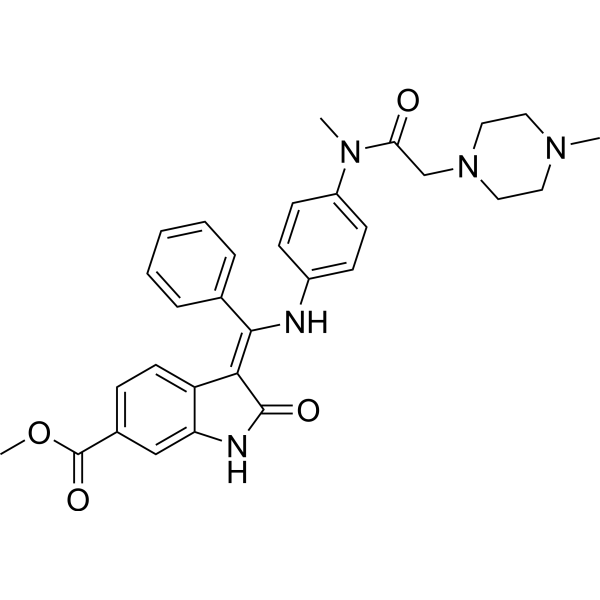
HY-50904
NintedanibPDGFR/VEGFR/FGFR Inhibitor -
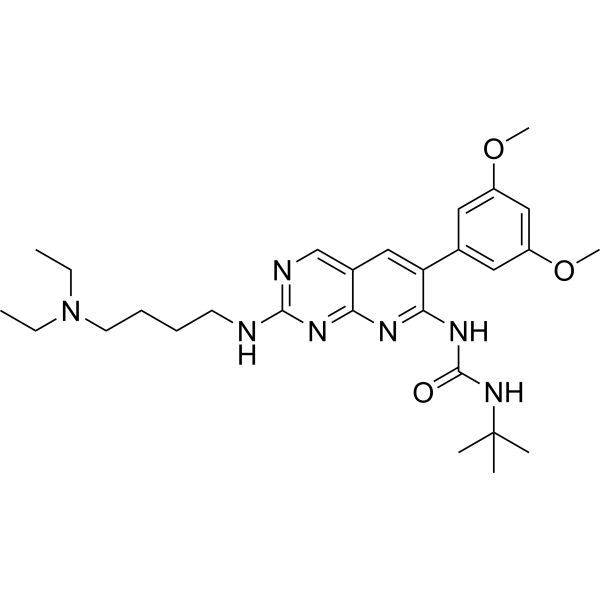
HY-10321
PD173074FGFR1 Inhibitor -
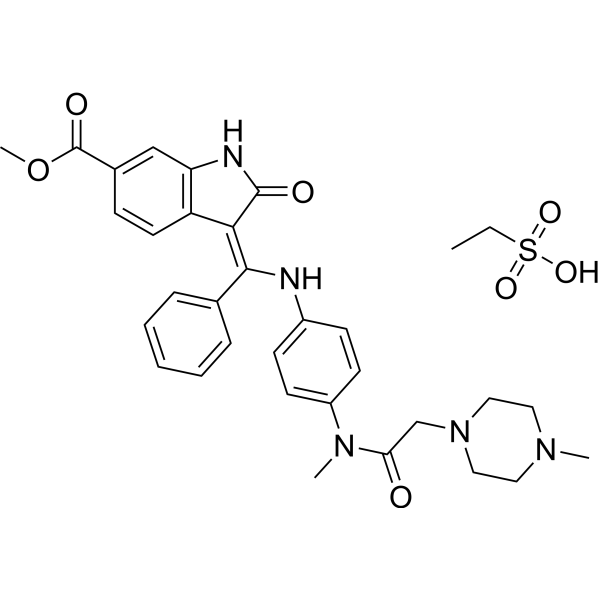
HY-11106
Nintedanib esylatePDGFR/VEGFR/FGFR Inhibitor -
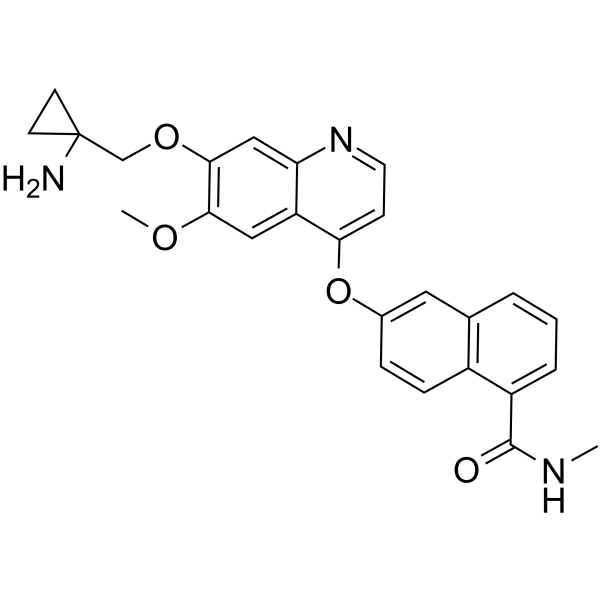
HY-15391
LucitanibVEGFR/FGFR Inhibitor -

HY-50904R
Nintedanib (Standard)PDGFR/VEGFR/FGFR Inhibitor -
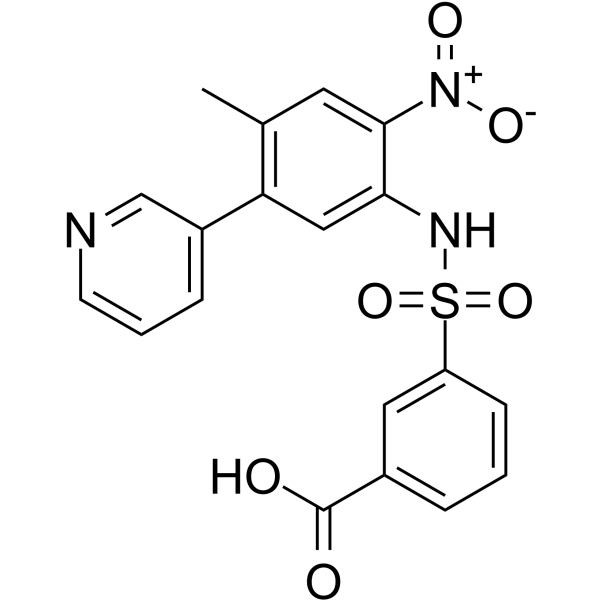
HY-17601
Alofanib -
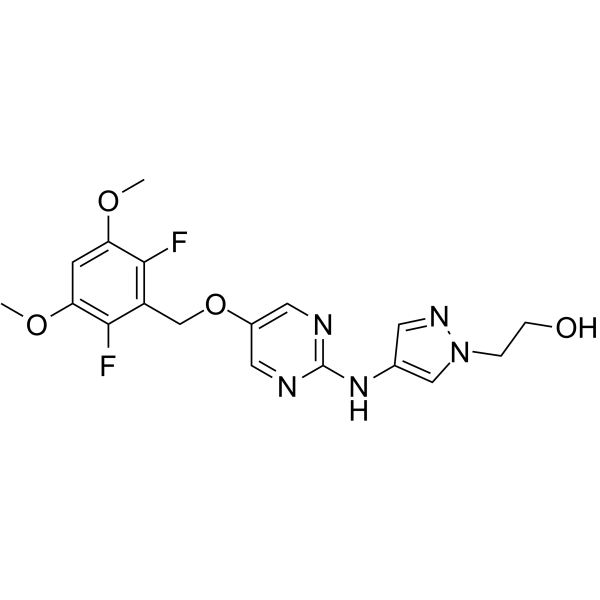
HY-19983
ASP5878 -

HY-15391R
Lucitanib (Standard)VEGFR/FGFR Inhibitor -

HY-10321G
PD173074 (GMP)FGFR Inhibitor -

HY-10321R
PD173074 (Standard)FGFR1 Inhibitor -

HY-11106R
Nintedanib esylate (Standard)PDGFR/VEGFR/FGFR Inhibitor
Publications Citing Use of MedChemExpress (MCE) Lucitanib dihydrochloride
More- Science. 2017 Dec 1;358(6367):eaan4368. [Abstract]
- Sci Transl Med. 2018 Jul 18;10(450):eaaq1093. [Abstract]
- Oncogene. 2023 Feb;42(6):434-448. [Abstract]
- Mol Cancer Ther. 2019 Jan;18(1):28-38. [Abstract]
- Mol Syst Biol. 2024 Jan;20(1):28-55. [Abstract]
- Bioorg Chem. 2024 Jun:147:107412. [Abstract]
- bioRxiv. 2024 Jul 25.
- University of California. 2021 Sep.
All VEGFR Isoforms
More

Biological Activity
Description
IC50 & Target
|
VEGFR1 7 nM (IC50) |
VEGFR2 25 nM (IC50) |
VEGFR3 10 nM (IC50) |
FGFR1 17.5 nM (IC50) |
FGFR2 82.5 nM (IC50) |
In Vitro
Consistent with the inhibitory activity of VEGFR and FGFR auto-phosphorylation, Lucitanib potently inhibits VEGF and bFGF-stimulated HUVEC proliferation with IC50 of 40 and 50 nM, respectively. Besides, Lucitanib (E-3810) also inhibits CSF-1R with IC50 of 5 nM[1]. Lucitanib potently inhibits FGFR2 activity (Ki<0.05 μM), follows by PDGFRα activity (Ki=0.11 μM). The Ki values obtained for DDR2, LYN, CARDIAK, CSBP (2), EPHA2, and YES range between 0.26 and 8 μM[2].
MedChemExpress (MCE) has not independently confirmed the accuracy of these methods. They are for reference only. .
In Vivo
MedChemExpress (MCE) has not independently confirmed the accuracy of these methods. They are for reference only.


Chemical Information
-
CAS No. 2108875-91-6
-
Appearance Solid
-
Molecular Weight 516.42
-
Formula C26H27Cl2N3O4
-
Color White to off-white
-
SMILES
[H]Cl.O=C(NC)C1=CC=CC2=C1C=CC(OC3=CC=NC4=CC(OCC5(N)CC5)=C(OC)C=C43)=C2.[H]Cl
-
Shipping
Room temperature in continental US; may vary elsewhere.
-
Storage
4°C, sealed storage, away from moisture
* In solvent : -80°C, 6 months; -20°C, 1 month (sealed storage, away from moisture)


Publications (8)
-
Journal Impact Factor
-
Most Recent
-
Science
2017 Dec 1;358(6367):eaan4368. PMID: 29191878 -
Sci Transl Med
PP2A inhibition is a druggable MEK inhibitor resistance mechanism in KRAS-mutant lung cancer cells. [Abstract]2018 Jul 18;10(450):eaaq1093. PMID: 30021885 -
Oncogene
2023 Feb;42(6):434-448. PMID: 36509998 -
Mol Cancer Ther
ODM-203, a Selective Inhibitor of FGFR and VEGFR, Shows Strong Antitumor Activity, and Induces Antitumor Immunity. [Abstract]2019 Jan;18(1):28-38. PMID: 30301864 -
Mol Syst Biol
Illuminating phenotypic drug responses of sarcoma cells to kinase inhibitors by phosphoproteomics. [Abstract]2024 Jan;20(1):28-55. PMID: 38177929 -
Bioorg Chem
Identification of FTY720 and COH29 as novel topoisomerase I catalytic inhibitors by experimental and computational studies. [Abstract]2024 Jun:147:107412. PMID: 38696845 -
-


Solvent & Solubility
In Vitro:
DMSO : 25 mg/mL (48.41 mM; Need ultrasonic; Hygroscopic DMSO has a significant impact on the solubility of product, please use newly opened DMSO)
Please refer to the solubility information to select the appropriate solvent. Once prepared, please aliquot and store the solution to prevent product inactivation from repeated freeze-thaw cycles.
Storage method and period of stock solution: -80°C, 6 months; -20°C, 1 month (sealed storage, away from moisture). When stored at -80°C, please use it within 6 months. When stored at -20°C, please use it within 1 month.
Please refer to the solubility information to select the appropriate solvent. Once prepared, please aliquot and store the solution to prevent product inactivation from repeated freeze-thaw cycles.
Storage method and period of stock solution: -80°C, 6 months; -20°C, 1 month (sealed storage, away from moisture). When stored at -80°C, please use it within 6 months. When stored at -20°C, please use it within 1 month.
Concentration (start) × Volume (start) = Concentration (final) × Volume (final)


Purity & Documentation
-
Data Sheet (284 KB)
-
SDS (252 KB)
- English - EN (252 KB)
- Français - FR (252 KB)
- Deutsch - DE (252 KB)
- Norwegian - NO (252 KB)
- Español - ES (252 KB)
- Swedish - SV (252 KB)
- Italian - IT (252 KB)
- Korean - KR (252 KB)
- Portuguese - PT (252 KB)
-
Handling Instructions (2659 KB)
References
[1]. Bello E, et al. E-3810 is a potent dual inhibitor of VEGFR and FGFR that exerts antitumor activity in multiple preclinical models. Cancer Res. 2011 Feb 15;71(4):1396-405. [Content Brief]
[2]. Colzani M, et al. Quantitative chemical proteomics identifies novel targets of the anti-cancer multi-kinase inhibitor E-3810. Mol Cell Proteomics. 2014 Jun;13(6):1495-509. [Content Brief]
[3]. Bello E, et al. The tyrosine kinase inhibitor E-3810 combined with NSC 125973 inhibits the growth of advanced-stage triple-negative breast cancer xenografts. Mol Cancer Ther. 2013 Feb;12(2):131-40 [Content Brief]


Complete Stock Solution Preparation Table
Please refer to the solubility information to select the appropriate solvent. Once prepared, please aliquot and store the solution to prevent product inactivation from repeated freeze-thaw cycles.
Storage method and period of stock solution: -80°C, 6 months; -20°C, 1 month (sealed storage, away from moisture). When stored at -80°C, please use it within 6 months. When stored at -20°C, please use it within 1 month.
| Optional Solvent | Concentration Solvent Mass | 1 mg | 5 mg | 10 mg | 25 mg |
|---|---|---|---|---|---|
| DMSO | 1 mM | 1.9364 mL | 9.6820 mL | 19.3641 mL | 48.4102 mL |
| 5 mM | 0.3873 mL | 1.9364 mL | 3.8728 mL | 9.6820 mL | |
| 10 mM | 0.1936 mL | 0.9682 mL | 1.9364 mL | 4.8410 mL | |
| 15 mM | 0.1291 mL | 0.6455 mL | 1.2909 mL | 3.2273 mL | |
| 20 mM | 0.0968 mL | 0.4841 mL | 0.9682 mL | 2.4205 mL | |
| 25 mM | 0.0775 mL | 0.3873 mL | 0.7746 mL | 1.9364 mL | |
| 30 mM | 0.0645 mL | 0.3227 mL | 0.6455 mL | 1.6137 mL | |
| 40 mM | 0.0484 mL | 0.2421 mL | 0.4841 mL | 1.2103 mL |


Lucitanib dihydrochloride Related Classifications
HY-15391A Related Classifications
 Powered by Bioz