



Lupenone

Based on 1 Customer Validation
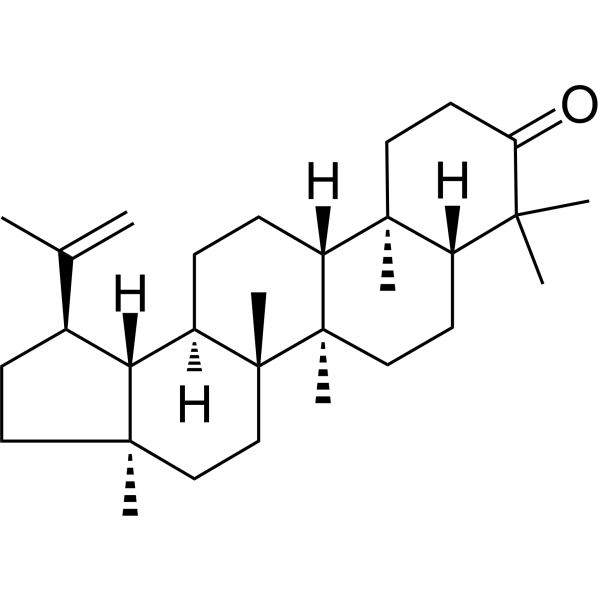
Lupenone is an orally active lupine-type triterpenoid that can be isolated from Musa basjoo. Lupenone Lupenone plays a role through the PI3K/Akt/mTOR and NF-κB signaling pathways. Lupenone has anti-inflammatory, antiviral, antidiabetic and anticancer activities.
For research use only. We do not sell to patients.
- Purity : 99.81%
- CAS No.: 1617-70-5
- Formula: C30H48O
- Molecular Weight:424.70
-
Storage:
4°C, protect from light
* In solvent : -80°C, 6 months; -20°C, 1 month (protect from light)

To place orders, for customer services and technical support, please contact: MedChemExpress USA
Tel: 609-228-6898 E-mail: [email protected] [email protected]


-
 Biological Activity
-
Chemical Information
-
Solvent & Solubility
- Protocols
- Purity & Documentation
- References
-
 Help & FAQs




All Parasite Isoforms
More

Biological Activity
Description
IC50 & Target
|
Trypanosoma |
Cellular Effect
|
Cell Line

|
Type | Value | Description | References |
|---|---|---|---|---|
| B16 | ED50 |
0.35 μM
Compound: 2
|
Induction of melanogenesis in mouse B16 2F2 cells assessed as intracellular melanin content after 3 days
Induction of melanogenesis in mouse B16 2F2 cells assessed as intracellular melanin content after 3 days
|
[PMID: 12027734] |
| B16 | IC50 |
25.4 μM
Compound: 2
|
Growth inhibition of mouse B16 2F2 cells after 3 days
Growth inhibition of mouse B16 2F2 cells after 3 days
|
[PMID: 12027734] |
| CHO | EC50 |
>10 μM
Compound: Lupenone
|
Agonist activity at TGR5 expressed in CHO cells by CRE-driven luciferase reporter gene assay
Agonist activity at TGR5 expressed in CHO cells by CRE-driven luciferase reporter gene assay
|
[PMID: 19911773] |
| COS-1 | EC50 |
0 μM
Compound: Lupenone
|
Agonist activity at human FXR expressed in COS1 cells by luciferase reporter gene assay
Agonist activity at human FXR expressed in COS1 cells by luciferase reporter gene assay
|
[PMID: 19911773] |
| DU-145 | CC50 |
>500 μM
Compound: 4
|
Cytotoxic activity in human DU145 cells by sulforhodamine B assay
Cytotoxic activity in human DU145 cells by sulforhodamine B assay
|
[PMID: 29120172] |
| DU-145 | IC50 |
>500 μM
Compound: 4
|
Antiproliferative activity in human DU145 cells by sulforhodamine B assay
Antiproliferative activity in human DU145 cells by sulforhodamine B assay
|
[PMID: 29120172] |
| HEK293 | CC50 |
>500 μM
Compound: 4
|
Cytotoxic activity in HEK293 cells by sulforhodamine B assay
Cytotoxic activity in HEK293 cells by sulforhodamine B assay
|
[PMID: 29120172] |
| HEK293 | IC50 |
>500 μM
Compound: 4
|
Antiproliferative activity in HEK293 cells by sulforhodamine B assay
Antiproliferative activity in HEK293 cells by sulforhodamine B assay
|
[PMID: 29120172] |
| HeLa | CC50 |
>500 μM
Compound: 4
|
Cytotoxic activity in human HeLa cells by sulforhodamine B assay
Cytotoxic activity in human HeLa cells by sulforhodamine B assay
|
[PMID: 29120172] |
| HeLa | IC50 |
>10 μg/mL
Compound: lupenone
|
Cytotoxicity against human HeLa cells after 48 hrs by MTT assay
Cytotoxicity against human HeLa cells after 48 hrs by MTT assay
|
[PMID: 16038541] |
| HeLa | IC50 |
>500 μM
Compound: 4
|
Antiproliferative activity in human HeLa cells by sulforhodamine B assay
Antiproliferative activity in human HeLa cells by sulforhodamine B assay
|
[PMID: 29120172] |
| HEp-2 | CC50 |
>500 μM
Compound: 4
|
Cytotoxic activity in human Hep2 cells by sulforhodamine B assay
Cytotoxic activity in human Hep2 cells by sulforhodamine B assay
|
[PMID: 29120172] |
| HEp-2 | IC50 |
>10 μg/mL
Compound: lupenone
|
Cytotoxicity against human Hep2 cells after 48 hrs by MTT assay
Cytotoxicity against human Hep2 cells after 48 hrs by MTT assay
|
[PMID: 16038541] |
| HEp-2 | IC50 |
>500 μM
Compound: 4
|
Antiproliferative activity in human Hep2 cells by sulforhodamine B assay
Antiproliferative activity in human Hep2 cells by sulforhodamine B assay
|
[PMID: 29120172] |
| J774.A1 | IC50 |
38.8 μM
Compound: 2
|
Antiinflammatory activity in mouse J774A1 cells assessed as inhibition of LPS-induced NO production incubated for 1 hr prior to LPS challenge measured after 24 hrs by Griess method
Antiinflammatory activity in mouse J774A1 cells assessed as inhibition of LPS-induced NO production incubated for 1 hr prior to LPS challenge measured after 24 hrs by Griess method
|
[PMID: 24909081] |
| KB | CC50 |
>500 μM
Compound: 4
|
Cytotoxic activity in human KB cells by sulforhodamine B assay
Cytotoxic activity in human KB cells by sulforhodamine B assay
|
[PMID: 29120172] |
| KB | IC50 |
>500 μM
Compound: 4
|
Antiproliferative activity in human KB cells by sulforhodamine B assay
Antiproliferative activity in human KB cells by sulforhodamine B assay
|
[PMID: 29120172] |
| L6 | IC50 |
>90 μM
Compound: 10
|
Cytotoxicity against rat L6 cells after 72 hrs by microplate fluorimetry
Cytotoxicity against rat L6 cells after 72 hrs by microplate fluorimetry
|
[PMID: 21438586] |
| MCF7 | CC50 |
>500 μM
Compound: 4
|
Cytotoxic activity in human MCF7 cells by sulforhodamine B assay
Cytotoxic activity in human MCF7 cells by sulforhodamine B assay
|
[PMID: 29120172] |
| MCF7 | IC50 |
>500 μM
Compound: 4
|
Antiproliferative activity in human MCF7 cells by sulforhodamine B assay
Antiproliferative activity in human MCF7 cells by sulforhodamine B assay
|
[PMID: 29120172] |
| MDA-MB-231 | CC50 |
>500 μM
Compound: 4
|
Cytotoxic activity in human MDA-MB-231 cells by sulforhodamine B assay
Cytotoxic activity in human MDA-MB-231 cells by sulforhodamine B assay
|
[PMID: 29120172] |
| MDA-MB-231 | IC50 |
>500 μM
Compound: 4
|
Antiproliferative activity in human MDA-MB-231 cells by sulforhodamine B assay
Antiproliferative activity in human MDA-MB-231 cells by sulforhodamine B assay
|
[PMID: 29120172] |
| RAW264.7 | IC50 |
>0.4 μM
Compound: lupenone
|
Antiinflammatory activity against mouse RAW264.7 cells assessed as inhibition of LPS-induced nitric oxide release after 24 hrs
Antiinflammatory activity against mouse RAW264.7 cells assessed as inhibition of LPS-induced nitric oxide release after 24 hrs
|
[PMID: 20192236] |
| RAW264.7 | IC50 |
38.5 μM
Compound: 2
|
Antiinflammatory activity in mouse RAW264.7 cells assessed as inhibition of LPS-induced NO production incubated for 1 hr prior to LPS challenge measured after 24 hrs by Griess method
Antiinflammatory activity in mouse RAW264.7 cells assessed as inhibition of LPS-induced NO production incubated for 1 hr prior to LPS challenge measured after 24 hrs by Griess method
|
[PMID: 24909081] |
| SiHa | CC50 |
>500 μM
Compound: 4
|
Cytotoxic activity in human SiHa cells by sulforhodamine B assay
Cytotoxic activity in human SiHa cells by sulforhodamine B assay
|
[PMID: 29120172] |
| SiHa | IC50 |
>500 μM
Compound: 4
|
Antiproliferative activity in human SiHa cells by sulforhodamine B assay
Antiproliferative activity in human SiHa cells by sulforhodamine B assay
|
[PMID: 29120172] |
| Vero | CC50 |
>500 μM
Compound: 4
|
Cytotoxic activity in African green monkey Vero cells by sulforhodamine B assay
Cytotoxic activity in African green monkey Vero cells by sulforhodamine B assay
|
[PMID: 29120172] |
| Vero | IC50 |
>10 μg/mL
Compound: lupenone
|
Cytotoxicity against african green monkey Vero cells after 48 hrs by MTT assay
Cytotoxicity against african green monkey Vero cells after 48 hrs by MTT assay
|
[PMID: 16038541] |
| Vero | IC50 |
>500 μM
Compound: 4
|
Antiproliferative activity in African green monkey Vero cells by sulforhodamine B assay
Antiproliferative activity in African green monkey Vero cells by sulforhodamine B assay
|
[PMID: 29120172] |
In Vitro
Lupenone (40 μM, 1 h) protects neuroblastoma SH-SY5y cells from methamphetamine-induced apoptotic cell death through PI3K/Akt/mTOR signaling pathway[1].
MedChemExpress (MCE) has not independently confirmed the accuracy of these methods. They are for reference only.
-
Cell Line:SH-SY5y
-
Concentration:5, 10. 20, 40 μM
-
Incubation Time:24 h
-
Result:Did not cause significant cell death at different concentrations.
-
Cell Line:SH-SY5y
-
Concentration:40 μM
-
Incubation Time:1 h
-
Result:Reduced the population of annexinV/PI-positive cells (early apoptotic cells) and annexinV positive cells (total apoptotic cells).
-
Cell Line:SH-SY5y
-
Concentration:40 μM
-
Incubation Time:1 h
-
Result:Increased the expression of anti-apoptotic proteins, including bcl-2 and caspases such as caspase 3, caspase 7, and caspase 8.
Recuperate the phosphorylation level of PI3K and Akt.
Inhibited the translocation of p65 from the cytosol to the nucleus, IκBα degradation, and IκBα phosphorylation.
In Vivo
MedChemExpress (MCE) has not independently confirmed the accuracy of these methods. They are for reference only.
-
Animal Model:Spontaneous type 2 diabetic nephropathy db/db mouse models[1]
-
Dosage:6, 12, 24 mg/kg
-
Administration:i.g.
-
Result:Maintained the fasting blood glucose.
Reduced glycosylated hemoglobin, insulin, and 24 h proteinuria levels.
Regulated changes in biochemical indicators


Chemical Information
-
CAS No. 1617-70-5
-
Appearance Solid
-
Molecular Weight 424.70
-
Formula C30H48O
-
Color White to off-white
-
SMILES
C[C@]12[C@@](CC[C@@]3([H])[C@]2(CC[C@](C4(C)C)([H])[C@@]3(CCC4=O)C)C)([H])[C@]5([H])[C@](C)(CC[C@H]5C(C)=C)CC1
-
Structure Classification
-
Shipping
Room temperature in continental US; may vary elsewhere.
-
Storage
4°C, protect from light
* In solvent : -80°C, 6 months; -20°C, 1 month (protect from light)


Solvent & Solubility
In Vitro:
Ethanol : 10 mg/mL (23.55 mM; ultrasonic and warming and heat to 60°C)
Please refer to the solubility information to select the appropriate solvent. Once prepared, please aliquot and store the solution to prevent product inactivation from repeated freeze-thaw cycles.
Storage method and period of stock solution: -80°C, 6 months; -20°C, 1 month (protect from light). When stored at -80°C, please use it within 6 months. When stored at -20°C, please use it within 1 month.
Please refer to the solubility information to select the appropriate solvent. Once prepared, please aliquot and store the solution to prevent product inactivation from repeated freeze-thaw cycles.
Storage method and period of stock solution: -80°C, 6 months; -20°C, 1 month (protect from light). When stored at -80°C, please use it within 6 months. When stored at -20°C, please use it within 1 month.
Concentration (start) × Volume (start) = Concentration (final) × Volume (final)
In Vivo:
Select the appropriate dissolution method based on your experimental animal and administration route.
- For the following dissolution methods, please ensure to first prepare a clear stock solution using an In Vitro approach and then sequentially add co-solvents:
- To ensure reliable experimental results, the clarified stock solution can be appropriately stored based on storage conditions. As for the working solution for In Vivo experiments, it is recommended to prepare freshly and use it on the same day.
- The percentages shown for the solvents indicate their volumetric ratio in the final prepared solution. If precipitation or phase separation occurs during preparation, heat and/or sonication can be used to aid dissolution.
Add each solvent one by one: 10% EtOH 40% PEG300 5% Tween-80 45% Saline
Solubility: ≥ 1 mg/mL (2.35 mM); Clear solution
This protocol yields a clear solution of ≥ 1 mg/mL (saturation unknown).
Taking 1 mL working solution as an example, add 100 μL EtOH stock solution (10.0 mg/mL) to 400 μL PEG300, and mix evenly; then add 50 μL Tween-80 and mix evenly; then add 450 μL Saline to adjust the volume to 1 mL.
Preparation of Saline: Dissolve 0.9 g sodium chloride in ddH₂O and dilute to 100 mL to obtain a clear Saline solution.
Add each solvent one by one: 10% EtOH 90% Corn Oil
Solubility: ≥ 1 mg/mL (2.35 mM); Clear solution
This protocol yields a clear solution of ≥ 1 mg/mL (saturation unknown). If the continuous dosing period exceeds half a month, please choose this protocol carefully.
Taking 1 mL working solution as an example, add 100 μL EtOH stock solution (10.0 mg/mL) to 900 μL Corn oil, and mix evenly.
In Vivo Dissolution Calculator
Please enter the basic information of animal experiments:
-
-
-
-
Recommended: Prepare an additional quantity of animals to account for potential losses during experiments.
Working solution concentration: 0.22 mg/mL


Purity & Documentation
-
Data Sheet (285 KB)
-
SDS (252 KB)
- English - EN (252 KB)
- Français - FR (252 KB)
- Deutsch - DE (252 KB)
- Norwegian - NO (252 KB)
- Español - ES (252 KB)
- Swedish - SV (252 KB)
- Italian - IT (252 KB)
- Korean - KR (252 KB)
- Portuguese - PT (252 KB)
-
Handling Instructions (2659 KB)
References
[1]. Lee HS, et al. Lupenone Protects Neuroblastoma SH-SY5y Cells Against Methamphetamine-Induced Apoptotic Cell Death via PI3K/Akt/mTOR Signaling Pathway. Int J Mol Sci. 2020 Feb 27;21(5):1617. [Content Brief]
[2]. Wu H, et al. Lupenone improves type 2 diabetic nephropathy by regulating NF-κB pathway-mediated inflammation and TGF-β1/Smad/CTGF-associated fibrosis. Phytomedicine. 2023 Sep;118:154959. [Content Brief]
[3]. Mukerjee N, et al. Dynamics of natural product Lupenone as a potential fusion inhibitor against the spike complex of novel Semliki Forest Virus. PLoS One. 2022 Feb 25;17(2):e0263853. [Content Brief]


Complete Stock Solution Preparation Table
Please refer to the solubility information to select the appropriate solvent. Once prepared, please aliquot and store the solution to prevent product inactivation from repeated freeze-thaw cycles.
Storage method and period of stock solution: -80°C, 6 months; -20°C, 1 month (protect from light). When stored at -80°C, please use it within 6 months. When stored at -20°C, please use it within 1 month.
| Optional Solvent | Concentration Solvent Mass | 1 mg | 5 mg | 10 mg | 25 mg |
|---|---|---|---|---|---|
| Ethanol | 1 mM | 2.3546 mL | 11.7730 mL | 23.5460 mL | 58.8651 mL |
| 5 mM | 0.4709 mL | 2.3546 mL | 4.7092 mL | 11.7730 mL | |
| 10 mM | 0.2355 mL | 1.1773 mL | 2.3546 mL | 5.8865 mL | |
| 15 mM | 0.1570 mL | 0.7849 mL | 1.5697 mL | 3.9243 mL | |
| 20 mM | 0.1177 mL | 0.5887 mL | 1.1773 mL | 2.9433 mL |


Lupenone Related Classifications
HY-N2590 Related Classifications
 Powered by Bioz