



LY-466195
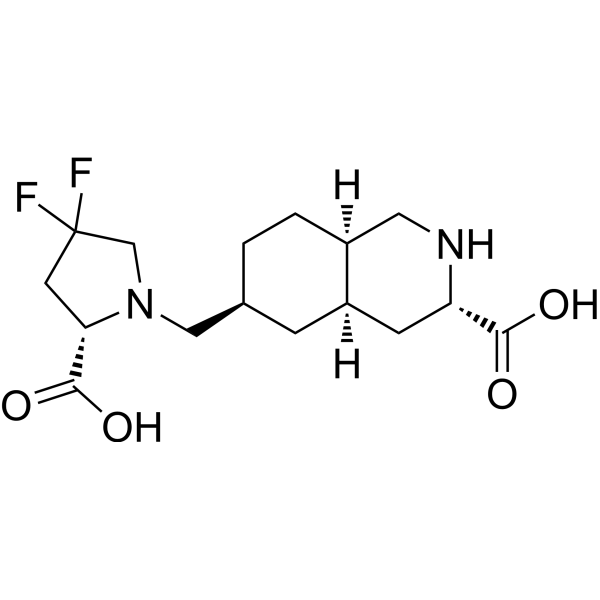
LY-466195 is a selective and competitive GLUK5 receptor antagonist. LY-466195 antagonizes Kainate-induced currents with an IC50 value of 0.045 μM in rat dorsal root ganglion neurons. In HEK293 cells transfected with GLUK5, GLUK2/GLUK5, or GLUK5/GLUK66 receptors, LY466195 produces IC50 values of 0.08 μM, 0.34 μM, and 0.07 μM, respectively.
For research use only. We do not sell to patients.
- CAS No.: 317844-33-0
- Formula: C16H24F2N2O4
- Molecular Weight:346.37
-
Storage:
Please store the product under the recommended conditions in the Certificate of Analysis.

To place orders, for customer services and technical support, please contact: MedChemExpress USA
Tel: 609-228-6898 E-mail: [email protected] [email protected]


-
 Biological Activity
-
Chemical Information
- Protocols
- Purity & Documentation
- References
-
 Help & FAQs


All iGluR Isoforms
More

Biological Activity
Description


Chemical Information
-
CAS No. 317844-33-0
-
Molecular Weight 346.37
-
Formula C16H24F2N2O4
-
SMILES
O=C([C@H]1NC[C@]2([H])CC[C@H](CN3[C@H](C(O)=O)CC(F)(F)C3)C[C@]2([H])C1)O
-
Shipping
Room temperature in continental US; may vary elsewhere.
-
Storage
Please store the product under the recommended conditions in the Certificate of Analysis.

Protocols
-
Cell Cytotoxicity Assay
Cytotoxicity assays are usually based on the assessment of cell membrane damage, which can also be indirectly detected by measuring cell viability. Detection methods include MTT assay, CKK-8 assay, LDH assay and ATP assay, etc.
-
Primary Dorsal Root Ganglion Sensory Neuron Culture
Primary dorsal root ganglion sensory neuron culture isolates DRG neuronal somata from rodent or human ganglia, dissociates tissue enzymatically and mechanically, and maintains post-mitotic sensory neurons in vitro for readouts such as neurite outgrowth, immunocytochemical marker expression, calcium imaging, electrophysiology, RNA/protein analysis, or neuropeptide release assays. The method reflects peripheral sensory neuron biology because DRG neurons are primary sensory neurons whose cell bodies reside in dorsal root ganglia and whose cultured dissociated cells can retain neuronal morphology, sensory-neuron marker expression, and stimulus-responsive properties depending on the downstream assay.


Purity & Documentation
References

Calculators
Concentration (start) × Volume (start) = Concentration (final) × Volume (final)


LY-466195 Related Classifications
HY-19858 Related Classifications
 Powered by Bioz