



Lysophosphatidylcholine C19:0

Based on 1 Customer Validation
Lysophosphatidylcholine C19:0 (19:0 Lyso PC) is a lysophosphatidylcholine with a fully saturated C19 acyl chain. When combined with LPS (HY-D1056), Lysophosphatidylcholine C19:0 induces the secretion of IL-1β by human monocyte-derived dendritic cells. Lysophosphatidylcholine C19:0 reduces the viability of monocyte-derived dendritic cells.
For research use only. We do not sell to patients.
- Purity : 99.0%
- CAS No.: 108273-88-7
- Formula: C27H56NO7P
- Molecular Weight:537.71
-
Storage:Powder -20°C, 3 years ; In solvent -80°C, 6 months , -20°C, 1 month


To place orders, for customer services and technical support, please contact: MedChemExpress USA
Tel: 609-228-6898 E-mail: [email protected] [email protected]


-
 Biological Activity
-
Chemical Information
- Protocols
- Purity & Documentation
- References
-
 Help & FAQs


-
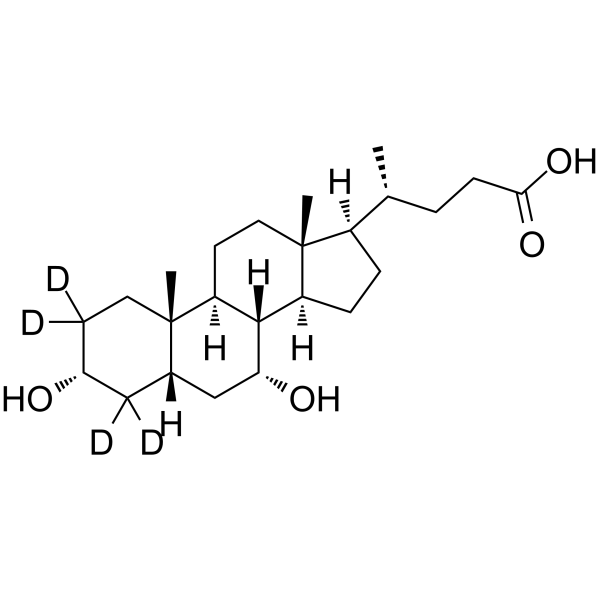
HY-76847S
Chenodeoxycholic Acid-d4Stable Isotope -
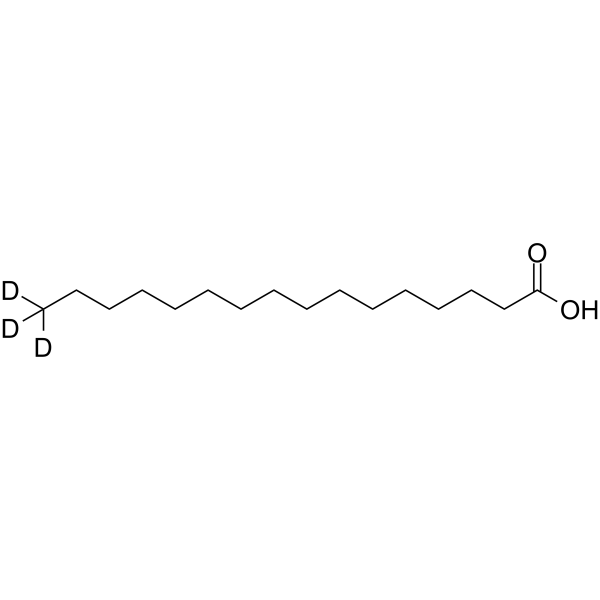
HY-N0830S5
Palmitic acid-d3Stable Isotope -
![[Leu5]-Enkephalin](https://file.medchemexpress.com/product_pic/hy-p0288.gif)
HY-P0288
[Leu5]-EnkephalinEndogenous Metabolite -
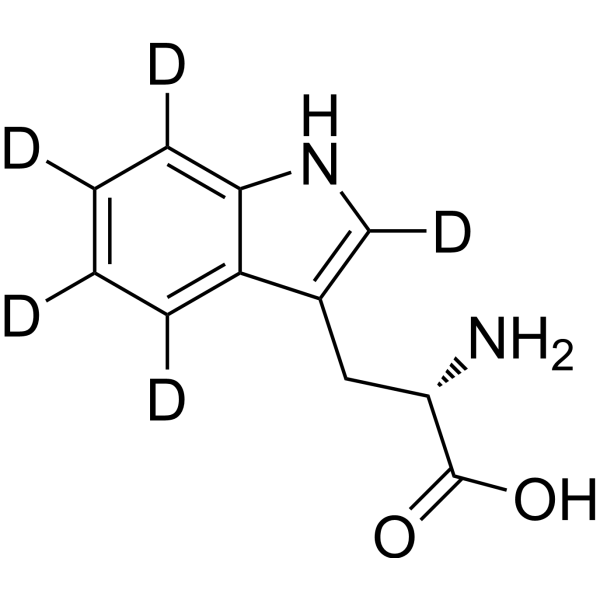
HY-N0623S
L-Tryptophan-d5Stable Isotope -
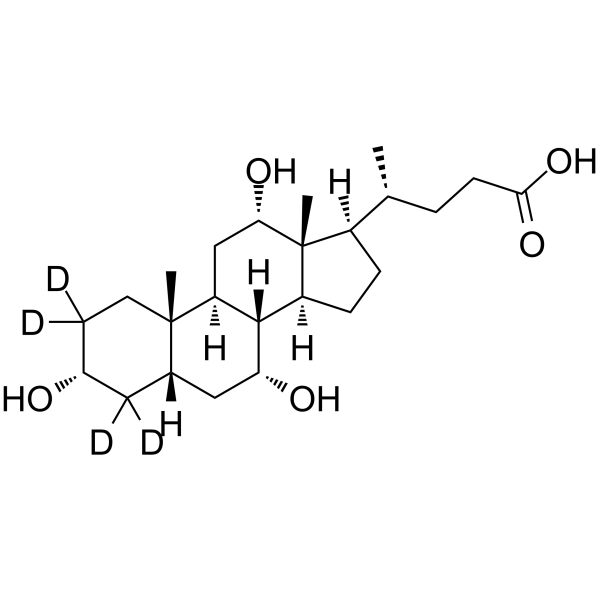
HY-N0324S
Cholic acid-d4Stable Isotope -

HY-W923642
Sphingomyelin (d18:1/12:0)Metabolomic Signature Of Hyperlipidemia -
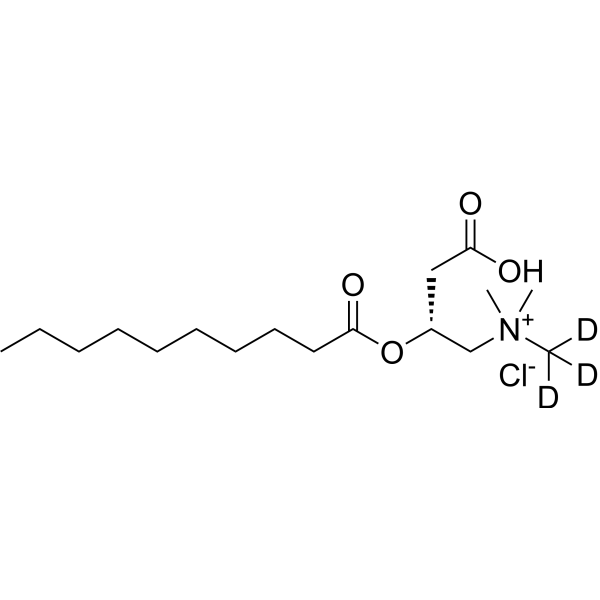
HY-132949S
Decanoyl-L-carnitine-d3 chlorideStable Isotope -
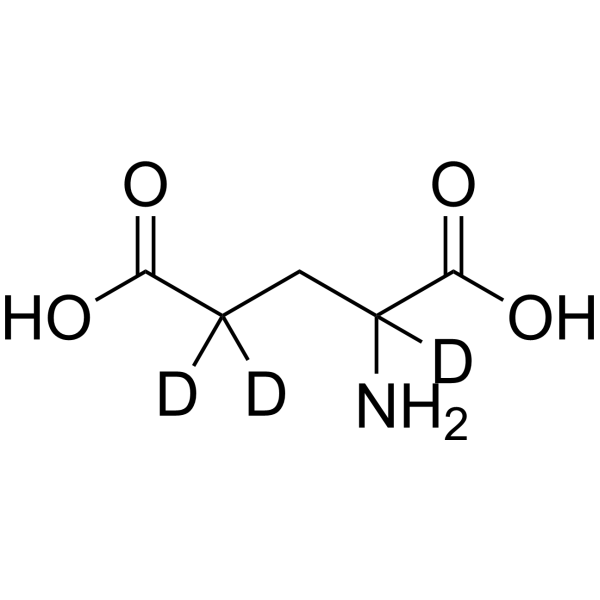
HY-W041895S1
DL-Glutamic acid-d3Stable Isotope


Biological Activity
Description
In Vitro
Lysophosphatidylcholine C19:0 (1.3-82.5 μM; 2 days) stimulates human monocyte-derived dendritic cells to secrete IL-1β in a concentration-dependent manner, with an activity index of 6.34 activity units, but causes dose-dependent reduction in cell viability[1].
MedChemExpress (MCE) has not independently confirmed the accuracy of these methods. They are for reference only. Further protocols information, click here.


Chemical Information
-
CAS No. 108273-88-7
-
Appearance Solid
-
Molecular Weight 537.71
-
Formula C27H56NO7P
-
Color White to off-white
-
SMILES
CCCCCCCCCCCCCCCCCCC(OC[C@@H](O)COP(OCC[N+](C)(C)C)([O-])=O)=O
-
Synonyms
1-Nonadecanoyl-2-hydroxy-sn-glycero-3-phosphocholine; 19:0 Lyso PC
-
Shipping
Room temperature in continental US; may vary elsewhere.
-
Storage
Powder -20°C 3 years In solvent -80°C 6 months -20°C 1 month

Protocols
-
Monocyte-derived dendritic cell differentiation
Human monocyte-derived dendritic cells are generated by isolating PBMC-derived monocytes and culturing them with GM-CSF plus IL-4, which produces cells with dendritic-cell antigen-presenting properties, reduced monocyte phenotype, and increased dendritic-cell functional readouts such as antigen uptake, allogeneic T-cell stimulation, and expression of markers including HLA-DR, CD80, CD86, CD83, CD1a, or CD209 depending on protocol and maturation state. The main readout is phenotypic and functional differentiation: immature MoDCs are commonly evaluated by loss or reduction of CD14 with acquisition of dendritic-cell markers and antigen uptake capacity, whereas mature MoDCs are evaluated by increased CD83, CD80, CD86, HLA-DR, and T-cell stimulatory function after exposure to maturation stimuli such as TNF-α or a cytokine/PGE2 cocktail.
-
Pyroptosis Solutions
Pyroptosis is a lytic inflammatory cell-death pathway executed by gasdermin pores, most classically through inflammasome-mediated activation of caspase-1, cleavage of gasdermin D, membrane pore formation, LDH release, and secretion of IL-1β and IL-18. The canonical pathway is commonly modeled by priming cells with an inflammatory signal such as LPS to induce pro-IL-1β and inflammasome components, followed by an activation signal such as ATP or nigericin to activate NLRP3, ASC speck formation, caspase-1 cleavage, GSDMD cleavage, cytokine release, and pyroptotic membrane rupture. The non-canonical pathway is triggered when cytosolic LPS activates mouse caspase-11 or human caspase-4/5, leading to GSDMD cleavage and pyroptosis, and this can secondarily activate NLRP3-dependent IL-1β release. Pyroptosis is linked to inflammatory injury, infection, cancer, liver disease, ocular disease, placental inflammation, and other disease phenotypes, but unresolved questions include which gasdermin fam
-
Cell Viability Determination by MTT Colorimetric Assay
The following protocol uses the MTT colorimetric assay as a classic literature-established method for assessing cell viability/metabolic activity in cultured mammalian cells. MTT[3-(4,5-dimethylthiazol-2-yl)-2,5-diphenyltetrazolium bromide] is reduced by metabolically active cells to a colored formazan product; the amount of formazan is quantified spectrophotometrically and provides an indirect measure of metabolically active viable cells. Importantly, MTT reduction reflects cellular oxidoreductase/metabolic activity rather than an absolute direct count of living cells, so changes in cellular metabolism can alter the signal independently of cell number.


Purity & Documentation
-
Data Sheet (263 KB)
-
SDS (254 KB)
- English - EN (254 KB)
- Français - FR (254 KB)
- Deutsch - DE (254 KB)
- Norwegian - NO (254 KB)
- Español - ES (254 KB)
- Swedish - SV (254 KB)
- Italian - IT (254 KB)
- Korean - KR (254 KB)
- Portuguese - PT (254 KB)
-
Handling Instructions (2659 KB)
References

Calculators
Concentration (start) × Volume (start) = Concentration (final) × Volume (final)


Lysophosphatidylcholine C19:0 Related Classifications
HY-154830 Related Classifications
 Powered by Bioz
Keywords
- Lysophosphatidylcholine C19:0
- 108273-88-7
- 1-Nonadecanoyl-2-hydroxy-sn-glycero-3-phosphocholine
- 19:0 Lyso PC
- Liposome
- Interleukin Related
- human PBMCs
- B16-F10 melanoma-bearing mice
- non-human primate moDCs
- Th17 memory CD4+ T cells
- murine BMDCs
- Th1 memory CD4+ T cells
- IL-1β
- canine PBMCs
- LPS
- human monocyte-derived dendritic cells
- Inhibitor
- inhibitor
- inhibit