



Mabuterol

Based on 1 Customer Validation
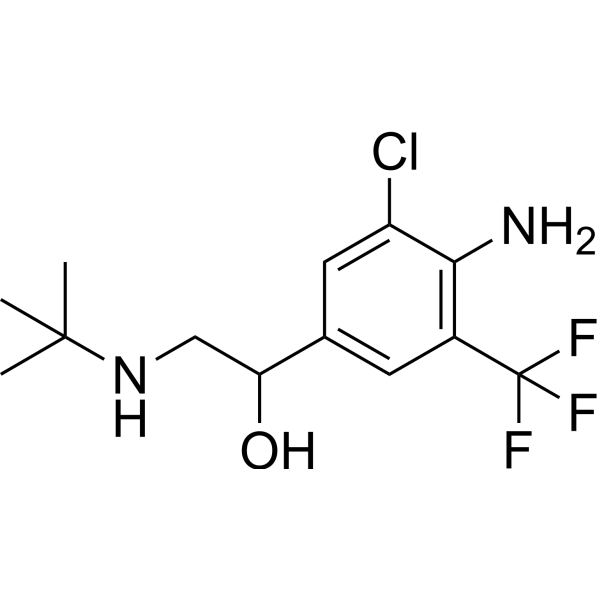
Mabuterol is a selective and orally active beta-2 adrenergic receptor (ADRB2) agonist. Mabuterol inhibits the proliferation and suppresses the increase of intracellular Ca2+ induced by PDGF-BB. Mabuterol suppresses the protein expressions of Drp-1, cyclinD1 and PCNA and enhanced the expression of Mfn-2 induced by PDGF-BB.
For research use only. We do not sell to patients.
- Purity : 99.96%
- CAS No.: 56341-08-3
- Formula: C13H18ClF3N2O
- Molecular Weight:310.74
-
Storage:
4°C, protect from light
* In solvent : -80°C, 6 months; -20°C, 1 month (protect from light)

To place orders, for customer services and technical support, please contact: MedChemExpress USA
Tel: 609-228-6898 E-mail: [email protected] [email protected]


-
 Biological Activity
-
Chemical Information
-
Solvent & Solubility
- Protocols
- Purity & Documentation
- References
-
 Help & FAQs


-
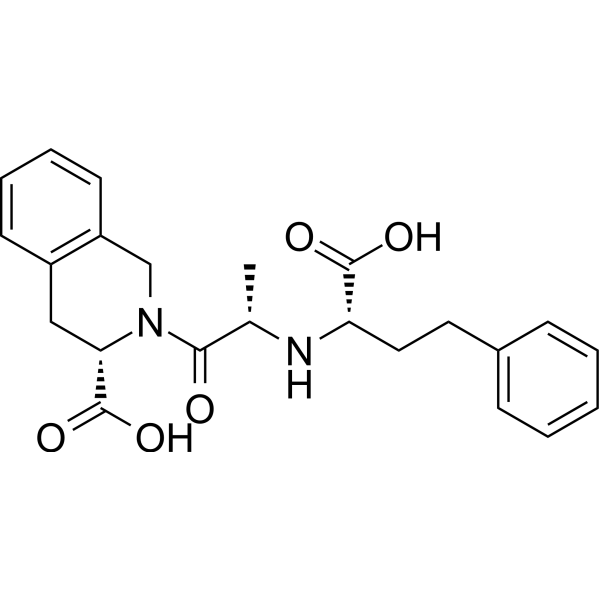
HY-127026
QuinaprilatACE Inhibitor -
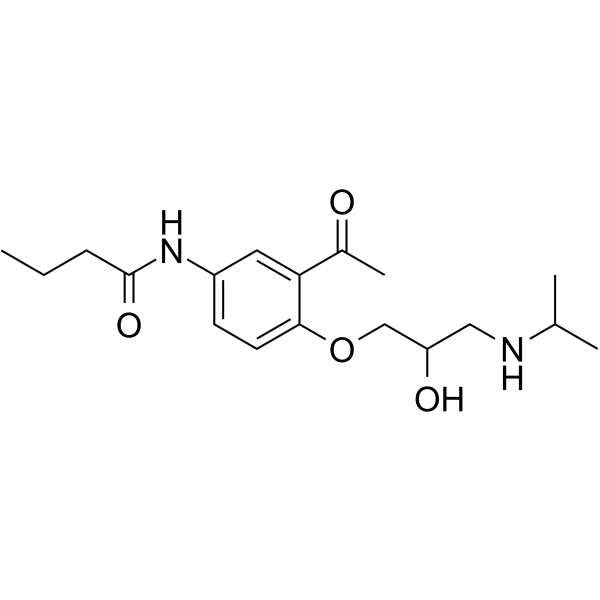
HY-17497
Acebutololβ1 Adrenergic Receptor Antagonist -

HY-13338R
Mabuterol (Standard)ADRB2 Agonist -

HY-127026R
Quinaprilat (Standard)ACE Inhibitor -
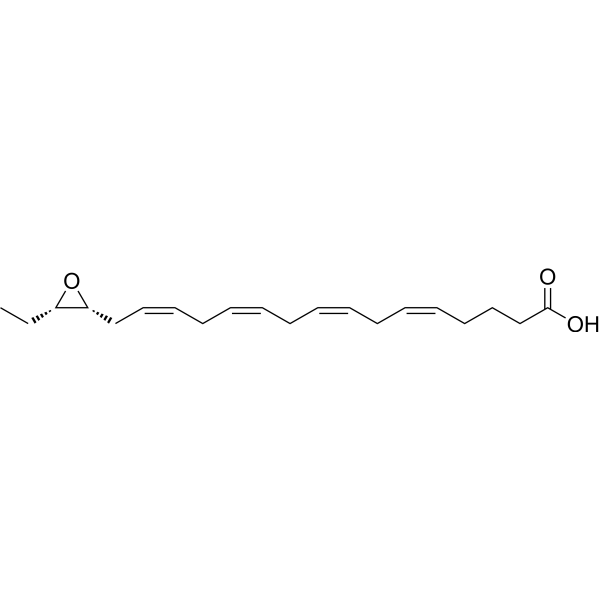
HY-113040A
(17R,18S)-Epoxyeicosatetraenoic acidBKα Activator -
HY-100623
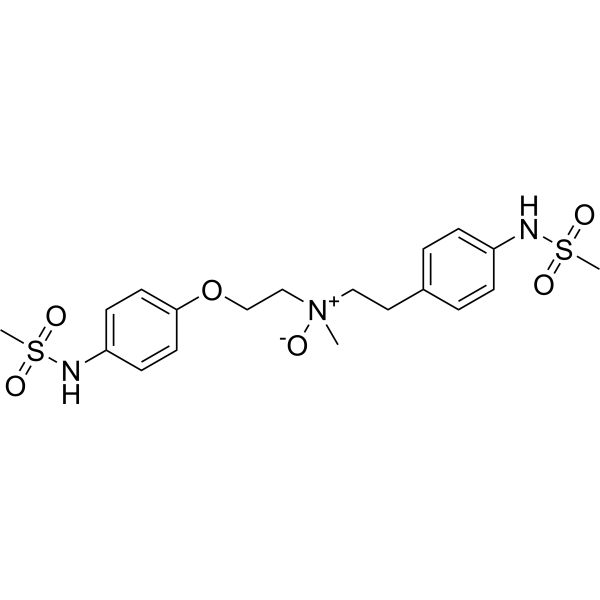
Dofetilide N-oxideAntiarrhythmic Agent -
HY-B1589AS
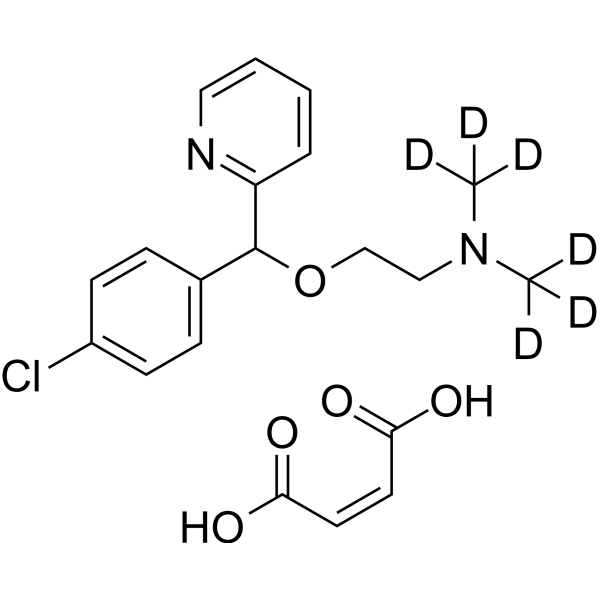
Carbinoxamine-d6 maleateStable?Isotope
All Adrenergic Receptor Isoforms
More

Biological Activity
Description
|
Beta-2 adrenergic receptor |
In Vitro
Mabuterol (10-60 µM; 48 h) inhibits the proliferation of ASMCs induced by PDGF-BB[2].
Mabuterol (50 µM; 1h) suppresses the increase of intracellular Ca2+ induced by PDGF-BB (25 ng/ml)[2].
Mabuterol (50 µM; 48 h) significantly suppresses the protein expressions of Drp-1, cyclinD1 and PCNA and enhanced the expression of Mfn-2 induced by PDGF-BB[2].
MedChemExpress (MCE) has not independently confirmed the accuracy of these methods. They are for reference only. Further protocols information, click here.
-
Cell Line:rat ASMCs[2]
-
Concentration:10, 20, 30, 40, 50, 60 µM
-
Incubation Time:24, 48 h
-
Result:Inhibited the proliferation of ASMCs induced by PDGF-BB (25 ng/ml) in a dose-dependent maner at 48 h.


Chemical Information
-
CAS No. 56341-08-3
-
Appearance Solid
-
Molecular Weight 310.74
-
Formula C13H18ClF3N2O
-
Color White to off-white
-
SMILES
CC(NCC(O)C1=CC(C(F)(F)F)=C(N)C(Cl)=C1)(C)C
-
Shipping
Room temperature in continental US; may vary elsewhere.
-
Storage
4°C, protect from light
* In solvent : -80°C, 6 months; -20°C, 1 month (protect from light)


Solvent & Solubility
In Vitro:
DMSO : 125 mg/mL (402.27 mM; Need ultrasonic; Hygroscopic DMSO has a significant impact on the solubility of product, please use newly opened DMSO)
Please refer to the solubility information to select the appropriate solvent. Once prepared, please aliquot and store the solution to prevent product inactivation from repeated freeze-thaw cycles.
Storage method and period of stock solution: -80°C, 6 months; -20°C, 1 month (protect from light). When stored at -80°C, please use it within 6 months. When stored at -20°C, please use it within 1 month.
Please refer to the solubility information to select the appropriate solvent. Once prepared, please aliquot and store the solution to prevent product inactivation from repeated freeze-thaw cycles.
Storage method and period of stock solution: -80°C, 6 months; -20°C, 1 month (protect from light). When stored at -80°C, please use it within 6 months. When stored at -20°C, please use it within 1 month.
Concentration (start) × Volume (start) = Concentration (final) × Volume (final)

Protocols
-
RNA extraction experimental
By lysing cells, releasing RNA, and removing impurities such as proteins and DNA, high-purity RNA products are finally obtained. The commonly used traditional method is the guanidine isothiocyanate/phenol/chloroform method (Trizol), which is suitable for a variety of animal materials including animal tissues, microorganisms, cultured cells, etc., and most plant materials.
-
PCNA Immunodetection Proliferation Assay
PCNA immunodetection measures proliferative activity by detecting proliferating cell nuclear antigen, a nuclear protein associated with DNA polymerase δ function and DNA replication. The assay readout is the proportion of PCNA-positive nuclei among total counted cells, but PCNA labeling is not identical to BrdU labeling because PCNA can mark late G1/early S-associated replication competence and may persist beyond active DNA synthesis depending on fixation and extraction conditions.
-
Ca2+ Staining Technique
Ca2+ staining is an experimental technique that utilizes specific fluorescent probes (such as Fluo-4 AM, Fura-2, etc.) to qualitatively or quantitatively detect dynamic changes in intracellular Ca2+ concentrations; this is achieved by monitoring the changes in fluorescent signals generated when these probes bind to free intracellular calcium ions. The underlying principle relies primarily on the presence of chelating groups within the probe's molecular structure that possess high affinity for calcium ions.
-
Cell Viability Determination by MTT Colorimetric Assay
The following protocol uses the MTT colorimetric assay as a classic literature-established method for assessing cell viability/metabolic activity in cultured mammalian cells. MTT[3-(4,5-dimethylthiazol-2-yl)-2,5-diphenyltetrazolium bromide] is reduced by metabolically active cells to a colored formazan product; the amount of formazan is quantified spectrophotometrically and provides an indirect measure of metabolically active viable cells. Importantly, MTT reduction reflects cellular oxidoreductase/metabolic activity rather than an absolute direct count of living cells, so changes in cellular metabolism can alter the signal independently of cell number.


Purity & Documentation
-
Data Sheet (272 KB)
-
SDS (420 KB)
- English - EN (420 KB)
- Français - FR (420 KB)
- Deutsch - DE (420 KB)
- Norwegian - NO (420 KB)
- Español - ES (420 KB)
- Swedish - SV (420 KB)
- Italian - IT (420 KB)
- Korean - KR (420 KB)
- Portuguese - PT (420 KB)
-
Handling Instructions (2659 KB)
References


Complete Stock Solution Preparation Table
Please refer to the solubility information to select the appropriate solvent. Once prepared, please aliquot and store the solution to prevent product inactivation from repeated freeze-thaw cycles.
Storage method and period of stock solution: -80°C, 6 months; -20°C, 1 month (protect from light). When stored at -80°C, please use it within 6 months. When stored at -20°C, please use it within 1 month.
| Optional Solvent | Concentration Solvent Mass | 1 mg | 5 mg | 10 mg | 25 mg |
|---|---|---|---|---|---|
| DMSO | 1 mM | 3.2181 mL | 16.0906 mL | 32.1812 mL | 80.4531 mL |
| 5 mM | 0.6436 mL | 3.2181 mL | 6.4362 mL | 16.0906 mL | |
| 10 mM | 0.3218 mL | 1.6091 mL | 3.2181 mL | 8.0453 mL | |
| 15 mM | 0.2145 mL | 1.0727 mL | 2.1454 mL | 5.3635 mL | |
| 20 mM | 0.1609 mL | 0.8045 mL | 1.6091 mL | 4.0227 mL | |
| 25 mM | 0.1287 mL | 0.6436 mL | 1.2872 mL | 3.2181 mL | |
| 30 mM | 0.1073 mL | 0.5364 mL | 1.0727 mL | 2.6818 mL | |
| 40 mM | 0.0805 mL | 0.4023 mL | 0.8045 mL | 2.0113 mL | |
| 50 mM | 0.0644 mL | 0.3218 mL | 0.6436 mL | 1.6091 mL | |
| 60 mM | 0.0536 mL | 0.2682 mL | 0.5364 mL | 1.3409 mL | |
| 80 mM | 0.0402 mL | 0.2011 mL | 0.4023 mL | 1.0057 mL | |
| 100 mM | 0.0322 mL | 0.1609 mL | 0.3218 mL | 0.8045 mL |


Mabuterol Related Classifications
HY-13338 Related Classifications
 Powered by Bioz