



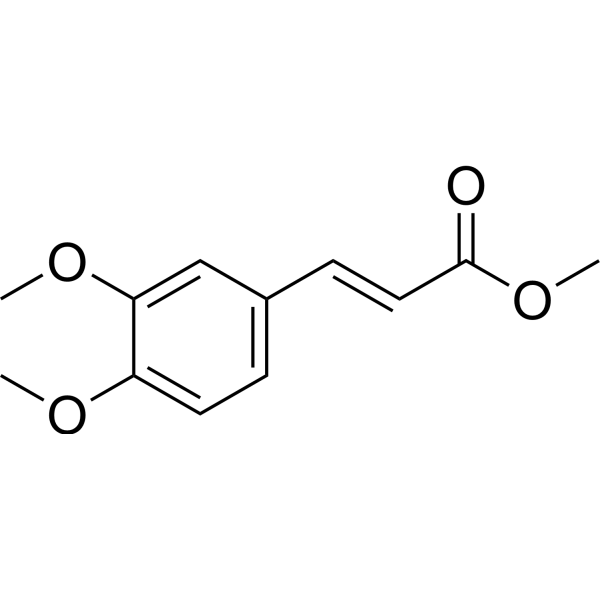
Methyl 3,4-dimethoxycinnamate
Methyl 3,4-dimethoxycinnamate is an inhibitor of uredospore germination. Methyl 3,4-dimethoxycinnamate also inhibits global DNA methylation in in Hep3B cells.
Nos produits utilisent uniquement pour la recherche. Nous ne vendons pas aux patients.
- CAS No.: 5396-64-5
- Formule: C12H14O4
- Masse moléculaire:222.24
-
Stockage:Powder -20°C, 3 years ; In solvent -80°C, 6 months , -20°C, 1 month

To place orders, for customer services and technical support, please contact: MedChemExpress USA
Tel: 609-228-6898 E-mail: [email protected] [email protected]


-
 Activité biologique
-
Chemical Information
- Protocole
- Pureté et documentation
- Références
-
 Help & FAQs




Activité biologique
Description
Cellular Effect
|
Cell Line

|
Type | Value | Description | References |
|---|---|---|---|---|
| A-431 | IC50 |
>30 μg/mL
Compound: 4k
|
Inhibitory concentration required against A 431 human epidermoid carcinoma cell line
Inhibitory concentration required against A 431 human epidermoid carcinoma cell line
|
[PMID: 11354370] |
| B16 | IC50 |
>30 μg/mL
Compound: 4k
|
Inhibitory concentration against B16 murine melanoma cell line
Inhibitory concentration against B16 murine melanoma cell line
|
[PMID: 11354370] |
| HCT-116 | IC50 |
>30 μg/mL
Compound: 4k
|
Inhibitory concentration against HCT 116 human colon cancer cell line
Inhibitory concentration against HCT 116 human colon cancer cell line
|
[PMID: 11354370] |


Chemical Information
-
CAS No. 5396-64-5
-
Appearance Solid
-
Masse moléculaire 222.24
-
Formule C12H14O4
-
Color White to off-white
-
SMILES
O=C(OC)/C=C/C1=CC=C(OC)C(OC)=C1
-
Structure Classification
-
Livraison
Room temperature in continental US; may vary elsewhere.
-
Stockage
Powder -20°C 3 years In solvent -80°C 6 months -20°C 1 month

Protocole
-
Research Protocol for Epigenomic Data Analysis
Epigenomic data analysis identifies genome-wide regulatory features that influence gene expression, chromatin state, and phenotype without changing the underlying DNA sequence. In this strategy, the core regulatory layer includes chromatin accessibility, transcription-factor or histone-mark occupancy, DNA methylation, and chromatin-state patterns; these features are measured by sequencing-based assays and interpreted as regulatory elements, promoters, enhancers, repressive domains, methylated cytosines, or candidate phenotype-associated chromatin programs. The literature links epigenomic features to phenotype by showing that functional genomic elements can be mapped across human cell types and tissues, and that integrated epigenomic maps reveal cell-type-specific regulatory programs. ENCODE integrated transcription, chromatin accessibility, transcription-factor occupancy, and histone modification data to annotate functional elements in the human genome, while the Roadmap Epigenomics Co


Pureté et documentation
-
Fiche technique (265 KB)
-
SDS (252 KB)
- Français - FR (252 KB)
- Deutsch - DE (252 KB)
- Norwegian - NO (252 KB)
- Español - ES (252 KB)
- Swedish - SV (252 KB)
- Italian - IT (252 KB)
- Korean - KR (252 KB)
- Portuguese - PT (252 KB)
-
Instruction de manipulation (2659 KB)
Références
[1]. Macko V, et al. Self-inhibitor of bean rust uredospores: methyl 3,4-dimethoxycinnamate. Science. 1970 Oct 30;170(3957):539-40. [Content Brief]
[2]. Castro-Vazquez D, et al. Methyl benzoate and cinnamate analogs as modulators of DNA methylation in hepatocellular carcinoma. Chem Biol Drug Des. 2022 Aug;100(2):245-255. [Content Brief]

Calculators
Concentration (start) × Volume (start) = Concentration (final) × Volume (final)


Methyl 3,4-dimethoxycinnamate Related Classifications
HY-W242821 Related Classifications
 Powered by Bioz