



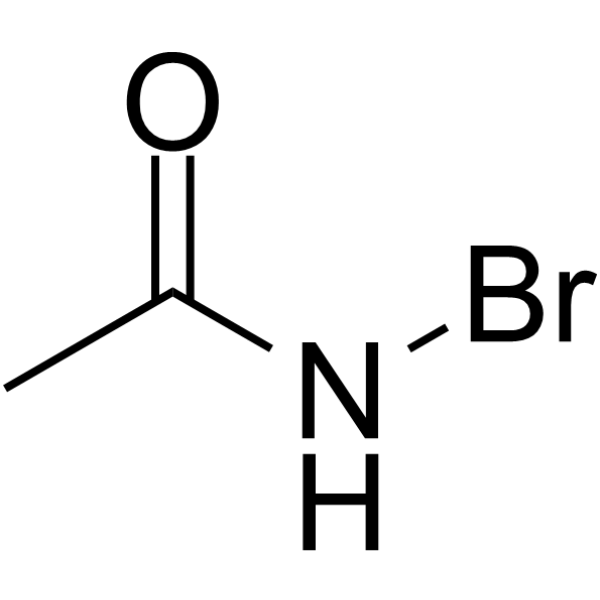
N-Bromoacetamide

Based on 1 Customer Validation
N-Bromoacetamide is an ion channel modulator that modifies proteins by cleaving peptide bonds. N-Bromoacetamide prolongs sodium channel opening time, increases Na+ influx, and eliminates fast inactivation of voltage-gated Na+ channels. N-Bromoacetamide irreversibly eliminates the calcium-dependent component of calcium-activated potassium channel opening and reduces channel open probability. N-Bromoacetamide slows the inactivation of inactivating K+ currents. N-Bromoacetamide also exhibits anti-enterovirus 71 (EV71) activity, inhibiting EV71 replication, reducing viral yield, and alleviating EV71-induced cytopathic effects. N-Bromoacetamide can be used in research on enterovirus infection.
For research use only. We do not sell to patients.
- Purity : 98.0%
- CAS No.: 79-15-2
- Formula: C2H4BrNO
- Molecular Weight:137.96
-
Storage:Powder -20°C, 3 years , 4°C, 2 years ; In solvent -80°C, 6 months , -20°C, 1 month

To place orders, for customer services and technical support, please contact: MedChemExpress USA
Tel: 609-228-6898 E-mail: [email protected] [email protected]


-
 Biological Activity
-
Chemical Information
-
Solvent & Solubility
- Protocols
- Purity & Documentation
- References
-
 Help & FAQs




Biological Activity
Description
IC50 & Target
Cellular Effect
|
Cell Line

|
Type | Value | Description | References |
|---|---|---|---|---|
| RD | CC50 |
138 μM
|
Cytotoxicity against human rhabdomyosarcoma RD cells infected with EV71 assessed as reduction in cell viability.
Cytotoxicity against human rhabdomyosarcoma RD cells infected with EV71 assessed as reduction in cell viability.
|
27873071 |
In Vitro
N-Bromoacetamide (1.25-5 μM) exhibited dose-dependent anti-EV71 activity in HeLa-G2AwtR cells[1].
N-Bromoacetamide (1.25-10 μM; 12 h) inhibits EV71 viral production in RD cells in a dose-dependent manner at non-toxic concentrations[1].
N-Bromoacetamide (NBA) (0.3-1 mM; 2-8 min) irreversibly removes the calcium-dependent channel-opening component of large-conductance calcium-activated potassium channels in cultured rat skeletal muscle myotubes while preserving the voltage-sensitive activity component, with single-channel conductance (267 pS) unaffected[2].
N-bromoacetamide can gradually slow the inactivation of IK (i) and increase the peak current in GH3 cells[3].
N-bromoacetamide (100 μM; 2 min) shifts the steady-state inactivation-voltage relationship in the depolarizing direction and alters inactivation in GH3 cells regardless of the holding potential[3].
N-bromoacetamide reversibly prolongs the open time of single K+ channels in excised outside-out patches from GH3 cells without changing single-channel conductance, but does not affect channels in on-cell patches[3].
N-bromoacetamide can eliminate the fast inactivation of Na+ channels in N1E-115 mouse neuroblastoma cells, keeping them in a steady-state open state during sustained depolarization and exhibiting hibernation under continuous depolarizing stimulation[4].
MedChemExpress (MCE) has not independently confirmed the accuracy of these methods. They are for reference only. Further protocols information, click here.


Chemical Information
-
CAS No. 79-15-2
-
Appearance Solid
-
Molecular Weight 137.96
-
Formula C2H4BrNO
-
Color Off-white to light yellow
-
SMILES
CC(NBr)=O
-
Shipping
Room temperature in continental US; may vary elsewhere.
-
Storage
Powder -20°C 3 years 4°C 2 years In solvent -80°C 6 months -20°C 1 month


Solvent & Solubility
In Vitro:
H2O : 100 mg/mL (724.85 mM; Need ultrasonic)
Please refer to the solubility information to select the appropriate solvent. Once prepared, please aliquot and store the solution to prevent product inactivation from repeated freeze-thaw cycles.
Storage method and period of stock solution: -80°C, 6 months; -20°C, 1 month. When stored at -80°C, please use it within 6 months. When stored at -20°C, please use it within 1 month.
* Note: If you choose water as the stock solution, please dilute it to the working solution, then filter and sterilize it with a 0.22 μm filter before use.
Please refer to the solubility information to select the appropriate solvent. Once prepared, please aliquot and store the solution to prevent product inactivation from repeated freeze-thaw cycles.
Storage method and period of stock solution: -80°C, 6 months; -20°C, 1 month. When stored at -80°C, please use it within 6 months. When stored at -20°C, please use it within 1 month.
* Note: If you choose water as the stock solution, please dilute it to the working solution, then filter and sterilize it with a 0.22 μm filter before use.
Concentration (start) × Volume (start) = Concentration (final) × Volume (final)

Protocols
-
Research Protocol for Infectious Diseases
Infectious-disease experiments test how pathogens interact with host barriers, innate immune receptors, inflammatory signaling, pathogen replication, and tissue injury; pattern-recognition receptors such as TLRs, RIG-I-like receptors, NOD-like receptors, and inflammasomes detect microbial molecules and activate NF-κB, interferon, and cytokine responses. The central hypothesis is that infection severity reflects the balance between pathogen burden and host response: protective inflammation restricts pathogen growth, whereas excessive or mislocalized inflammation contributes to tissue damage and disease phenotype. Unresolved questions include which host pathways are protective versus pathogenic, why some infection models fail to translate to human disease, and which combined readouts best predict clinically relevant infection outcomes.
-
Two-electrode voltage clamp in Xenopus oocytes
Two-electrode voltage clamp measures whole-oocyte membrane current from Xenopus oocytes expressing exogenous ion channels, receptors, or transporters; one intracellular microelectrode senses membrane voltage, and the second injects current so the amplifier can hold the membrane at command voltages while recording the compensating current as the functional readout. The method is suited to Xenopus oocytes because their large size supports microinjection and intracellular electrode impalement, but the large membrane area can limit voltage-clamp speed and accuracy, especially for large or fast currents.


Purity & Documentation
-
Data Sheet (273 KB)
-
SDS (476 KB)
- English - EN (476 KB)
- Français - FR (476 KB)
- Deutsch - DE (476 KB)
- Norwegian - NO (476 KB)
- Español - ES (476 KB)
- Swedish - SV (476 KB)
- Italian - IT (476 KB)
- Korean - KR (476 KB)
- Portuguese - PT (476 KB)
-
Handling Instructions (2659 KB)
References


Complete Stock Solution Preparation Table
Please refer to the solubility information to select the appropriate solvent. Once prepared, please aliquot and store the solution to prevent product inactivation from repeated freeze-thaw cycles.
Storage method and period of stock solution: -80°C, 6 months; -20°C, 1 month. When stored at -80°C, please use it within 6 months. When stored at -20°C, please use it within 1 month.
| Optional Solvent | Concentration Solvent Mass | 1 mg | 5 mg | 10 mg | 25 mg |
|---|---|---|---|---|---|
| H2O | 1 mM | 7.2485 mL | 36.2424 mL | 72.4848 mL | 181.2119 mL |
| 5 mM | 1.4497 mL | 7.2485 mL | 14.4970 mL | 36.2424 mL | |
| 10 mM | 0.7248 mL | 3.6242 mL | 7.2485 mL | 18.1212 mL | |
| 15 mM | 0.4832 mL | 2.4162 mL | 4.8323 mL | 12.0808 mL | |
| 20 mM | 0.3624 mL | 1.8121 mL | 3.6242 mL | 9.0606 mL | |
| 25 mM | 0.2899 mL | 1.4497 mL | 2.8994 mL | 7.2485 mL | |
| 30 mM | 0.2416 mL | 1.2081 mL | 2.4162 mL | 6.0404 mL | |
| 40 mM | 0.1812 mL | 0.9061 mL | 1.8121 mL | 4.5303 mL | |
| 50 mM | 0.1450 mL | 0.7248 mL | 1.4497 mL | 3.6242 mL | |
| 60 mM | 0.1208 mL | 0.6040 mL | 1.2081 mL | 3.0202 mL | |
| 80 mM | 0.0906 mL | 0.4530 mL | 0.9061 mL | 2.2651 mL | |
| 100 mM | 0.0725 mL | 0.3624 mL | 0.7248 mL | 1.8121 mL |
* Note: If you choose water as the stock solution, please dilute it to the working solution, then filter and sterilize it with a 0.22 μm filter before use.


N-Bromoacetamide Related Classifications
HY-131899 Related Classifications
 Powered by Bioz
Keywords
- N-Bromoacetamide
- 79-15-2
- Potassium Channel
- Sodium Channel
- Enterovirus
- large-conductance calcium-activated potassium channels
- enterovirus 71
- HeLa-G2AwtR cells
- rat skeletal muscle myotubes
- EV71 replication
- enterovirus inhibitor
- GH3 cells
- N1E-115 mouse neuroblastoma cells
- RD cells
- sodium channel modulator
- Inhibitor
- inhibitor
- inhibit