



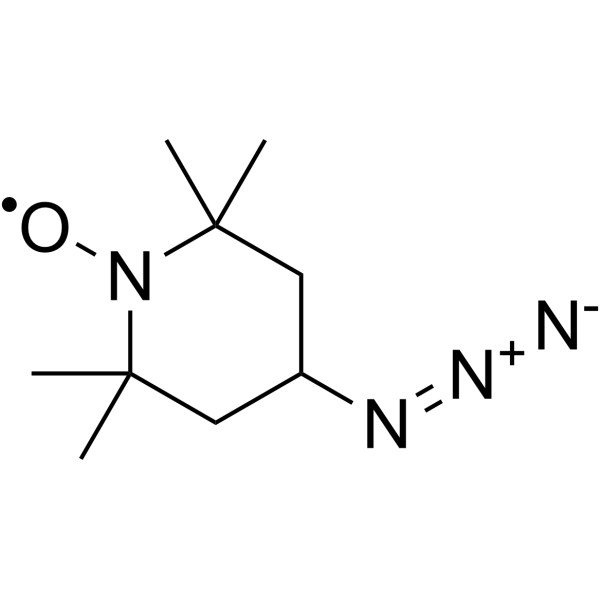
N3-TEMPO
Based on 2 publication(s) in Google Scholar
N3-TEMPO is a click chemistry reagent containing an azide group. Click chemistry has great potential for use in binding between nucleic acids, lipids, proteins, and other molecules, and has been used in many research fields because of its beneficial characteristics, including high yield, high specificity, and simplicity. It contains an azide group and can undergo copper-catalyzed azide-alkyne cycloaddition (CuAAc) with molecules containing alkyne groups. It can also undergo ring strain-promoted alkyne-azide cycloaddition (SPAAC) with molecules containing DBCO or BCN groups.
Nur für Forschungszwecke. Wir verkaufen nicht an Patienten.
- Reinheit : 99.20%
- CAS. Nr.: 63697-61-0
- Formel: C9H17N4O*
- Molecular Weight:197.26
-
Speicherung:
-20°C, protect from light, stored under nitrogen
* In solvent : -80°C, 6 months; -20°C, 1 month (protect from light, stored under nitrogen)

To place orders, for customer services and technical support, please contact: MedChemExpress USA
Tel: 609-228-6898 E-mail: [email protected] [email protected]


-
 Biologische Aktivität
-
Chemical Information
- Protokoll
- Reinheit & Dokumentation
- Verweise
-
 Help & FAQs


Publications Citing Use of MedChemExpress (MCE) N3-TEMPO
MoreAlle ADC Linkers Isoform-spezifische Produkte anzeigen
More

Biologische Aktivität
Beschreibung


Chemical Information
-
CAS. Nr. 63697-61-0
-
Appearance Solid
-
Molecular Weight 197.26
-
Formel C9H17N4O*
-
Color Yellow to orange
-
SMILES
CC1(C)CC(N=[N+]=[N-])CC(C)(C)N1[O]
-
Versand
Room temperature in continental US; may vary elsewhere.
-
Speicherung
-20°C, protect from light, stored under nitrogen
* In solvent : -80°C, 6 months; -20°C, 1 month (protect from light, stored under nitrogen)


Publications (2)
-
Journal Impact Factor
-
Most Recent


Reinheit & Dokumentation
-
Data Sheet (267 KB)
-
SDS (252 KB)
- English - EN (252 KB)
- Français - FR (252 KB)
- Deutsch - DE (252 KB)
- Norwegian - NO (252 KB)
- Español - ES (252 KB)
- Swedish - SV (252 KB)
- Italian - IT (252 KB)
- Korean - KR (252 KB)
- Portuguese - PT (252 KB)
-
Handling Instructions (2659 KB)
Verweise

Calculators
Konzentration (Stammlösung) × Volumen (Stammlösung) = Konzentration (Ziellösung) × Volumen (Ziellösung)


N3-TEMPO Related Classifications
HY-151847 Related Classifications
 Powered by Bioz