



NB-598 hydrochloride
Based on 16 publication(s) in Google Scholar
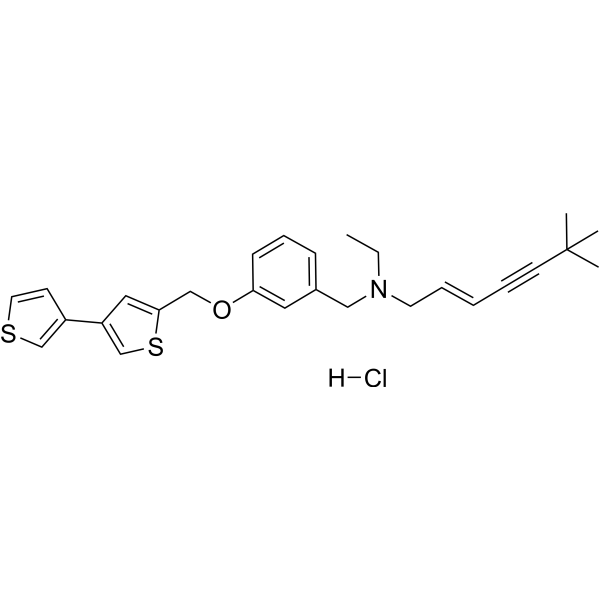
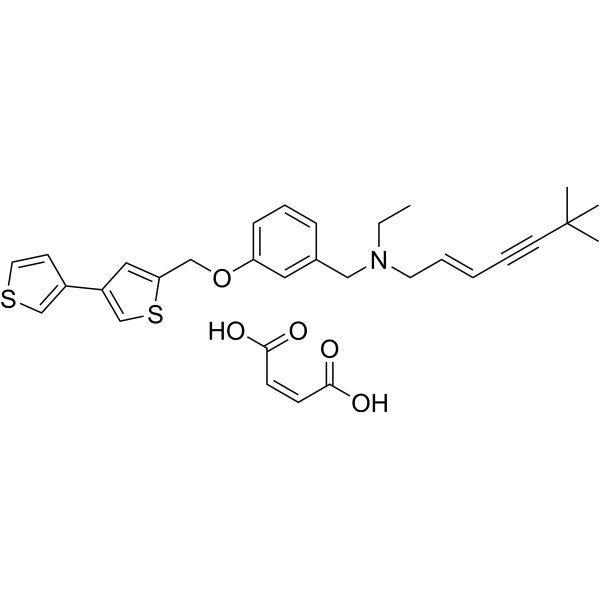
NB-598 hydrochloride is a potent and competitive inhibitor of squalene epoxidase (SE), and suppresses triglyceride biosynthesis through the farnesol pathway. NB-598 (hydrochloride) is a click chemistry reagent, it contains an Alkyne group and can undergo copper-catalyzed azide-alkyne cycloaddition (CuAAc) with molecules containing Azide groups.
Nur für Forschungszwecke. Wir verkaufen nicht an Patienten.
- CAS. Nr.: 136719-25-0
- Formel: C27H32ClNOS2
- Molecular Weight:486.13
-
Speicherung:
Please store the product under the recommended conditions in the Certificate of Analysis.

To place orders, for customer services and technical support, please contact: MedChemExpress USA
Tel: 609-228-6898 E-mail: [email protected] [email protected]


-
 Biologische Aktivität
-
Chemical Information
- Protokoll
- Reinheit & Dokumentation
- Verweise
-
 Help & FAQs



Publications Citing Use of MedChemExpress (MCE) NB-598 hydrochloride
More- Cell Metab. 2020 Apr 7;31(4):862-877.e14. [Abstract]
- Cancer Res. 2022 Sep 2;82(17):3032-3044. [Abstract]
- Nat Chem Biol. 2016 Jul;12(7):497-503. [Abstract]
- Adv Sci (Weinh). 2023 Sep;10(27):e2206878. [Abstract]
- Cell Death Dis. 2021 May 13;12(5):482. [Abstract]
- Cancer Lett. 2025 Sep 1:627:217810. [Abstract]
- Sci China Life Sci. 2022 Feb;65(2):341-361. [Abstract]
- Genome Biol. 2016 Jun 29;17(1):140. [Abstract]
- Cell Chem Biol. 2021 Jun 17;28(6):866-875.e5. [Abstract]
- Antioxidants (Basel). 2024 Jun 13;13(6):722. [Abstract]
- Cell Rep. 2020 Aug 4;32(5):107944. [Abstract]
- Arch Pharm (Weinheim). 2025 Feb;358(2):e2400807. [Abstract]
- J Steroid Biochem Mol Biol. 2015 Aug:152:34-44. [Abstract]
- bioRxiv. 2026 Jun 18.
- bioRxiv. 2026 Jan 23:2026.01.22.701194. [Abstract]
- University of Toronto. 2022.
 Customer Validation & Images

-
WB

-
WB

-
Bio/Physico-chemical Assay

-
Bio/Physico-chemical Assay

-
Bio/Physico-chemical Assay


Biologische Aktivität
Beschreibung
IC50 & Target
squalene epoxidase
In Vitro
NB598 (10 μM) causes a 36±7% reduction in total cholesterol level of MIN6 cells. NB598 causes a significant decrease in cholesterol by 49±2%, 46±7%, and 48±2% from PM, ER, and SG, respectively. NB598 dose-dependently inhibits insulin secretion under both basal (1 mM glucose) and glucose-stimulated (16.7 mM glucose) conditions. NB598 at concentrations up to 10 μM does not affect peak outward KV currents or the voltage dependence of activation but increases current inactivation[1]. NB-598 (10 μM) inhibits the synthesis of sterol and sterol ester from [14C]acetate without affecting the synthesis of other lipids such as phospholipids (PL), free fatty acids (FFA) and triacylglycerol (TG). In the absence of exogenous liposomal cholesterol, NB-598 reduces ACAT activity by 31%. NB-598 reduces ACAT activity by 22% even in the presence of a 600 PM concentration of liposomal cholesterol[2]. NB-598 suppresses the secretion of cholesterol and triacylglycerol from HepG2 cells into the medium[3].
MedChemExpress (MCE) has not independently confirmed the accuracy of these methods. They are for reference only. Further protocols information, click here.


Chemical Information
-
CAS. Nr. 136719-25-0
-
Molecular Weight 486.13
-
Formel C27H32ClNOS2
-
SMILES
CCN(C/C=C/C#CC(C)(C)C)CC1=CC=CC(OCC2=CC(C3=CSC=C3)=CS2)=C1.[H]Cl
-
Versand
Room temperature in continental US; may vary elsewhere.
-
Speicherung
Please store the product under the recommended conditions in the Certificate of Analysis.


Publications (16)
-
Journal Impact Factor
-
Most Recent
-
Cell Metab
Single-Cell RNA Sequencing Maps Endothelial Metabolic Plasticity in Pathological Angiogenesis. [Abstract]2020 Apr 7;31(4):862-877.e14. PMID: 32268117 -
Cancer Res
Squalene Epoxidase Metabolic Dependency Is a Targetable Vulnerability in Castration-Resistant Prostate Cancer. [Abstract]2022 Sep 2;82(17):3032-3044. PMID: 35767703 -
Nat Chem Biol
2016 Jul;12(7):497-503. PMID: 27159577 -
Adv Sci (Weinh)
Targeting Squalene Epoxidase Confers Metabolic Vulnerability and Overcomes Chemoresistance in HNSCC. [Abstract]2023 Sep;10(27):e2206878. PMID: 37490552
NB-598 hydrochloride purchased from MedChemExpress. Usage Cited in: Adv Sci (Weinh). 2023 Sep;10(27):e2206878. [Abstract]
Time-course analysis of p-c-Myc T58, c-Myc, p-GSK-3β S9, GSK-3β, p-Akt S473, and Akt expression in SCC-1cisR and SCC-23cisR cells treated with NB-598 (1 µM).
NB-598 hydrochloride purchased from MedChemExpress. Usage Cited in: Adv Sci (Weinh). 2023 Sep;10(27):e2206878. [Abstract]
Time-course analysis of p-Akt S473 and Akt expression in lipid raft and nonraft components of SCC-1cisR and SCC-23cisR cells treated with DMSO or NB-598 (1 µM). Western blot analyses performed with indicated antibodies. β-actin or Flot2 serves as internal control for determining protein expression in nonraft components or lipid rafts, respectively.
-
Cell Death Dis
Targeting epigenetic modulation of cholesterol synthesis as a therapeutic strategy for head and neck squamous cell carcinoma. [Abstract]2021 May 13;12(5):482. PMID: 33986254 -
Cancer Lett
Fusobacterium nucleatum enhances cholesterol biosynthesis in colorectal cancer via miR-130a-3p-mediated AMPK inhibition, a process counteracted by butyrate. [Abstract]2025 Sep 1:627:217810. PMID: 40414519 -
Sci China Life Sci
2022 Feb;65(2):341-361. PMID: 34047913 -
Genome Biol
Genomic alterations underlie a pan-cancer metabolic shift associated with tumour hypoxia. [Abstract]2016 Jun 29;17(1):140. PMID: 27358048
NB-598 hydrochloride purchased from MedChemExpress. Usage Cited in: Genome Biol. 2016 Jun 29;17(1):140. [Abstract]
SQLE inhibition with NB-598 (1 nM-10 μM) reduces cell viability at a range of concentrations with a GI50 of 6 nM in HCC1806 and GI of 10.9 nM in DLD-1 under hypoxia (1 % O2) but not normoxia.
NB-598 hydrochloride purchased from MedChemExpress. Usage Cited in: Genome Biol. 2016 Jun 29;17(1):140. [Abstract]
Clonogenic analysis of SQLE. Clonogenic analysis of SQLE inhibition by NB-598 (30 nM) under normoxia and hypoxia (1 % O2) in HCC1954.
NB-598 hydrochloride purchased from MedChemExpress. Usage Cited in: Genome Biol. 2016 Jun 29;17(1):140. [Abstract]
Clonogenic analysis of SQLE. Clonogenic analysis of SQLE inhibition by NB-598 (30 nM) under normoxia and hypoxia (1 % O2) in HCC1569, MDA-MB-453.
-
Cell Chem Biol
Modulation of lanosterol synthase drives 24,25-epoxysterol synthesis and oligodendrocyte formation. [Abstract]2021 Jun 17;28(6):866-875.e5. PMID: 33636107 -
Antioxidants (Basel)
Supplementation of Mangiferin to a High-Starch Diet Alleviates Hepatic Injury and Lipid Accumulation Potentially through Modulating Cholesterol Metabolism in Channel Catfish (Ictalurus punctatus). [Abstract]2024 Jun 13;13(6):722. PMID: 38929161 -
Cell Rep
The MARCH6-SQLE Axis Controls Endothelial Cholesterol Homeostasis and Angiogenic Sprouting. [Abstract]2020 Aug 4;32(5):107944. PMID: 32755570 -
Arch Pharm (Weinheim)
Targeting the isoprenoid pathway in choleste biosynthesis: An approach to identify isoprenoid biosynthesis inhibitors. [Abstract]2025 Feb;358(2):e2400807. PMID: 39945543 -
J Steroid Biochem Mol Biol
Androgens induce sebaceous differentiation in sebocyte cells expressing a stable functional androgen receptor. [Abstract]2015 Aug:152:34-44. PMID: 25864624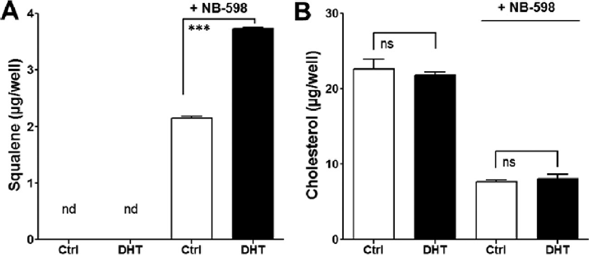
NB-598 hydrochloride purchased from MedChemExpress. Usage Cited in: J Steroid Biochem Mol Biol. 2015 Aug:152:34-44. [Abstract]
GC/MS quantitation of squalene (A) and cholesterol (B) extracted from confluent 6-well plates cell layers from SEBO662 AR+ treated or not (Ctrl) with 10 nM DHT, in the presence or not of the squalene epoxidase inhibitor NB-598 (10 μM). Treatment time is 7 days. Squalene is only detected in NB-598-treated cell layers. DHT significantly increases squalene without significantly modifying cholesterol.
-
-
bioRxiv
SAGA/ATAC complexes sustain aberrant chromatin regulation and promote tumorigenesis in diffuse midline glioma. [Abstract]2026 Jan 23:2026.01.22.701194. PMID: 41648478 -

Protokoll
-
EdU Incorporation Assay (Click Chemistry-Based DNA Synthesis Measurement)
The EdU incorporation assay measures DNA synthesis by adding the thymidine analog 5-ethynyl-2′-deoxyuridine to cells or tissues, where it is incorporated into newly synthesized DNA during S phase. Incorporated EdU is detected by copper-catalyzed azide-alkyne cycloaddition, in which a fluorescent azide covalently reacts with the ethynyl group on EdU, allowing S-phase cells to be detected by fluorescence microscopy, flow cytometry, or high-content imaging. EdU detection does not require DNA denaturation or anti-BrdU antibody access, which preserves sample structure and improves compatibility with immunostaining and multiparameter cytometry compared with BrdU-based detection. EdU can be cytotoxic in a cell-type- and exposure-dependent manner, so pulse duration, concentration, and continuous-labeling designs should be validated for each cell type.


Reinheit & Dokumentation
Verweise
[1]. Xia F, et al. Inhibition of cholesterol biosynthesis impairs insulin secretion and voltage-gated calcium channel function in pancreatic beta-cells. Endocrinology. 2008 Oct;149(10):5136-45. [Content Brief]
[2]. Horie M, et al. Effects of NB-598, a potent squalene epoxidase inhibitor, on the apical membrane uptake of cholesterol and basolateral membrane secretion of lipids in Caco-2 cells. Biochem Pharmacol. 1993 Jul 20;46(2):297-305. [Content Brief]
[3]. Horie M, et al. An inhibitor of squalene epoxidase, NB-598, suppresses the secretion of cholesterol and triacylglycerol and simultaneously reduces apolipoprotein B in HepG2 cells. Biochim Biophys Acta. 1993 May 20;1168(1):45-51. [Content Brief]

Calculators
Konzentration (Stammlösung) × Volumen (Stammlösung) = Konzentration (Ziellösung) × Volumen (Ziellösung)


NB-598 hydrochloride Related Classifications
HY-16343A Related Classifications
 Powered by Bioz