



Neodidymelliosides A
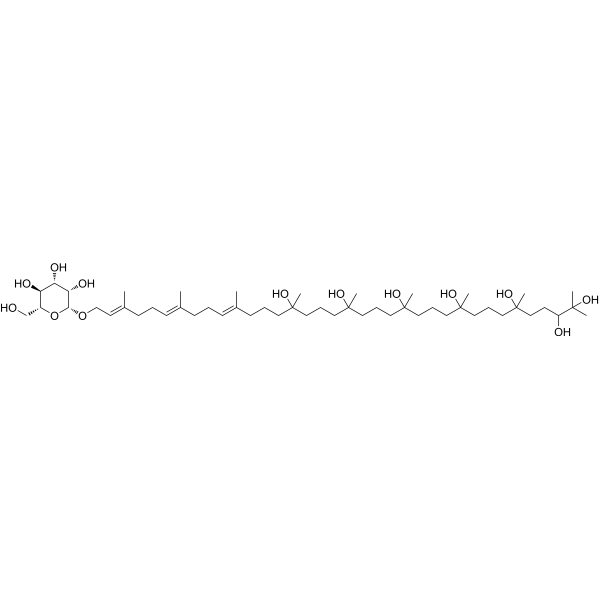
Neodidymelliosides A (compound 1)It is a secondary metabolite of fungi and has a significant inhibitory effect on Staphylococcus aureus and Candida albicans biofilms. Neodidymelliosides AIt also has anti-cancer activity and can inhibit KB3.1 (cervix),PC-3 (prostate),MCF-7(breast),SKOV-3 (ovary),A431 (skin )and A549 (lung )Cell viability of cell lines.
For research use only. We do not sell to patients.
- Formula: C51H96O13
- Molecular Weight:917.30
-
Storage:
Please store the product under the recommended conditions in the Certificate of Analysis.

To place orders, for customer services and technical support, please contact: MedChemExpress USA
Tel: 609-228-6898 E-mail: [email protected] [email protected]


-
 Biological Activity
-
Chemical Information
- Protocols
- Purity & Documentation
-
 Help & FAQs




Biological Activity
Description
Cellular Effect
|
Cell Line

|
Type | Value | Description | References |
|---|---|---|---|---|
| A-431 | IC50 |
4.8 μM
Compound: 1
|
Antiproliferative activity against human A-431 cells assessed as reduction in cell growth incubated for 5 days by MTT assay
Antiproliferative activity against human A-431 cells assessed as reduction in cell growth incubated for 5 days by MTT assay
|
[PMID: 38351796] |
| A549 | IC50 |
4.8 μM
Compound: 1
|
Antiproliferative activity against human A549 cells assessed as reduction in cell growth incubated for 5 days by MTT assay
Antiproliferative activity against human A549 cells assessed as reduction in cell growth incubated for 5 days by MTT assay
|
[PMID: 38351796] |
| KB 3-1 | IC50 |
8.3 μM
Compound: 1
|
Antiproliferative activity against human KB-3-1 cells assessed as reduction in cell growth incubated for 5 days by MTT assay
Antiproliferative activity against human KB-3-1 cells assessed as reduction in cell growth incubated for 5 days by MTT assay
|
[PMID: 38351796] |
| L929 | IC50 |
8.1 μM
Compound: 1
|
Cytotoxicity against mouse L929 cells assessed as reduction in cell viability incubated for 5 days by MTT assay
Cytotoxicity against mouse L929 cells assessed as reduction in cell viability incubated for 5 days by MTT assay
|
[PMID: 38351796] |
| MCF7 | IC50 |
4.8 μM
Compound: 1
|
Antiproliferative activity against human MCF7 cells assessed as reduction in cell growth incubated for 5 days by MTT assay
Antiproliferative activity against human MCF7 cells assessed as reduction in cell growth incubated for 5 days by MTT assay
|
[PMID: 38351796] |
| PC-3 | IC50 |
4.8 μM
Compound: 1
|
Antiproliferative activity against human PC-3 cells assessed as reduction in cell growth incubated for 5 days by MTT assay
Antiproliferative activity against human PC-3 cells assessed as reduction in cell growth incubated for 5 days by MTT assay
|
[PMID: 38351796] |
| SK-OV-3 | IC50 |
4.8 μM
Compound: 1
|
Antiproliferative activity against human SK-OV-3 cells assessed as reduction in cell growth incubated for 5 days by MTT assay
Antiproliferative activity against human SK-OV-3 cells assessed as reduction in cell growth incubated for 5 days by MTT assay
|
[PMID: 38351796] |


Chemical Information
-
Molecular Weight 917.30
-
Formula C51H96O13
-
SMILES
C/C(CCCC(O)(C)CCCC(O)(CCCC(O)(CCCC(O)(CCCC(O)(CCC(C(O)(C)C)O)C)C)C)C)=C\CC/C(C)=C/CC/C(C)=C/CO[C@H]1[C@H]([C@H]([C@@H]([C@@H](CO)O1)O)O)O
-
Structure Classification
-
Initial Source
Neodidymelliopsis negundinis
-
Shipping
Room temperature in continental US; may vary elsewhere.
-
Storage
Please store the product under the recommended conditions in the Certificate of Analysis.

Protocols
-
Cell Cytotoxicity Assay
Cytotoxicity assays are usually based on the assessment of cell membrane damage, which can also be indirectly detected by measuring cell viability. Detection methods include MTT assay, CKK-8 assay, LDH assay and ATP assay, etc.
-
Mammalian live/dead viability and cytotoxicity staining
Live/dead viability and cytotoxicity staining assays are based on the simultaneous detection of intracellular esterase activity in metabolically active (viable) cells and membrane integrity loss in non-viable cells. In commonly used dual-staining approaches, membrane-permeant fluorogenic substrates are converted by intracellular esterases into fluorescent products in live cells, while impermeant DNA-binding dyes selectively enter cells with compromised plasma membranes and label nucleic acids in dead or dying cells, enabling discrimination between viable and non-viable populations by fluorescence microscopy or flow cytometry.
-
CCK-8/WST-8 Cell Proliferation Assay
The CCK-8/WST-8 assay is based on the reduction of the water-soluble tetrazolium salt WST-8 to a water-soluble formazan product by cellular dehydrogenases in metabolically active cells, where the generated formazan amount is proportional to the number of living cells and is quantified by measuring absorbance in the visible range, providing a colorimetric readout for cell viability and proliferation assessment. This class of tetrazolium-based assays improves upon earlier MTT-based systems by producing a water-soluble formazan, eliminating the need for organic solubilization steps and enabling direct spectrophotometric measurement in culture medium.
-
MTT Cell Proliferation Assay
The MTT assay is a colorimetric endpoint assay for estimating viable cell number, cell growth, cytotoxicity, or cell activation in cultured mammalian cells. Living cells reduce the yellow tetrazolium salt MTT into purple/blue formazan, while dead cells do not generate the same signal; the resulting color can be quantified with a multiwell spectrophotometer. MTT reduction is commonly interpreted as a readout of metabolic activity that often correlates with viable cell number, but it should not be treated as a direct cell-counting method unless the assay is optimized for the cell type and experimental condition. Studies show that MTT reduction can involve mitochondrial and non-mitochondrial reducing systems, and formazan may accumulate in intracellular lipid droplets rather than simply marking mitochondria.
-
Cell Viability Determination by MTT Colorimetric Assay
The following protocol uses the MTT colorimetric assay as a classic literature-established method for assessing cell viability/metabolic activity in cultured mammalian cells. MTT[3-(4,5-dimethylthiazol-2-yl)-2,5-diphenyltetrazolium bromide] is reduced by metabolically active cells to a colored formazan product; the amount of formazan is quantified spectrophotometrically and provides an indirect measure of metabolically active viable cells. Importantly, MTT reduction reflects cellular oxidoreductase/metabolic activity rather than an absolute direct count of living cells, so changes in cellular metabolism can alter the signal independently of cell number.


Purity & Documentation

Calculators
Concentration (start) × Volume (start) = Concentration (final) × Volume (final)


Neodidymelliosides A Related Classifications
HY-N12606 Related Classifications
 Powered by Bioz