



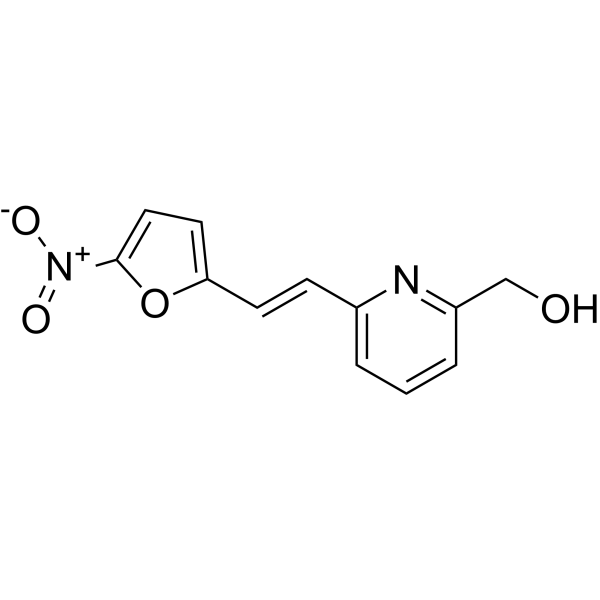
Nifurpirinol
Based on 1 publication(s) in Google Scholar
Nifurpirinol (P-7138) is a selective prosubstrate of bacterial nitroreductase (NTR). NTR catalyzes the reduction of nifurpirinol to generate cytotoxic metabolites that induce apoptosis in target cells. Nifurpirinol selectively ablates NTR-expressing cells such as pancreatic β cells, osteoblasts, dopaminergic neurons, and podocytes in transgenic zebrafish models. Nifurpirinol can be used in regeneration studies and disease modeling such as focal segmental glomerulosclerosis (FSGS).
For research use only. We do not sell to patients.
- Purity : 98.70%
- CAS No.: 13411-16-0
- Formula: C12H10N2O4
- Molecular Weight:246.22
-
Storage:Powder -20°C, 3 years , 4°C, 2 years ; In solvent -80°C, 6 months , -20°C, 1 month

To place orders, for customer services and technical support, please contact: MedChemExpress USA
Tel: 609-228-6898 E-mail: [email protected] [email protected]


-
 Biological Activity
-
Chemical Information
-
Solvent & Solubility
- Protocols
- Purity & Documentation
- References
-
 Help & FAQs


Publications Citing Use of MedChemExpress (MCE) Nifurpirinol
More

Biological Activity
Description
IC50 & Target
IC50: bacterial nitroreductase (NTR) enzyme[1]
In Vivo
Nifurpirinol (50 nM; bathing; continuous 24-48 h) induces focal segmental glomerulosclerosis (FSGS)-like injury in ScreeFi strain zebrafish larvae, characterized by podocyte loss, proteinuria (eGFP leakage), thickening of the glomerular basement membrane and activation of parietal epithelial cells[2].
MedChemExpress (MCE) has not independently confirmed the accuracy of these methods. They are for reference only.
-
Animal Model:Transgenic zebrafish larvae (Tg(osx:mCherry-NTR), male/female, 3-4 dpf) with osteoblast ablation model[1]
-
Dosage:5 μM (E3 medium with 0.2% DMSO)
-
Administration:Bath treatment, 24 h
-
Result:Led to complete osteoblast ablation, with only cell debris and mCherry-positive macrophages detected in skeletal structures (cleitrum, dento-maxilar, opercular), compared to intact osteoblasts in controls.


Chemical Information
-
CAS No. 13411-16-0
-
Appearance Solid
-
Molecular Weight 246.22
-
Formula C12H10N2O4
-
Color Yellow to brown
-
SMILES
OCC1=NC(/C=C/C2=CC=C([N+]([O-])=O)O2)=CC=C1
-
Synonyms
P-7138
-
Shipping
Room temperature in continental US; may vary elsewhere.
-
Storage
Powder -20°C 3 years 4°C 2 years In solvent -80°C 6 months -20°C 1 month


Publications (1)
-
Journal Impact Factor
-
Most Recent
-
bioRxiv
Two axolotl-adapted cell-ablation platforms reveal macrophage-dependent processes essential for spinal-cord and skeletal regeneration. [Abstract]2026 Feb 12:2026.02.10.705144. PMID: 41727137


Solvent & Solubility
In Vitro:
DMSO : ≥ 20.83 mg/mL (84.60 mM; Hygroscopic DMSO has a significant impact on the solubility of product, please use newly opened DMSO)
* "≥" means soluble, but saturation unknown.
Please refer to the solubility information to select the appropriate solvent. Once prepared, please aliquot and store the solution to prevent product inactivation from repeated freeze-thaw cycles.
Storage method and period of stock solution: -80°C, 6 months; -20°C, 1 month. When stored at -80°C, please use it within 6 months. When stored at -20°C, please use it within 1 month.
Please refer to the solubility information to select the appropriate solvent. Once prepared, please aliquot and store the solution to prevent product inactivation from repeated freeze-thaw cycles.
Storage method and period of stock solution: -80°C, 6 months; -20°C, 1 month. When stored at -80°C, please use it within 6 months. When stored at -20°C, please use it within 1 month.
Concentration (start) × Volume (start) = Concentration (final) × Volume (final)
In Vivo:
Select the appropriate dissolution method based on your experimental animal and administration route.
- For the following dissolution methods, please ensure to first prepare a clear stock solution using an In Vitro approach and then sequentially add co-solvents:
- To ensure reliable experimental results, the clarified stock solution can be appropriately stored based on storage conditions. As for the working solution for In Vivo experiments, it is recommended to prepare freshly and use it on the same day.
- The percentages shown for the solvents indicate their volumetric ratio in the final prepared solution. If precipitation or phase separation occurs during preparation, heat and/or sonication can be used to aid dissolution.
Add each solvent one by one: 10% DMSO 40% PEG300 5% Tween-80 45% Saline
Solubility: ≥ 1 mg/mL (4.06 mM); Clear solution
This protocol yields a clear solution of ≥ 1 mg/mL (saturation unknown).
Taking 1 mL working solution as an example, add 100 μL DMSO stock solution (10.0 mg/mL) to 400 μL PEG300, and mix evenly; then add 50 μL Tween-80 and mix evenly; then add 450 μL Saline to adjust the volume to 1 mL.
Preparation of Saline: Dissolve 0.9 g sodium chloride in ddH₂O and dilute to 100 mL to obtain a clear Saline solution.
In Vivo Dissolution Calculator
Please enter the basic information of animal experiments:
-
-
-
-
Recommended: Prepare an additional quantity of animals to account for potential losses during experiments.
Please enter your animal formula composition:
-
%DMSO +
Recommended: Keep the proportion of DMSO in working solution below 2% if your animal is weak.
-
%+
-
+%Tween-80 + +
-
%Saline +
The co-solvents required include: DMSO, . All of co-solvents are available by MedChemExpress (MCE). , Tween 80. All of co-solvents are available by MedChemExpress (MCE).
Working solution concentration: 0.22 mg/mL
Method for preparing stock solution: mg drug dissolved in μL DMSO. Stock solution concentration: mg/mL.
1. Take μL DMSO stock solution;
2. Add μL .
μL , mix evenly;
3. Then add μL Tween 80, mix evenly;
4. Then add μL
Please ensure that the stock solution in the first step is dissolved to a clear state, and add co-solvents in sequence. You can use ultrasonic heating (ultrasonic cleaner, recommended frequency 20-40 kHz), vortexing, etc. to assist dissolution.


Purity & Documentation
-
Data Sheet (272 KB)
-
SDS (393 KB)
- English - EN (393 KB)
- Français - FR (393 KB)
- Deutsch - DE (393 KB)
- Norwegian - NO (393 KB)
- Español - ES (393 KB)
- Swedish - SV (393 KB)
- Italian - IT (393 KB)
- Korean - KR (393 KB)
- Portuguese - PT (393 KB)
-
Handling Instructions (2659 KB)
References


Complete Stock Solution Preparation Table
Please refer to the solubility information to select the appropriate solvent. Once prepared, please aliquot and store the solution to prevent product inactivation from repeated freeze-thaw cycles.
Storage method and period of stock solution: -80°C, 6 months; -20°C, 1 month. When stored at -80°C, please use it within 6 months. When stored at -20°C, please use it within 1 month.
| Optional Solvent | Concentration Solvent Mass | 1 mg | 5 mg | 10 mg | 25 mg |
|---|---|---|---|---|---|
| DMSO | 1 mM | 4.0614 mL | 20.3070 mL | 40.6141 mL | 101.5352 mL |
| 5 mM | 0.8123 mL | 4.0614 mL | 8.1228 mL | 20.3070 mL | |
| 10 mM | 0.4061 mL | 2.0307 mL | 4.0614 mL | 10.1535 mL | |
| 15 mM | 0.2708 mL | 1.3538 mL | 2.7076 mL | 6.7690 mL | |
| 20 mM | 0.2031 mL | 1.0154 mL | 2.0307 mL | 5.0768 mL | |
| 25 mM | 0.1625 mL | 0.8123 mL | 1.6246 mL | 4.0614 mL | |
| 30 mM | 0.1354 mL | 0.6769 mL | 1.3538 mL | 3.3845 mL | |
| 40 mM | 0.1015 mL | 0.5077 mL | 1.0154 mL | 2.5384 mL | |
| 50 mM | 0.0812 mL | 0.4061 mL | 0.8123 mL | 2.0307 mL | |
| 60 mM | 0.0677 mL | 0.3385 mL | 0.6769 mL | 1.6923 mL | |
| 80 mM | 0.0508 mL | 0.2538 mL | 0.5077 mL | 1.2692 mL |


Nifurpirinol Related Classifications
HY-135470 Related Classifications
 Powered by Bioz