



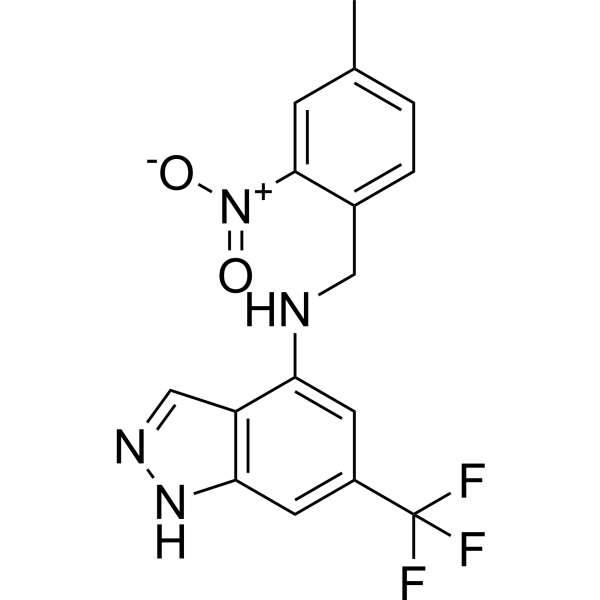
TDO-IN-1

Based on 1 Customer Validation
TDO-IN-1 is an orally active and selective inhibitor of tryptophan 2,3-dioxygenase (TDO), shows excellent selectivity over indoleamine-2,3-dioxygenase (IDO), with an IC50 value of 0.62 μM (IDO). TDO-IN-1 reverse the local immune tolerance of tumor tissue to inhibit tumor growth in vivo.
For research use only. We do not sell to patients.
- Purity : 98.67%
- CAS No.: 2490672-92-7
- Formula: C16H13F3N4O2
- Molecular Weight:350.30
-
Storage:Powder -20°C, 3 years , 4°C, 2 years ; In solvent -80°C, 6 months , -20°C, 1 month

To place orders, for customer services and technical support, please contact: MedChemExpress USA
Tel: 609-228-6898 E-mail: [email protected] [email protected]


-
 Biological Activity
-
Chemical Information
-
Solvent & Solubility
- Protocols
- Purity & Documentation
- References
-
 Help & FAQs




Biological Activity
Description
IC50 & Target
IC50: 0.62 μM (tryptophan 2,3-dioxygenase, TDO)[1]
Cellular Effect
|
Cell Line

|
Type | Value | Description | References |
|---|---|---|---|---|
| B16 | IC50 |
37.39 μM
Compound: HT-28
|
Cytotoxicity against mouse B16 cells assessed as inhibition of cell growth incubated for 24 hrs by MTT assay
Cytotoxicity against mouse B16 cells assessed as inhibition of cell growth incubated for 24 hrs by MTT assay
|
[PMID: 35952399] |
| H22 | IC50 |
1.34 μM
Compound: HT-28
|
Cytotoxicity against mouse H22 cells assessed as inhibition of cell growth incubated for 24 hrs by MTT assay
Cytotoxicity against mouse H22 cells assessed as inhibition of cell growth incubated for 24 hrs by MTT assay
|
[PMID: 35952399] |
| HepG2 | IC50 |
0.54 μM
Compound: HT-28
|
Cytotoxicity against human HepG2 cells assessed as inhibition of cell growth incubated for 24 hrs by MTT assay
Cytotoxicity against human HepG2 cells assessed as inhibition of cell growth incubated for 24 hrs by MTT assay
|
[PMID: 35952399] |
| Jurkat | IC50 |
7.25 μM
Compound: HT-28
|
Cytotoxicity against human Jurkat cells assessed as inhibition of cell growth incubated for 24 hrs by MTT assay
Cytotoxicity against human Jurkat cells assessed as inhibition of cell growth incubated for 24 hrs by MTT assay
|
[PMID: 35952399] |
| MOLM-13 | IC50 |
3.43 μM
Compound: HT-28
|
Cytotoxicity against human MOLM-13 cells assessed as inhibition of cell growth incubated for 24 hrs by MTT assay
Cytotoxicity against human MOLM-13 cells assessed as inhibition of cell growth incubated for 24 hrs by MTT assay
|
[PMID: 35952399] |
In Vitro
TDO-IN-1 (HT-28) (0-100 μM; 24 h) shows significant tumoricidal effect on different tumor lines, with IC50s of 0.54 μM (HepG2), 5.08 μM (Hepa1-6), 1.34 μM (H22), 37.39 μM (B16), 3.43 μM (MOLM-13), and 7.25 μM (Jurkat), respectively[1].
TDO-IN-1 (0-100 μM; 24 h) exhibits few cytotoxic activity against normal cells (HEK 293 cells) below 10 μM[1].
MedChemExpress (MCE) has not independently confirmed the accuracy of these methods. They are for reference only.
In Vivo
MedChemExpress (MCE) has not independently confirmed the accuracy of these methods. They are for reference only.
-
Animal Model:CT-26 allograft BALB/c mice (6-8 weeks old, female)[1]
-
Dosage:12.5, 25, and 50 mg/kg
-
Administration:Oral gavage; once daily; 9 days
-
Result:Resulted significant reduction in tumor weight and volume in mice, with the tumor volume inhibiton rate of 76.93%.
Reduced the expression of Foxp3 and enhance the expression of CD8 and TNF-α in tumor tissue to increase the immune response of tumor-bearing mice.


Chemical Information
-
CAS No. 2490672-92-7
-
Appearance Solid
-
Molecular Weight 350.30
-
Formula C16H13F3N4O2
-
Color Light yellow to yellow
-
SMILES
FC(C1=CC2=C(C(NCC3=CC=C(C)C=C3[N+]([O-])=O)=C1)C=NN2)(F)F
-
Shipping
Room temperature in continental US; may vary elsewhere.
-
Storage
Powder -20°C 3 years 4°C 2 years In solvent -80°C 6 months -20°C 1 month


Solvent & Solubility
In Vitro:
DMSO : 100 mg/mL (285.47 mM; Need ultrasonic; Hygroscopic DMSO has a significant impact on the solubility of product, please use newly opened DMSO)
Please refer to the solubility information to select the appropriate solvent. Once prepared, please aliquot and store the solution to prevent product inactivation from repeated freeze-thaw cycles.
Storage method and period of stock solution: -80°C, 6 months; -20°C, 1 month. When stored at -80°C, please use it within 6 months. When stored at -20°C, please use it within 1 month.
Please refer to the solubility information to select the appropriate solvent. Once prepared, please aliquot and store the solution to prevent product inactivation from repeated freeze-thaw cycles.
Storage method and period of stock solution: -80°C, 6 months; -20°C, 1 month. When stored at -80°C, please use it within 6 months. When stored at -20°C, please use it within 1 month.
Concentration (start) × Volume (start) = Concentration (final) × Volume (final)


Purity & Documentation
-
Data Sheet (274 KB)
-
SDS (251 KB)
- English - EN (251 KB)
- Français - FR (251 KB)
- Deutsch - DE (251 KB)
- Norwegian - NO (251 KB)
- Español - ES (251 KB)
- Swedish - SV (251 KB)
- Italian - IT (251 KB)
- Korean - KR (251 KB)
- Portuguese - PT (251 KB)
-
Handling Instructions (2659 KB)
References


Complete Stock Solution Preparation Table
Please refer to the solubility information to select the appropriate solvent. Once prepared, please aliquot and store the solution to prevent product inactivation from repeated freeze-thaw cycles.
Storage method and period of stock solution: -80°C, 6 months; -20°C, 1 month. When stored at -80°C, please use it within 6 months. When stored at -20°C, please use it within 1 month.
| Optional Solvent | Concentration Solvent Mass | 1 mg | 5 mg | 10 mg | 25 mg |
|---|---|---|---|---|---|
| DMSO | 1 mM | 2.8547 mL | 14.2735 mL | 28.5470 mL | 71.3674 mL |
| 5 mM | 0.5709 mL | 2.8547 mL | 5.7094 mL | 14.2735 mL | |
| 10 mM | 0.2855 mL | 1.4273 mL | 2.8547 mL | 7.1367 mL | |
| 15 mM | 0.1903 mL | 0.9516 mL | 1.9031 mL | 4.7578 mL | |
| 20 mM | 0.1427 mL | 0.7137 mL | 1.4273 mL | 3.5684 mL | |
| 25 mM | 0.1142 mL | 0.5709 mL | 1.1419 mL | 2.8547 mL | |
| 30 mM | 0.0952 mL | 0.4758 mL | 0.9516 mL | 2.3789 mL | |
| 40 mM | 0.0714 mL | 0.3568 mL | 0.7137 mL | 1.7842 mL | |
| 50 mM | 0.0571 mL | 0.2855 mL | 0.5709 mL | 1.4273 mL | |
| 60 mM | 0.0476 mL | 0.2379 mL | 0.4758 mL | 1.1895 mL | |
| 80 mM | 0.0357 mL | 0.1784 mL | 0.3568 mL | 0.8921 mL | |
| 100 mM | 0.0285 mL | 0.1427 mL | 0.2855 mL | 0.7137 mL |


TDO-IN-1 Related Classifications
HY-151425 Related Classifications
 Powered by Bioz