



Pafuramidine (Standard)
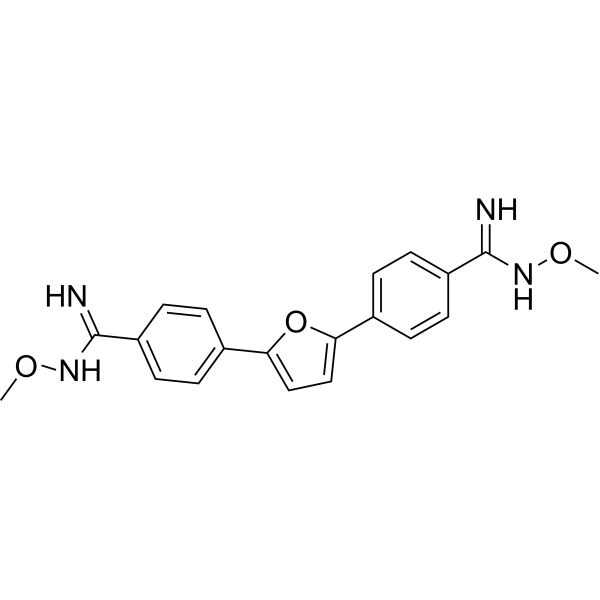
Pafuramidine (Standard) is the analytical standard of Pafuramidine. This product is intended for research and analytical applications. Pafuramidine (DB289) is an orally active proagent of Furamidine (HY-110137A). Pafuramidine is a potent anti-parasitic agent, can be used to research trypanosomiasis, Pneumocystis pneumonia and malaria.
Nos produits utilisent uniquement pour la recherche. Nous ne vendons pas aux patients.
- Pureté : 98%
- CAS No.: 186953-56-0
- Formule: C20H20N4O3
- Masse moléculaire:364.40
-
Stockage:
Please store the product under the recommended conditions in the Certificate of Analysis.


To place orders, for customer services and technical support, please contact: MedChemExpress USA
Tel: 609-228-6898 E-mail: [email protected] [email protected]


-
 Product Information
-
Chemical Information
- Pureté et documentation
-
 Help & FAQs




Product Information
Information
Application
The compound is the grade of analytical standard, which is the reference standard supplied assay. It is commonly used in qualitative, quantitative and methodological research experiments in HPLC, GC and MS.


Chemical Information
-
CAS No. 186953-56-0
-
Masse moléculaire 364.40
-
Formule C20H20N4O3
-
SMILES
N=C(C1=CC=C(C2=CC=C(C3=CC=C(C(NOC)=N)C=C3)O2)C=C1)NOC
-
Synonyms
DB289 (Standard)
-
Livraison
Room temperature in continental US; may vary elsewhere.
-
Stockage
Please store the product under the recommended conditions in the Certificate of Analysis.


Pureté et documentation
Références
[1]. Mdachi RE, et al. Efficacy of the novel diamidine compound 2,5-Bis(4-amidinophenyl)- furan-bis-O-Methlylamidoxime (Pafuramidine, DB289) against Trypanosoma brucei rhodesiense infection in vervet monkeys after oral administration. Antimicrob Agents Chemother. 2009 Mar;53(3):953-7. [Content Brief]
[2]. Pohlig G, et al. Efficacy and Safety of Pafuramidine versus Pentamidine Maleate for Treatment of First Stage Sleeping Sickness in a Randomized, Comparator-Controlled, International Phase 3 Clinical Trial. PLoS Negl Trop Dis. 2016 Feb 16;10(2):e0004363. [Content Brief]
[3]. Chen D, et al. Pafuramidine for Pneumocystis jiroveci pneumonia in HIV-infected individuals. Expert Rev Anti Infect Ther. 2007 Dec;5(6):921-8. [Content Brief]
[4]. Purfield AE, et al. Interactions of DB75, a novel antimalarial agent, with other antimalarial drugs in vitro. Antimicrob Agents Chemother. 2008 Jun;52(6):2253-5. [Content Brief]

Calculators
Concentration (start) × Volume (start) = Concentration (final) × Volume (final)


Pafuramidine (Standard) Related Classifications
HY-14932R Related Classifications
 Powered by Bioz