



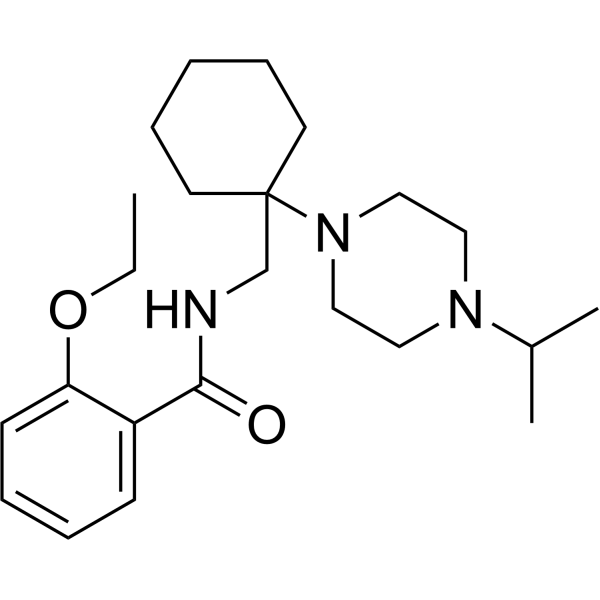
pan-HCN-IN-1

Based on 1 Customer Validation
pan-HCN-IN-1 is a potent HCN ion channel inhibitor with IC50 values of 58 nM, 522 nM, 58 nM, and 58 nM against HCN1, HCN2, HCN3, and HCN4, respectively. pan-HCN-IN-1 exerts voltage-dependent but not use-dependent inhibition, potently inhibits channels in the closed state, and significantly slows the activation time constant of HCN1 currents. pan-HCN-IN-1 can be used for the research of cognitive dysfunction.
For research use only. We do not sell to patients.
- Purity : 99.84%
- CAS No.: 1334308-63-2
- Formula: C23H37N3O2
- Molecular Weight:387.56
-
Storage:Pure form -20°C, 3 years , 4°C, 2 years ; In solvent -80°C, 6 months , -20°C, 1 month

To place orders, for customer services and technical support, please contact: MedChemExpress USA
Tel: 609-228-6898 E-mail: [email protected] [email protected]


-
 Biological Activity
-
Chemical Information
-
Solvent & Solubility
- Protocols
- Purity & Documentation
- References
-
 Help & FAQs




Biological Activity
Description
IC50 & Target
[1]|
HCN1 58 nM (IC50) |
HCN2 522 nM (IC50) |
HCN3 58 nM (IC50) |
HCN4 58 nM (IC50) |
In Vitro
Pan-HCN-IN-1 (Compound J&J12e) (14.6 nM - 30 µM; 10 min) potently and non-selectively inhibits HCN1, HCN2, and HCN4 channels expressed in HEK293 cells. It exhibits voltage-dependent inhibitory properties, rapid onset of action, and slows the activation kinetics of HCN1, with an IC50 of 58 nM against HCN1 channels[1].
pan-HCN-IN-1 inhibits HCN1 currents in HEK cells overexpressing HCN1, with voltage-dependent potency that reaches the highest level at -80 mV (IC50 = 25 nM) and the lowest level at -120 mV (IC50 = 148 nM)[1].
pan-HCN-IN-1 exhibits detectable metabolic clearance in human and rat microsomes and hepatocytes, shows weak P-gp-mediated efflux, has low plasma protein binding in rats, and potently inhibits hERG channels (IC20 = 0.04 μM)[1].
pan-HCN-IN-1 potently inhibits rHCN1 (IC50 = 9 nM) and modulates the activation kinetics of HCN channels in transiently transfected HEK cells, with a faster onset of block for rHCN1 than for hHCN1[1].
pan-HCN-IN-1 (0.02 µM) increases the tau value of HCN1 channel activation in HEK cells overexpressing HCN1[1].
Pan-HCN-IN-1 (0.03 µM-10 µM; 5 min per concentration) alters the electrophysiological properties of human induced pluripotent stem cell-derived atrial-like cardiomyocytes, prolongs the beating cycle and changes the peak potential amplitude[1].
pan-HCN-IN-1 alters the electrophysiological function of spontaneously beating atrial-like hIPS cardiomyocytes, prolongs the field potential duration, and simultaneously reduces the beating frequency and spike potential amplitude[1].
MedChemExpress (MCE) has not independently confirmed the accuracy of these methods. They are for reference only.
In Vivo
pan-HCN-IN-1 (0.8-10 mg/kg; i.p.; single administration; 30 min) exerts effects of failing to improve working memory and even exacerbating the deterioration of cognitive performance at the highest dose in both normal rats and rats with MK-801 (HY-15084B)-induced injury[1].
pan-HCN-IN-1 (2.5 mg/kg; i.p.; single administration; monitored for approximately 20 h) exerts a significant heart rate-lowering effect in healthy rats implanted with wireless telemetry devices[1].
MedChemExpress (MCE) has not independently confirmed the accuracy of these methods. They are for reference only.
-
Animal Model:Healthy male Lister Hooded rats, food-restricted to maintain 85% body weight, without specific disease modeling[1]
-
Dosage:3, 10, 30 mg/kg
-
Administration:i.p.; single dose; testing started 30 min post-dose.
-
Result:Induced severe dose-limiting side effects (such as a flattened body posture) at the highest dose (30 mg/kg).
Significantly prolonged response latency and increased the number of missed trials in animals following treatment.
-
Animal Model:Male Lister Hooded rats; some cohorts included an NMDAR deficit working memory impairment model induced by MK-801 (subcutaneous injection)[1]
-
Dosage:0.8, 1, 2.5, 3, 8, 10 mg/kg
-
Administration:i.p.; single dose; testing started 30 min post-dose.
-
Result:Did not significantly improve or restore working memory impairment induced by MK-801.
-
Animal Model:Healthy male Wistar Han rats implanted with radiotelemetry devices in the abdominal cavity[1]
-
Dosage:2.5 mg/kg
-
Administration:i.p.; single dose; monitored for approx. 20 hours
-
Result:Caused cardiovascular side effects through off-target inhibition of cardiac HCN channels.


Chemical Information
-
CAS No. 1334308-63-2
-
Appearance Oil
-
Molecular Weight 387.56
-
Formula C23H37N3O2
-
Color Off-white to light yellow
-
SMILES
CCOC1=CC=CC=C1C(NCC2(CCCCC2)N3CCN(CC3)C(C)C)=O
-
Shipping
Room temperature in continental US; may vary elsewhere.
-
Storage
Pure form -20°C 3 years 4°C 2 years In solvent -80°C 6 months -20°C 1 month


Solvent & Solubility
In Vitro:
DMSO : 100 mg/mL (258.02 mM; Need ultrasonic; Hygroscopic DMSO has a significant impact on the solubility of product, please use newly opened DMSO)
Please refer to the solubility information to select the appropriate solvent. Once prepared, please aliquot and store the solution to prevent product inactivation from repeated freeze-thaw cycles.
Storage method and period of stock solution: -80°C, 6 months; -20°C, 1 month. When stored at -80°C, please use it within 6 months. When stored at -20°C, please use it within 1 month.
Please refer to the solubility information to select the appropriate solvent. Once prepared, please aliquot and store the solution to prevent product inactivation from repeated freeze-thaw cycles.
Storage method and period of stock solution: -80°C, 6 months; -20°C, 1 month. When stored at -80°C, please use it within 6 months. When stored at -20°C, please use it within 1 month.
Concentration (start) × Volume (start) = Concentration (final) × Volume (final)
In Vivo:
Select the appropriate dissolution method based on your experimental animal and administration route.
- For the following dissolution methods, please ensure to first prepare a clear stock solution using an In Vitro approach and then sequentially add co-solvents:
- To ensure reliable experimental results, the clarified stock solution can be appropriately stored based on storage conditions. As for the working solution for In Vivo experiments, it is recommended to prepare freshly and use it on the same day.
- The percentages shown for the solvents indicate their volumetric ratio in the final prepared solution. If precipitation or phase separation occurs during preparation, heat and/or sonication can be used to aid dissolution.
Add each solvent one by one: 10% DMSO 40% PEG300 5% Tween-80 45% Saline
Solubility: ≥ 5 mg/mL (12.90 mM); Clear solution
This protocol yields a clear solution of ≥ 5 mg/mL (saturation unknown).
Taking 1 mL working solution as an example, add 100 μL DMSO stock solution (50.0 mg/mL) to 400 μL PEG300, and mix evenly; then add 50 μL Tween-80 and mix evenly; then add 450 μL Saline to adjust the volume to 1 mL.
Preparation of Saline: Dissolve 0.9 g sodium chloride in ddH₂O and dilute to 100 mL to obtain a clear Saline solution.
Add each solvent one by one: 10% DMSO 90% (20% SBE-β-CD in Saline)
Solubility: ≥ 5 mg/mL (12.90 mM); Clear solution
This protocol yields a clear solution of ≥ 5 mg/mL (saturation unknown).
Taking 1 mL working solution as an example, add 100 μL DMSO stock solution (50.0 mg/mL) to 900 μL 20% SBE-β-CD in Saline, and mix evenly.
Preparation of 20% SBE-β-CD in Saline (4°C, storage for one week): 2 g SBE-β-CD powder is dissolved in 10 mL Saline, completely dissolve until clear.
In Vivo Dissolution Calculator
Please enter the basic information of animal experiments:
-
-
-
-
Recommended: Prepare an additional quantity of animals to account for potential losses during experiments.
Please enter your animal formula composition:
-
%DMSO +
Recommended: Keep the proportion of DMSO in working solution below 2% if your animal is weak.
-
%+
-
+%Tween-80 + +
-
%Saline +
The co-solvents required include: DMSO, . All of co-solvents are available by MedChemExpress (MCE). , Tween 80. All of co-solvents are available by MedChemExpress (MCE).
Working solution concentration: 0.22 mg/mL
Method for preparing stock solution: mg drug dissolved in μL DMSO. Stock solution concentration: mg/mL.
1. Take μL DMSO stock solution;
2. Add μL .
μL , mix evenly;
3. Then add μL Tween 80, mix evenly;
4. Then add μL
Please ensure that the stock solution in the first step is dissolved to a clear state, and add co-solvents in sequence. You can use ultrasonic heating (ultrasonic cleaner, recommended frequency 20-40 kHz), vortexing, etc. to assist dissolution.


Purity & Documentation
-
Data Sheet (280 KB)
-
SDS (252 KB)
- English - EN (252 KB)
- Français - FR (252 KB)
- Deutsch - DE (252 KB)
- Norwegian - NO (252 KB)
- Español - ES (252 KB)
- Swedish - SV (252 KB)
- Italian - IT (252 KB)
- Korean - KR (252 KB)
- Portuguese - PT (252 KB)
-
Handling Instructions (2659 KB)
References


Complete Stock Solution Preparation Table
Please refer to the solubility information to select the appropriate solvent. Once prepared, please aliquot and store the solution to prevent product inactivation from repeated freeze-thaw cycles.
Storage method and period of stock solution: -80°C, 6 months; -20°C, 1 month. When stored at -80°C, please use it within 6 months. When stored at -20°C, please use it within 1 month.
| Optional Solvent | Concentration Solvent Mass | 1 mg | 5 mg | 10 mg | 25 mg |
|---|---|---|---|---|---|
| DMSO | 1 mM | 2.5802 mL | 12.9012 mL | 25.8025 mL | 64.5061 mL |
| 5 mM | 0.5160 mL | 2.5802 mL | 5.1605 mL | 12.9012 mL | |
| 10 mM | 0.2580 mL | 1.2901 mL | 2.5802 mL | 6.4506 mL | |
| 15 mM | 0.1720 mL | 0.8601 mL | 1.7202 mL | 4.3004 mL | |
| 20 mM | 0.1290 mL | 0.6451 mL | 1.2901 mL | 3.2253 mL | |
| 25 mM | 0.1032 mL | 0.5160 mL | 1.0321 mL | 2.5802 mL | |
| 30 mM | 0.0860 mL | 0.4300 mL | 0.8601 mL | 2.1502 mL | |
| 40 mM | 0.0645 mL | 0.3225 mL | 0.6451 mL | 1.6127 mL | |
| 50 mM | 0.0516 mL | 0.2580 mL | 0.5160 mL | 1.2901 mL | |
| 60 mM | 0.0430 mL | 0.2150 mL | 0.4300 mL | 1.0751 mL | |
| 80 mM | 0.0323 mL | 0.1613 mL | 0.3225 mL | 0.8063 mL | |
| 100 mM | 0.0258 mL | 0.1290 mL | 0.2580 mL | 0.6451 mL |


pan-HCN-IN-1 Related Classifications
HY-163455 Related Classifications
 Powered by Bioz