



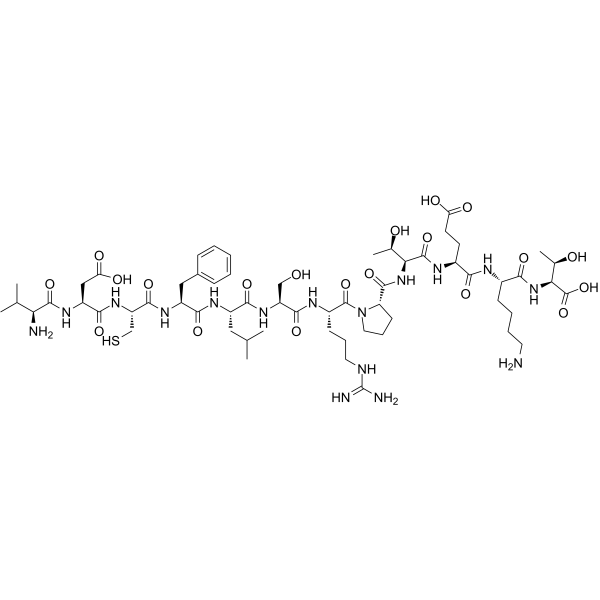
Peptide5

Based on 1 Customer Validation
Peptide5, a connexin 43 mimetic peptide, reduce animals swelling, astrogliosis, and neuronal cell death after spinal cord injury
Nur für Forschungszwecke. Wir verkaufen nicht an Patienten.
- Reinheit : 98.34%
- CAS. Nr.: 916977-43-0
- Formel: C60H98N16O20S
- Molecular Weight:1395.58
-
Speicherung:
Sealed storage, away from moisture.
Powder -80°C, 2 years , -20°C, 1 year* In solvent : -80°C, 6 months; -20°C, 1 month (sealed storage, away from moisture)

To place orders, for customer services and technical support, please contact: MedChemExpress USA
Tel: 609-228-6898 E-mail: [email protected] [email protected]


-
 Biologische Aktivität
-
Chemical Information
-
Lösungsmittel & Löslichkeit
- Protokoll
- Reinheit & Dokumentation
- Verweise
-
 Help & FAQs




Biologische Aktivität
Beschreibung
In Vitro
Peptide5, significantly reduces the degree of spinal cord injury (SCI) in a rodent ex vivo model. Peptide5 produces the more significant reduction in swelling and is analyzed further. Treatment with peptide5 reduced both the level of Cx43 and the number of glial fibrillary acidic protein (GFAP)-positive astrocytes, and at the same time reduces the loss of NeuN- and SMI-32–positive neurons in a concentration- and time-dependent manner[1].
MedChemExpress (MCE) has not independently confirmed the accuracy of these methods. They are for reference only.
In Vivo
MedChemExpress (MCE) has not independently confirmed the accuracy of these methods. They are for reference only.


Chemical Information
-
CAS. Nr. 916977-43-0
-
Appearance Solid
-
Molecular Weight 1395.58
-
Formel C60H98N16O20S
-
Color White to off-white
-
Sequence Shortening
VDCFLSRPTEKT
-
Versand
Room temperature in continental US; may vary elsewhere.
-
Speicherung
Sealed storage, away from moisture
Powder -80°C 2 years -20°C 1 year * In solvent : -80°C, 6 months; -20°C, 1 month (sealed storage, away from moisture)


Lösungsmittel & Löslichkeit
In Vitro:
DMSO : 100 mg/mL (71.65 mM; Need ultrasonic; Hygroscopic DMSO has a significant impact on the solubility of product, please use newly opened DMSO)
Please refer to the solubility information to select the appropriate solvent. Once prepared, please aliquot and store the solution to prevent product inactivation from repeated freeze-thaw cycles.
Storage method and period of stock solution: -80°C, 6 months; -20°C, 1 month (sealed storage, away from moisture). When stored at -80°C, please use it within 6 months. When stored at -20°C, please use it within 1 month.
Please refer to the solubility information to select the appropriate solvent. Once prepared, please aliquot and store the solution to prevent product inactivation from repeated freeze-thaw cycles.
Storage method and period of stock solution: -80°C, 6 months; -20°C, 1 month (sealed storage, away from moisture). When stored at -80°C, please use it within 6 months. When stored at -20°C, please use it within 1 month.
Konzentration (Stammlösung) × Volumen (Stammlösung) = Konzentration (Ziellösung) × Volumen (Ziellösung)


Reinheit & Dokumentation
-
Data Sheet (275 KB)
-
SDS (252 KB)
- English - EN (252 KB)
- Français - FR (252 KB)
- Deutsch - DE (252 KB)
- Norwegian - NO (252 KB)
- Español - ES (252 KB)
- Swedish - SV (252 KB)
- Italian - IT (252 KB)
- Korean - KR (252 KB)
- Portuguese - PT (252 KB)
-
Handling Instructions (2659 KB)
Verweise
[1]. Simon J O'Carroll, et al. Connexin 43 mimetic peptides reduce swelling, astrogliosis, and neuronal cell death after spinal cord injury. Cell Commun Adhes. 2008 May;15(1):27-42. [Content Brief]
[2]. Yilin Mao, et al. Characterisation of Peptide5 systemic administration for treating traumatic spinal cord injured rats. Exp Brain Res. 2017 Oct;235(10):3033-3048. [Content Brief]


Complete Stock Solution Preparation Table
Please refer to the solubility information to select the appropriate solvent. Once prepared, please aliquot and store the solution to prevent product inactivation from repeated freeze-thaw cycles.
Storage method and period of stock solution: -80°C, 6 months; -20°C, 1 month (sealed storage, away from moisture). When stored at -80°C, please use it within 6 months. When stored at -20°C, please use it within 1 month.
| Optional Solvent | Concentration Solvent Mass | 1 mg | 5 mg | 10 mg | 25 mg |
|---|---|---|---|---|---|
| DMSO | 1 mM | 0.7165 mL | 3.5827 mL | 7.1655 mL | 17.9137 mL |
| 5 mM | 0.1433 mL | 0.7165 mL | 1.4331 mL | 3.5827 mL | |
| 10 mM | 0.0717 mL | 0.3583 mL | 0.7165 mL | 1.7914 mL | |
| 15 mM | 0.0478 mL | 0.2388 mL | 0.4777 mL | 1.1942 mL | |
| 20 mM | 0.0358 mL | 0.1791 mL | 0.3583 mL | 0.8957 mL | |
| 25 mM | 0.0287 mL | 0.1433 mL | 0.2866 mL | 0.7165 mL | |
| 30 mM | 0.0239 mL | 0.1194 mL | 0.2388 mL | 0.5971 mL | |
| 40 mM | 0.0179 mL | 0.0896 mL | 0.1791 mL | 0.4478 mL | |
| 50 mM | 0.0143 mL | 0.0717 mL | 0.1433 mL | 0.3583 mL | |
| 60 mM | 0.0119 mL | 0.0597 mL | 0.1194 mL | 0.2986 mL |


Peptide5 Related Classifications
HY-P2275 Related Classifications
 Powered by Bioz