



Perfluoropentanesulfonic acid

Based on 1 Customer Validation
Perfluoropentanesulfonic acid (PFPeS) is a per- and polyfluoroalkyl substance. Perfluoropentanesulfonic acid increases alkaline phosphatase (ALKP). Perfluoropentanesulfonic acid induces systemic toxicity in mouse models and alters the expression of genes related to fatty acid metabolism, inflammation and skin integrity in the liver and skin.
For research use only. We do not sell to patients.
- Purity : 97.23%
- CAS No.: 2706-91-4
- Formula: C5HF11O3S
- Molecular Weight:350.11
-
Storage:Pure form -20°C, 3 years ; In solvent -80°C, 6 months , -20°C, 1 month


To place orders, for customer services and technical support, please contact: MedChemExpress USA
Tel: 609-228-6898 E-mail: [email protected] [email protected]


-
 Biological Activity
-
Chemical Information
- Protocols
- Purity & Documentation
- References
-
 Help & FAQs


-
HY-W792491
Perfluoropropanesulfonic acidEnvironmental Pollutant -

HY-W411827
1H,1H,2H,2H-Perfluorohexanesulfonic acidShort-chain Perfluoroalkyl Sulfonic Acids -

HY-W587805
Perfluorohexane sulfonamideCA II Inhibitor -

HY-W543676
N,N'-Di-o-tolyl-p-phenylenediamineAntioxidant -

HY-W674169
PerfluorobutanesulfonamidePFAS -

HY-W081085
2H,2H,3H,3H-Perfluorooctanoic acid -

HY-W679758
1H,1H,2H,2H-Perfluorodecanesulfonic acidPFAS Precursor -

HY-W1006349
1,2,3,4,6,7,8-HeptachlorodibenzofuranActive Product -

HY-W762015
1,2,3,6,7,8-HexachlorodibenzofuranDioxin-like PCDF -

HY-170514
1,2,3,7,8,9-HexachlorodibenzofuranPollutant


Biological Activity
Description
In Vivo
MedChemExpress (MCE) has not independently confirmed the accuracy of these methods. They are for reference only.
-
Animal Model:B6C3F1 mice (female, 7-8 weeks of age)[2]
-
Dosage:56 mg/kg; 113 mg/kg; 225 mg/kg
-
Administration:topical; daily; 28 days
-
Result:Increased serum PFPeS concentrations to 41 μg/mL (56 mg/kg), 79.8 μg/mL (113 mg/kg), 119.2 μg/mL (225 mg/kg) relative to vehicle control.
Increased urine PFPeS concentrations to 220 μg/mL (56 mg/kg), 430 μg/mL (113 mg/kg), 470 μg/mL (225 mg/kg) relative to vehicle control.
Increased relative liver weights by 32% (56 mg/kg), 63% (113 mg/kg), and a greater magnitude (225 mg/kg) compared to vehicle controls.
Increased absolute liver weights significantly at all three doses compared to vehicle controls.
Decreased relative spleen weight by 18% at the 225 mg/kg dose compared to vehicle controls.
Increased serum glucose by 28% (56 mg/kg), 24% (113 mg/kg), and 25% (225 mg/kg) compared to vehicle controls.
Increased serum alkaline phosphatase (ALKP) by 47% at the 225 mg/kg dose compared to vehicle controls.
Induced minimal hepatocellular hypertrophy in 3/5 mice, mild hypertrophy in 1/5 mice (56 mg/kg); mild hypertrophy in all 5 mice (113 mg/kg); moderate hypertrophy in all 5 mice (225 mg/kg).
Induced minimal hepatocyte necrosis in 3/5 mice (113 mg/kg) and 2/5 mice (225 mg/kg).
Induced minimal epidermal hyperplasia in all 5 mice, minimal mixed cell inflammation in the dermis in 3/5 mice (225 mg/kg).


Chemical Information
-
CAS No. 2706-91-4
-
Appearance Liquid
-
Molecular Weight 350.11
-
Formula C5HF11O3S
-
Color Colorless to light yellow
-
SMILES
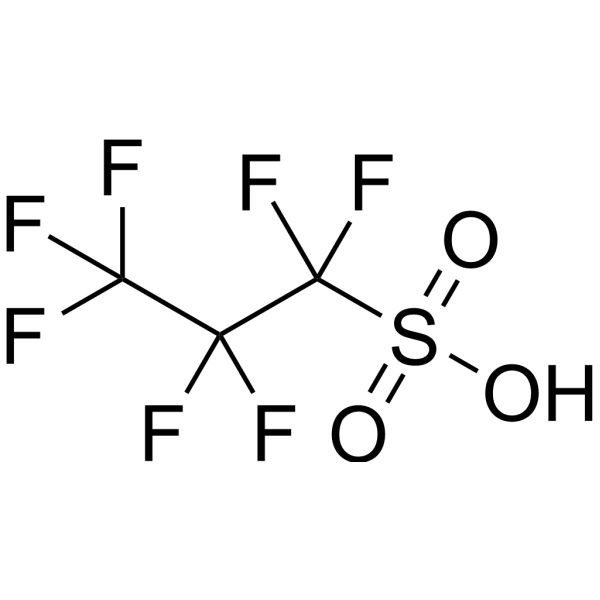
O=S(C(F)(F)C(F)(F)C(F)(F)C(F)(F)C(F)(F)F)(O)=O
-
Synonyms
PFPeS
-
Shipping
Room temperature in continental US; may vary elsewhere.
-
Storage
Pure form -20°C 3 years In solvent -80°C 6 months -20°C 1 month

Protocols
-
RNA extraction experimental
By lysing cells, releasing RNA, and removing impurities such as proteins and DNA, high-purity RNA products are finally obtained. The commonly used traditional method is the guanidine isothiocyanate/phenol/chloroform method (Trizol), which is suitable for a variety of animal materials including animal tissues, microorganisms, cultured cells, etc., and most plant materials.
-
Subchronic/Chronic Toxicity Study
A subchronic/chronic oral toxicity study detects systemic adverse effects caused by repeated administration of a test article, using mortality, clinical signs, body weight, food/water intake, ophthalmology, urinalysis, hematology, serum biochemistry, organ weights, gross necropsy, and histopathology as integrated readouts. The readout reflects dose-related physiological injury, target-organ pathology, reversibility after recovery, and derivation of NOAEL, LOAEL, or related point-of-departure values when the dataset supports them.
-
Research Protocol for Inflammation-related Diseases
The NLRP3 inflammasome is a cytosolic innate immune signaling platform that integrates priming signals and danger-signal activation to promote caspase-1 activation, maturation of IL-1β and IL-18, and gasdermin D-mediated pyroptotic cell death. The core experimental logic is to determine whether inflammatory disease phenotypes are driven by increased NLRP3 expression, ASC-containing inflammasome assembly, caspase-1 cleavage, GSDMD cleavage, and extracellular release of IL-1β/IL-18 rather than by nonspecific cell injury alone. The pathway is strongly linked to inflammation-related disease phenotypes because monosodium urate crystals activate NALP3/NLRP3 inflammasome signaling in gout-like crystal inflammation, cholesterol crystals activate NLRP3 inflammasomes in atherogenesis models, and DSS-induced intestinal inflammation has been reported to involve NLRP3 inflammasome activity. However, experimental colitis studies also show context-dependent protective effects of NLRP3 inflammasome co
-
Acute Systemic Toxicity Study
Acute systemic toxicity studies evaluate adverse effects occurring after a single exposure, or repeated exposure within a short acute window, and the main in vivo readouts are mortality, moribund condition, clinical signs, body-weight change, and gross pathological findings; acute oral toxicity methods were developed to replace classical LD50 testing with reduced-animal designs such as fixed-dose procedure, acute toxic class method, and up-and-down procedure. The fixed-dose procedure classifies acute toxicity by administering predefined dose levels and observing evident toxicity rather than using death as the primary endpoint, whereas the acute toxic class method uses sequential groups of three animals per step and the up-and-down procedure doses animals sequentially to estimate an LD50 with fewer animals than conventional LD50 testing.


Purity & Documentation
-
Data Sheet (273 KB)
-
SDS (394 KB)
- English - EN (394 KB)
- Français - FR (394 KB)
- Deutsch - DE (394 KB)
- Norwegian - NO (394 KB)
- Español - ES (394 KB)
- Swedish - SV (394 KB)
- Italian - IT (394 KB)
- Korean - KR (394 KB)
- Portuguese - PT (394 KB)
-
Handling Instructions (2659 KB)
References
[1]. Li Y, et al. Determinants of serum half-lives for linear and branched perfluoroalkyl substances after long-term high exposure-A study in Ronneby, Sweden. Environ Int. 2022;163:107198. [Content Brief]
[2]. Cooper MP, et al. Systemic toxicity induced by topical application of the sulfonic acids, perfluorobutane sulfonic acid (PFBS) and perfluoropentane sulfonic acid (PFPeS), in a murine model. Toxicol Appl Pharmacol. 2025;503:117487. [Content Brief]

Calculators
Concentration (start) × Volume (start) = Concentration (final) × Volume (final)


Perfluoropentanesulfonic acid Related Classifications
HY-W591838 Related Classifications
 Powered by Bioz