



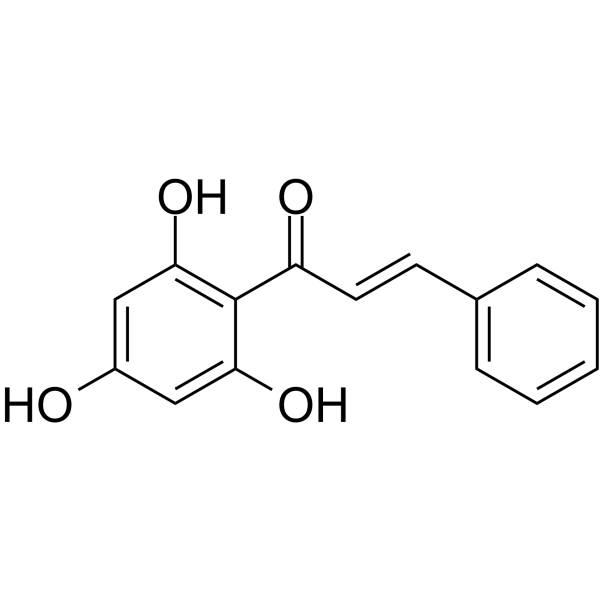
Pinocembrin chalcone

Based on 1 Customer Validation
Pinocembrin chalcone (2',4',6'-Trihydroxychalcone) is an antibacterial compound from Helichrysum Trilineatum. Pinocembrin chalcone facilitates AMP-activated protein kinase (AMPK) activation, improves glucose tolerance, increases muscle FAO and reduces fat accumulation in the liver and skeletal muscles in high-fat diet-induced (HFD) diabetic mice. Pinocembrin chalcone is promising for research of gastric ulcers and diabetes.
For research use only. We do not sell to patients.
- Purity : 99.48%
- CAS No.: 4197-97-1
- Formula: C15H12O4
- Molecular Weight:256.25
-
Storage:
4°C, sealed storage, away from moisture and light
* In solvent : -80°C, 6 months; -20°C, 1 month (sealed storage, away from moisture and light)

To place orders, for customer services and technical support, please contact: MedChemExpress USA
Tel: 609-228-6898 E-mail: [email protected] [email protected]


-
 Biological Activity
-
Chemical Information
-
Solvent & Solubility
- Protocols
- Purity & Documentation
- References
-
 Help & FAQs


All AMPK Isoforms
More

Biological Activity
Description
Cellular Effect
|
Cell Line

|
Type | Value | Description | References |
|---|---|---|---|---|
| HEK293 | IC50 |
25.4 μM
Compound: 8c
|
Inhibition of human SGLT1 expressed in HEK293 cells assessed as reduction in 2-deoxyglucose uptake pretreated for 10 mins followed by 2-deoxyglucose addition in presence of sodium buffer measured after 1 hr by resazurin dye based fluorescence assay
Inhibition of human SGLT1 expressed in HEK293 cells assessed as reduction in 2-deoxyglucose uptake pretreated for 10 mins followed by 2-deoxyglucose addition in presence of sodium buffer measured after 1 hr by resazurin dye based fluorescence assay
|
[PMID: 28098449] |
| HEK293 | IC50 |
33.3 μM
Compound: 8c
|
Inhibition of human SGLT2 expressed in HEK293 cells assessed as reduction in 2-deoxyglucose uptake pretreated for 10 mins followed by 2-deoxyglucose addition in presence of sodium buffer measured after 1 hr by resazurin dye based fluorescence assay
Inhibition of human SGLT2 expressed in HEK293 cells assessed as reduction in 2-deoxyglucose uptake pretreated for 10 mins followed by 2-deoxyglucose addition in presence of sodium buffer measured after 1 hr by resazurin dye based fluorescence assay
|
[PMID: 28098449] |
| RBL-1 | IC50 |
140 μM
Compound: 3
|
Inhibition of 5-lipoxygenase in rat RBL1 cells
Inhibition of 5-lipoxygenase in rat RBL1 cells
|
10.1007/s00044-013-0745-7 |
| RBL-1 | IC50 |
140 μM
Compound: 3
|
Inhibition of cyclooxygenase in rat RBL1 cells
Inhibition of cyclooxygenase in rat RBL1 cells
|
10.1007/s00044-013-0745-7 |
| RBL-1 | IC50 |
140 μM
Compound: 4
|
In vitro inhibition against 5-lipoxygenase in RBL-1 cells was determined
In vitro inhibition against 5-lipoxygenase in RBL-1 cells was determined
|
[PMID: 8254620] |
In Vitro
Pinocembrin chalcone (1.0 μg) is active at inhibiting the growth of S. aureus.[1].
Pinocembrin chalcone (10 μM, 24 h) markedly increases fatty acid oxidation rate and increases the phosphorylation of AMPKα with no cytotoxicity in C2C12 myotubes[2].
MedChemExpress (MCE) has not independently confirmed the accuracy of these methods. They are for reference only. Further protocols information, click here.
-
Cell Line:C2C12 myotubes
-
Concentration:10 μM
-
Incubation Time:24 h
-
Result:Stimulated AMPK phosphorylation at much lower concentrations (1 μM) within 2 h in C2C12 myotubes.
In Vivo
MedChemExpress (MCE) has not independently confirmed the accuracy of these methods. They are for reference only.
-
Animal Model:HFD-induced diabetic mice[2]
-
Dosage:30 mg/kg
-
Administration:oral gavage, daily for 3 weeks
-
Result:Reduced the circulating FFA levels and fat accumulation in the liver and muscles by increasing FAO, which improved glucose tolerance in HFD-induced diabetic mice.


Chemical Information
-
CAS No. 4197-97-1
-
Appearance Solid
-
Molecular Weight 256.25
-
Formula C15H12O4
-
Color Light yellow to yellow
-
SMILES
O=C(C1=C(O)C=C(O)C=C1O)/C=C/C2=CC=CC=C2
-
Synonyms
2',4',6'-Trihydroxychalcone
-
Structure Classification
-
Initial Source
-
Shipping
Room temperature in continental US; may vary elsewhere.
-
Storage
4°C, sealed storage, away from moisture and light
* In solvent : -80°C, 6 months; -20°C, 1 month (sealed storage, away from moisture and light)


Solvent & Solubility
In Vitro:
DMSO : 4.17 mg/mL (16.27 mM; ultrasonic and warming and heat to 60°C; Hygroscopic DMSO has a significant impact on the solubility of product, please use newly opened DMSO)
Please refer to the solubility information to select the appropriate solvent. Once prepared, please aliquot and store the solution to prevent product inactivation from repeated freeze-thaw cycles.
Storage method and period of stock solution: -80°C, 6 months; -20°C, 1 month (sealed storage, away from moisture and light). When stored at -80°C, please use it within 6 months. When stored at -20°C, please use it within 1 month.
Please refer to the solubility information to select the appropriate solvent. Once prepared, please aliquot and store the solution to prevent product inactivation from repeated freeze-thaw cycles.
Storage method and period of stock solution: -80°C, 6 months; -20°C, 1 month (sealed storage, away from moisture and light). When stored at -80°C, please use it within 6 months. When stored at -20°C, please use it within 1 month.
Concentration (start) × Volume (start) = Concentration (final) × Volume (final)

Protocols
-
Research Protocol for Infectious Diseases
Infectious-disease experiments test how pathogens interact with host barriers, innate immune receptors, inflammatory signaling, pathogen replication, and tissue injury; pattern-recognition receptors such as TLRs, RIG-I-like receptors, NOD-like receptors, and inflammasomes detect microbial molecules and activate NF-κB, interferon, and cytokine responses. The central hypothesis is that infection severity reflects the balance between pathogen burden and host response: protective inflammation restricts pathogen growth, whereas excessive or mislocalized inflammation contributes to tissue damage and disease phenotype. Unresolved questions include which host pathways are protective versus pathogenic, why some infection models fail to translate to human disease, and which combined readouts best predict clinically relevant infection outcomes.
-
Research Protocol for Metabolic Diseases
AMP-activated protein kinase, AMPK, is a conserved cellular energy sensor that responds to reduced cellular energy status and coordinates metabolism by increasing ATP-generating catabolic pathways while suppressing ATP-consuming anabolic processes. In metabolic disease research, the AMPK pathway is experimentally relevant because it regulates hepatic lipid synthesis, fatty acid oxidation, glucose production, skeletal-muscle glucose disposal, mTORC1-linked biosynthesis, autophagy, mitochondrial homeostasis, and whole-body energy balance. The central pathway logic is that energy stress, metformin, exercise-like stimulation, or direct AMPK activators increase AMPKα Thr172 phosphorylation and downstream substrate phosphorylation, including ACC and RAPTOR. Phosphorylation of ACC suppresses lipogenesis and supports fatty acid oxidation, whereas phosphorylation of RAPTOR suppresses mTORC1 signaling and links cellular energy status to growth and protein synthesis control. The pathway is linked


Purity & Documentation
-
Data Sheet (273 KB)
-
SDS (394 KB)
- English - EN (394 KB)
- Français - FR (394 KB)
- Deutsch - DE (394 KB)
- Norwegian - NO (394 KB)
- Español - ES (394 KB)
- Swedish - SV (394 KB)
- Italian - IT (394 KB)
- Korean - KR (394 KB)
- Portuguese - PT (394 KB)
-
Handling Instructions (2659 KB)
References


Complete Stock Solution Preparation Table
Please refer to the solubility information to select the appropriate solvent. Once prepared, please aliquot and store the solution to prevent product inactivation from repeated freeze-thaw cycles.
Storage method and period of stock solution: -80°C, 6 months; -20°C, 1 month (sealed storage, away from moisture and light). When stored at -80°C, please use it within 6 months. When stored at -20°C, please use it within 1 month.
| Optional Solvent | Concentration Solvent Mass | 1 mg | 5 mg | 10 mg | 25 mg |
|---|---|---|---|---|---|
| DMSO | 1 mM | 3.9024 mL | 19.5122 mL | 39.0244 mL | 97.5610 mL |
| 5 mM | 0.7805 mL | 3.9024 mL | 7.8049 mL | 19.5122 mL | |
| 10 mM | 0.3902 mL | 1.9512 mL | 3.9024 mL | 9.7561 mL | |
| 15 mM | 0.2602 mL | 1.3008 mL | 2.6016 mL | 6.5041 mL |


Pinocembrin chalcone Related Classifications
HY-N7515 Related Classifications
 Powered by Bioz